
The magnetic attraction of birds
By Jack Dumbacher
By now, most of the birds that summer in the Bay Area have settled into their new territories and are well on their way to producing this year’s family of nestlings. The warblers, orioles, tanagers, and vireos are singing and defending their territories – often the same territories where they nested last year or will nest next year. Likewise, many of our winter migrants are long gone, and probably already settled in their summer homes.
These long-distance migratory movements have long fascinated ornithologists, with the primary question: How do the birds find their way?
Decades of research have shown that birds use a variety of information including visual landmarks such as coastlines, rivers, stars and sun-angle. Even odors have been shown to be important for homing pigeons. But one of the most peculiar and interesting of all migratory aids is magnetic orientation.
Birds appear to have a magnetic sense.
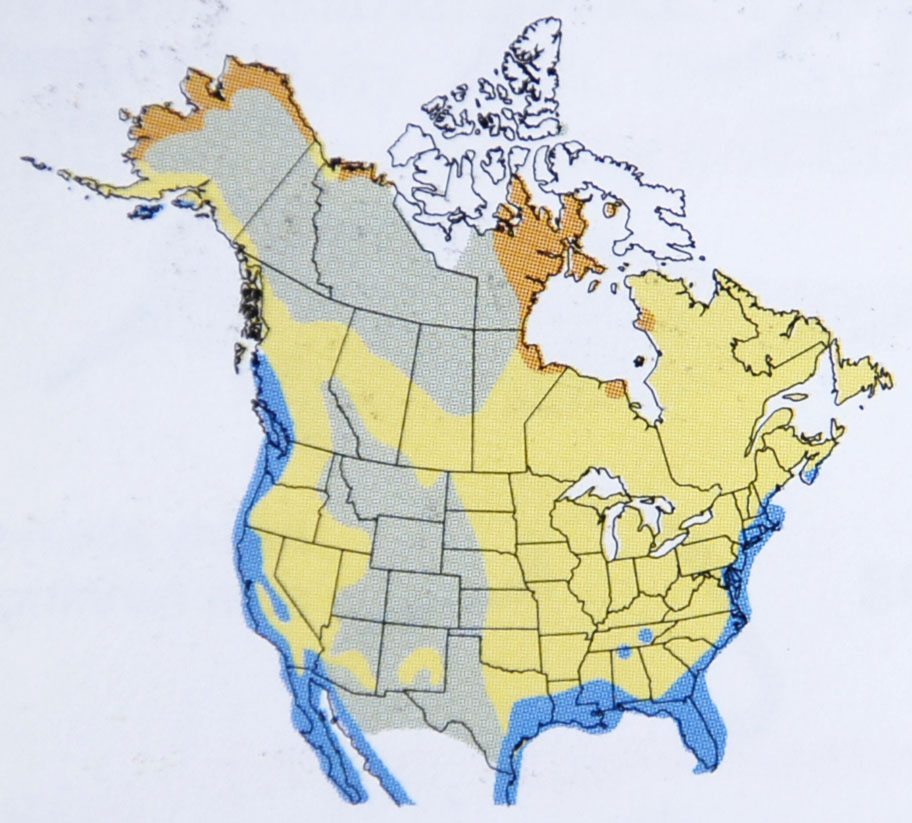 Range map of Dunlins, from The Sibley Guide to Birds of Western North America. The Dunlins that winter in the Bay Area (blue) migrate long distances to summer breeding sites (goldenrod) in Alaska.
Avian magnetic sense was first demonstrated in the 1960s by Friedrich Merkel, Wolfgang Wiltschko and colleagues in Germany using caged birds in altered magnetic fields. Birds adjusted their orientation when the magnetic field was altered. This was a stunning and unexpected result – so much so that many other researchers sought to test the effect using magnets strapped to the backs of birds, and even created bird backpacks that induced magnetic fields using coils of wire with electrical currents (called Helmholtz coils).
More and more researchers showed that birds respond to magnetic fields, often in predictable and useful ways. It’s now clear that birds can use this sense to orient to the earth’s magnetic field during migration.
The earth’s magnetic field contains a great amount of geographic information. For example, the direction of the field lines identifies the north-south azimuth, and the polarity of the magnetic field lines identifies which direction is north and which is south. The inclination (whether the field is level, pointed down, or up) can provide information about latitude. The strength of the magnetic field also provides information about latitude, as the field is stronger near the poles than at the equator. Local variations in the field could even be used as local magnetic “landmarks” for navigation.
But these are weak and subtle forces – can birds really use all of this information?…