THe Problem
Have you ever heard that “thunk!” – a bird striking a glass window or door? You are not alone.
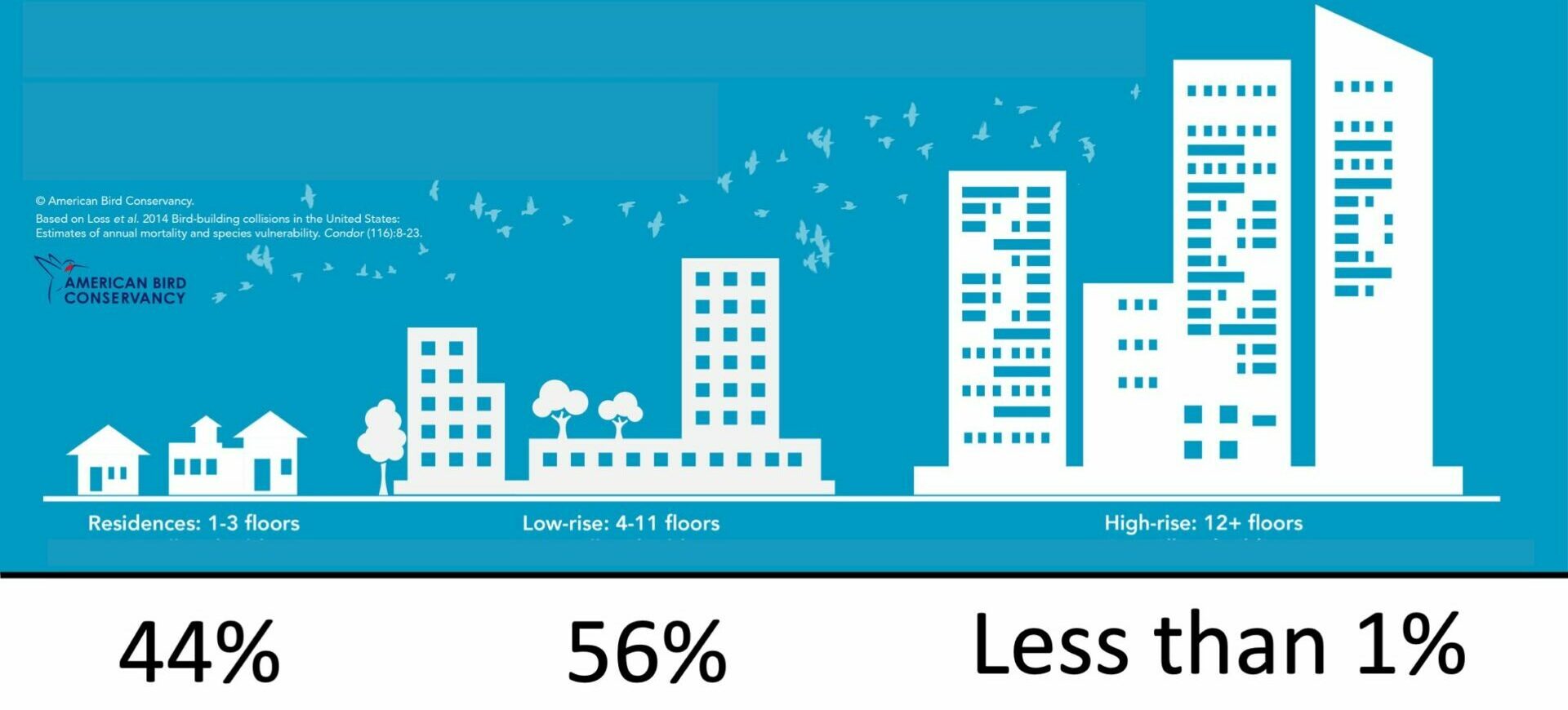
Glass collisions are a major threat to birds. More than 1 billion birds die from colliding with glass every year in the U.S. alone (link). You may think high-rises are the biggest threat, but the truth is that the 99% of bird-window collisions occur at private residences (1-3 stories) and low-rise buildings (4-11 stories). All sizes of glass windows or doors are a threat, from large to small.
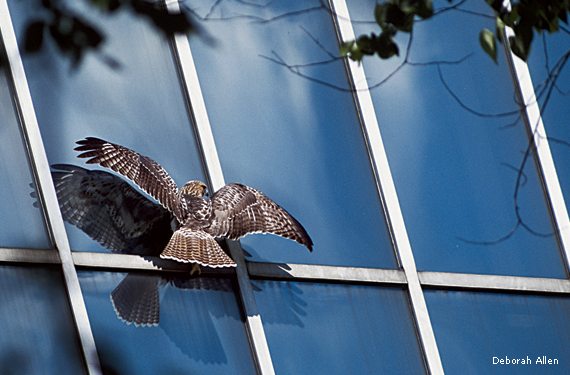
Birds collide with windows either when they see vegetation or sky reflected in the glass, or if they can see straight through and attempt to fly through. Artificial lights can make the reflection problem worse.
The good news – window collisions are a problem we can fix!
JOIN THE BIRD-SAFE MOveMENT!
Want to help protect birds? For updates on our new bird-safe community and invitations to workshops, sign up here:
Have you found a Dead bird?
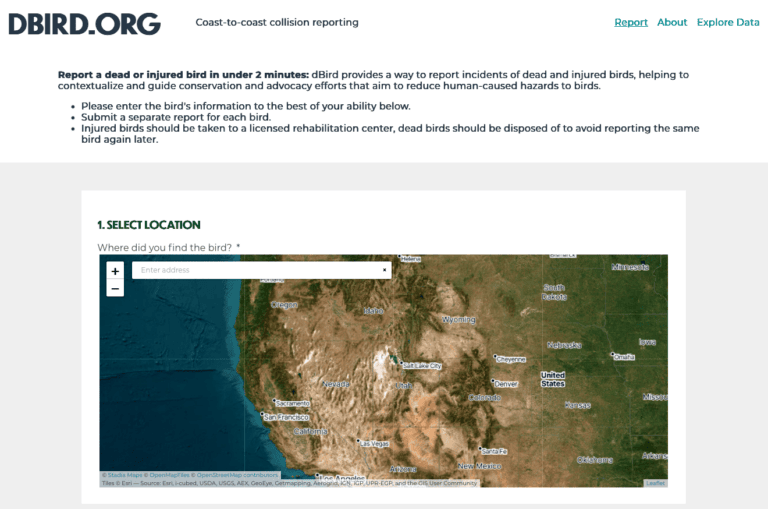
GGBA is tracking building collisions through community science reports. If you have found a dead bird please take just a few minutes to report it on dBird.
THe Solution
Treating your windows is easy and can be inexpensive. There are solutions from quick Do-It-Yourself options to products for purchase. Scroll down to learn about all the options below.
Regardless of the solution you choose, it should meet these basic criteria to be effective at preventing collisions:
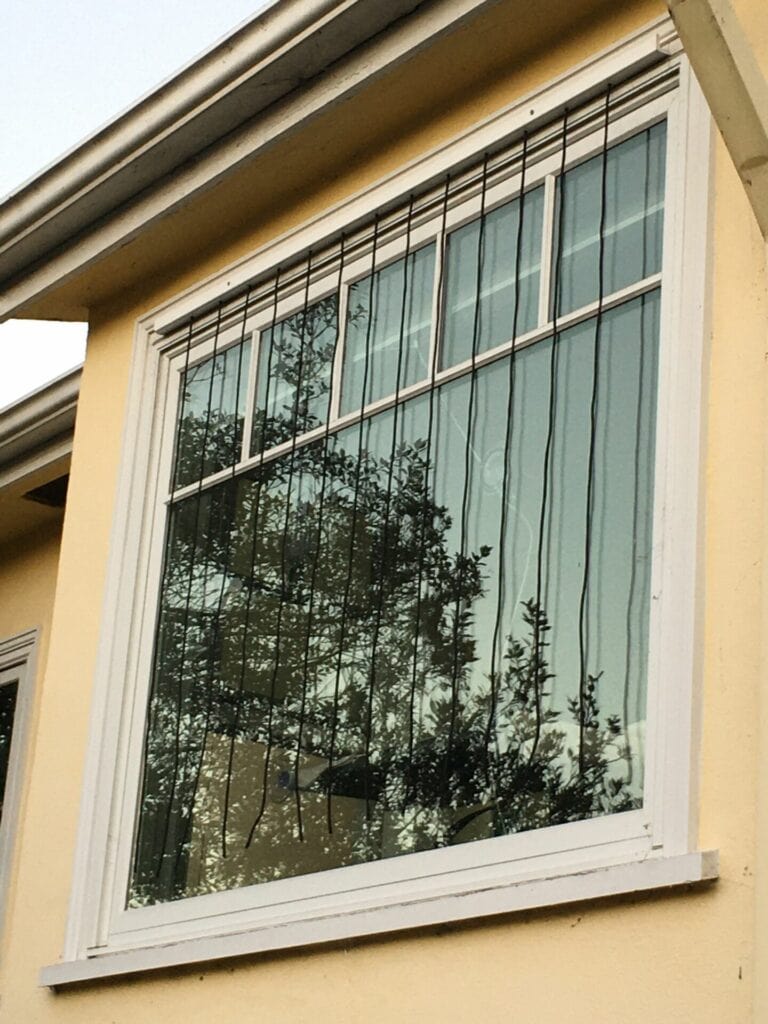
- Closely spaced. Birds can be small and they know their size and how to maneuver, the spacing must be tight enough to show birds there isn’t room to fly through. Markers applied on the glass must be spaced no further than 2-inches apart, called the “2 by 2 rule”. Hung paracording (Acopian Birdsavers or “Zen wind curtains”) can be spaced at 4-inches and equally effective.
- Apply to the outside of the window. It’s all about breaking up that reflection so any treatment should go on on the exterior surface (Surface 1 in technical speak).
- Large enough for birds to see. Dots and other shapes should be at least one-quarter inch in diameter. Stripes or hung cording should be at least one-eighth inch wide. Bigger is better.
Additional guidelines:
- Start with the most hazardous windows. Prioritize glass where collisions have already happened. Also, look at your windows at different times of day, from different angles. Glass that reflects vegetation or has a clear view of habitat inside (like potted plants) tends to be the most dangerous.
- Full Coverage. Cover the entire glass surface.
- Contrasting Color. Markers or cording should be in a contrasting color to the surrounding area and reflections. For markers on the glass, white is often the best.
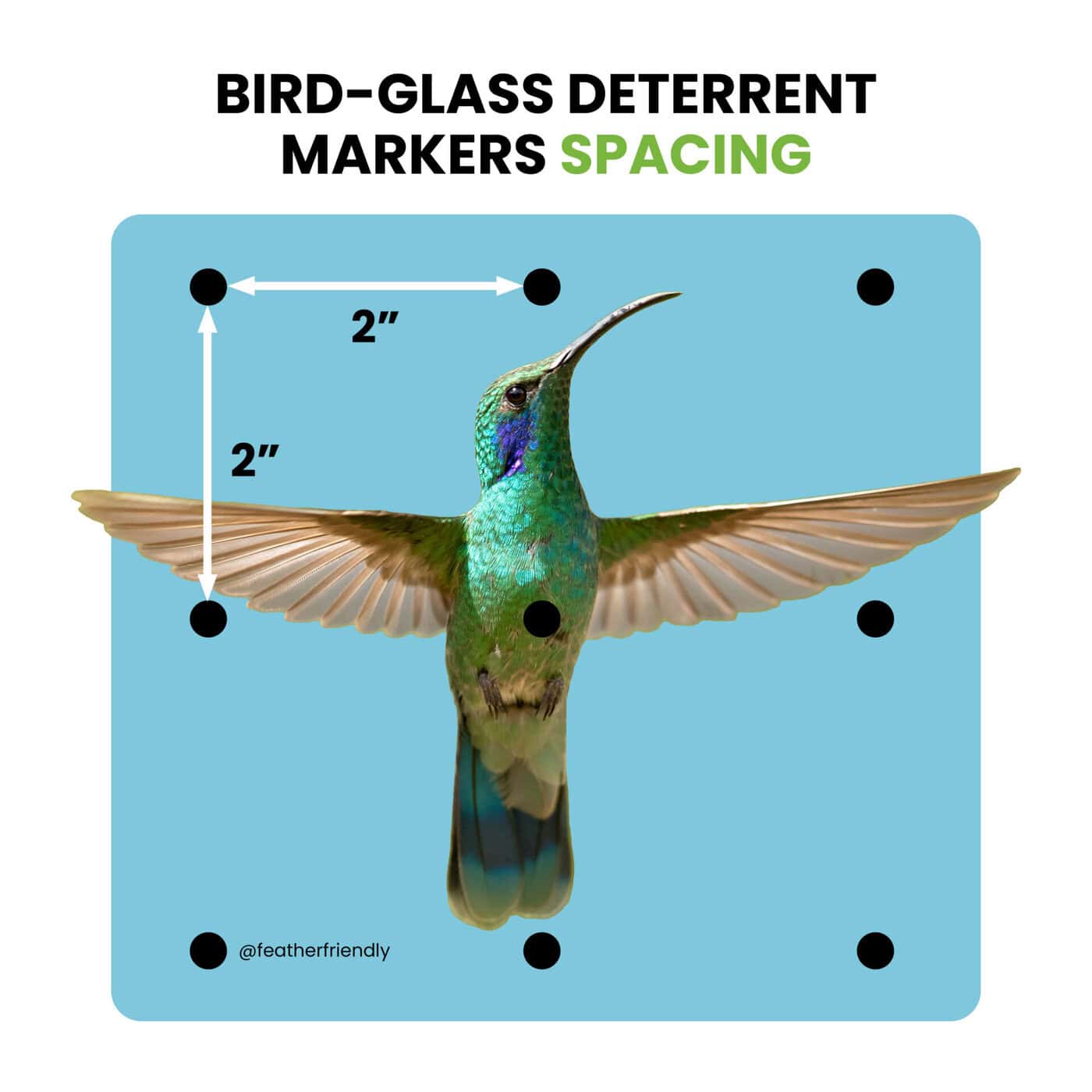
Image: ©Feather Friendly
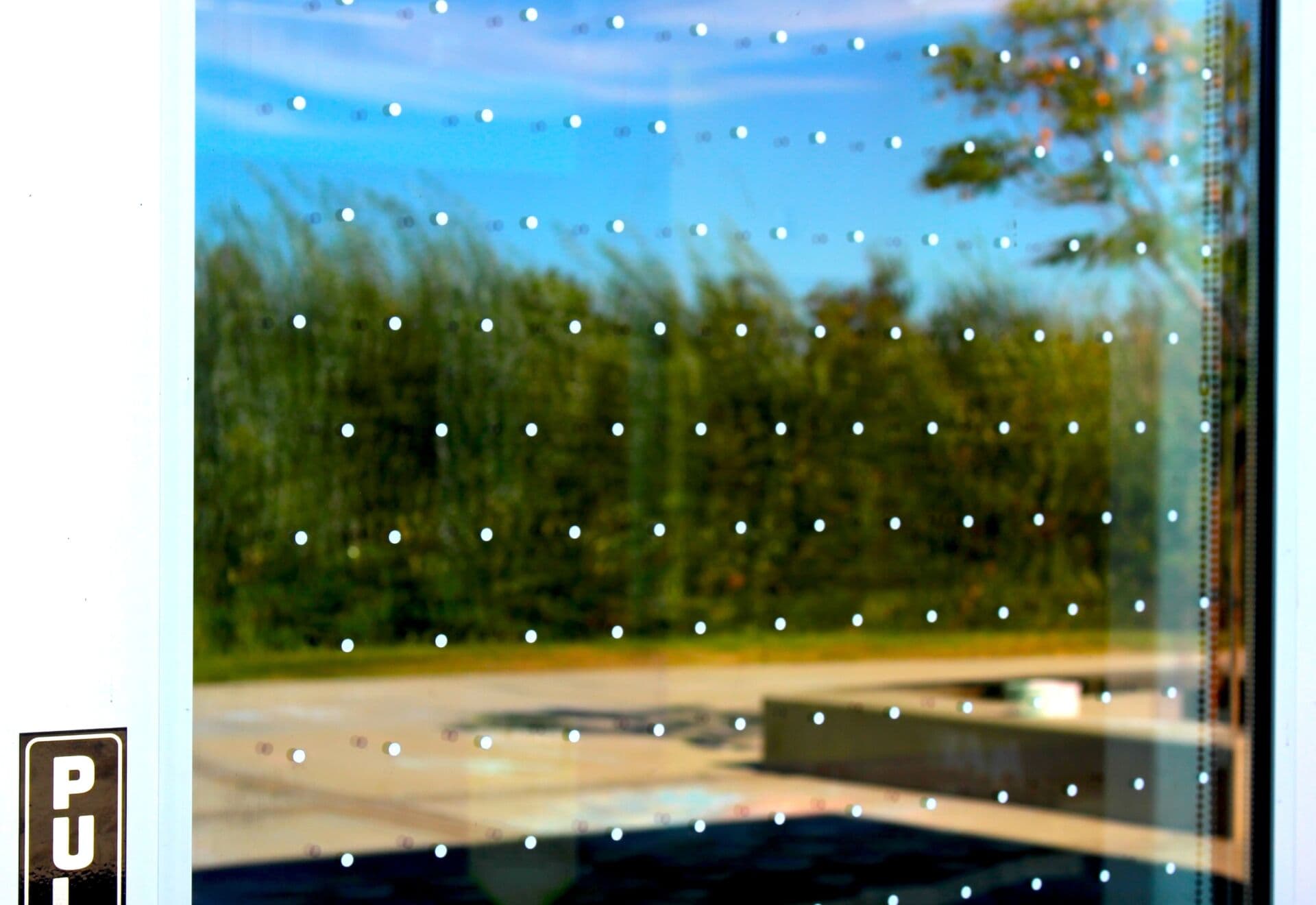
Photo: Erin Diehm
EXISTING GLASS
Bird-safe window solutions for retrofitting existing glass come in many forms, from simple DIY fixes to ready-made products. They’re readily available and affordable. Browse the options below to find one that fits your needs.
Do-It-Yourself
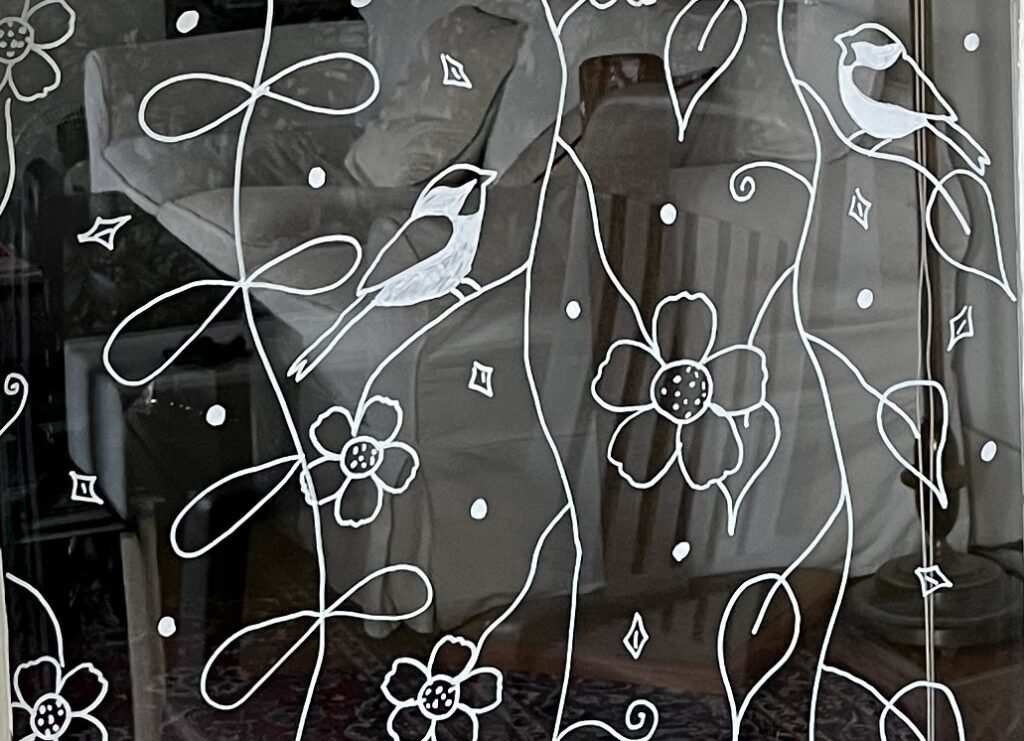
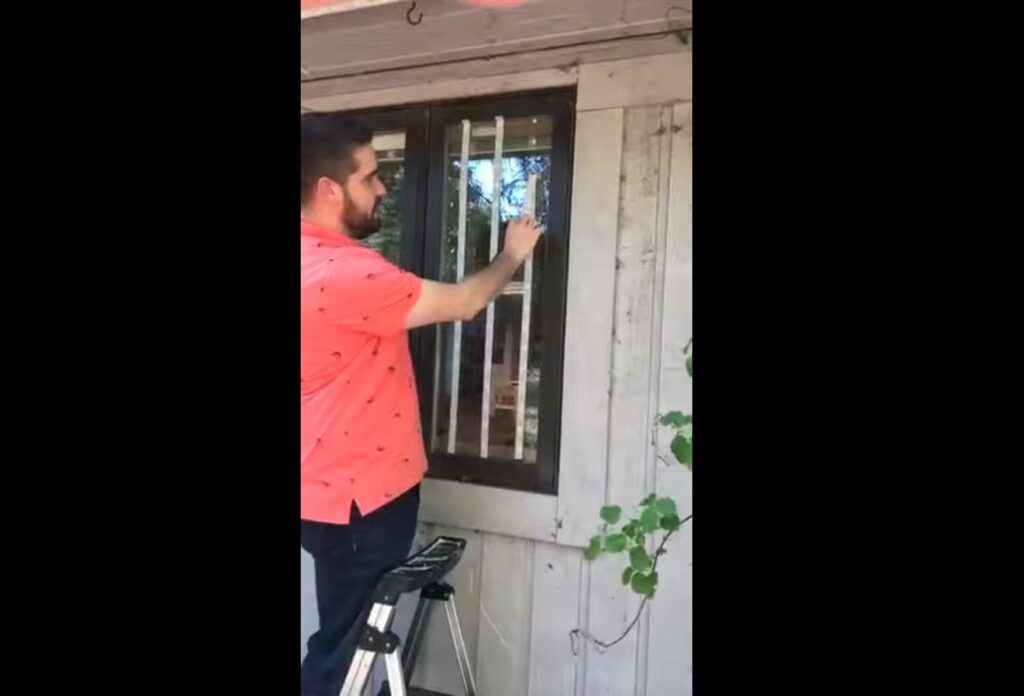
DRAWING ON GLASS
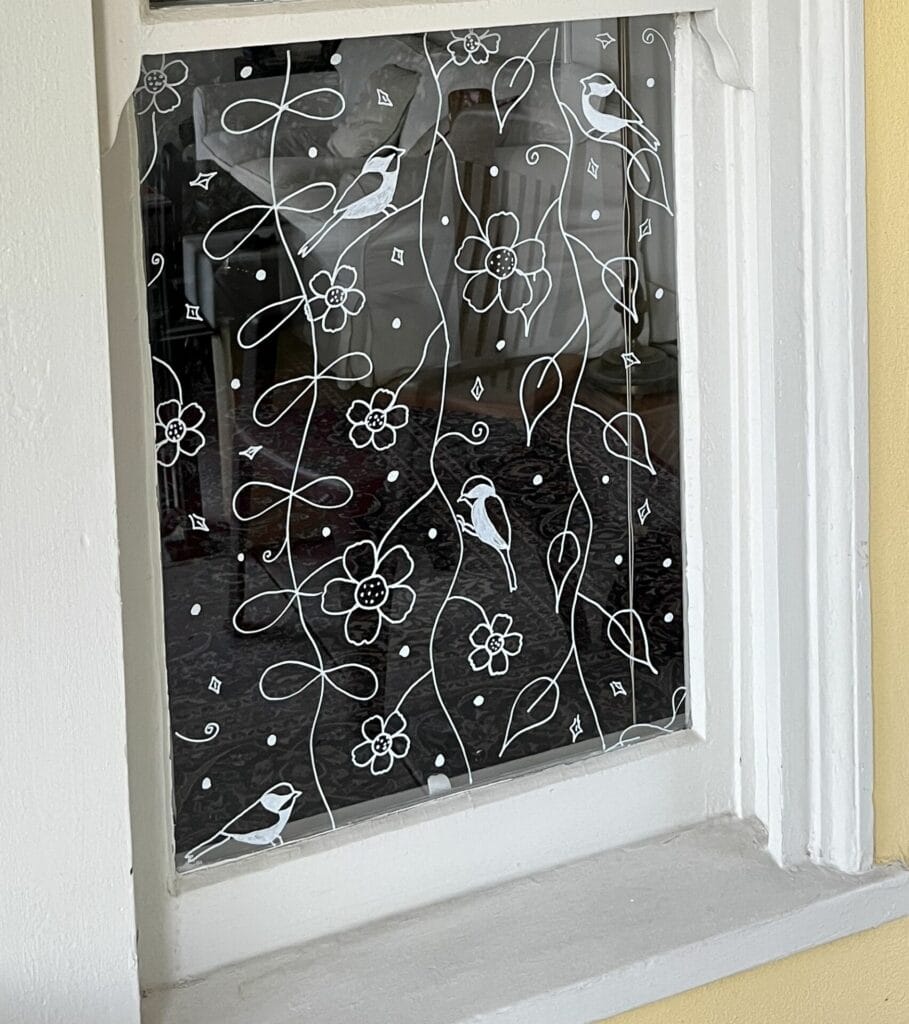
- With paint pens, tempera paint, or even soap
- Trace patterns (as above) or draw freehand
- A great activity for kids!
- Very affordable (oil-based marker only $7)
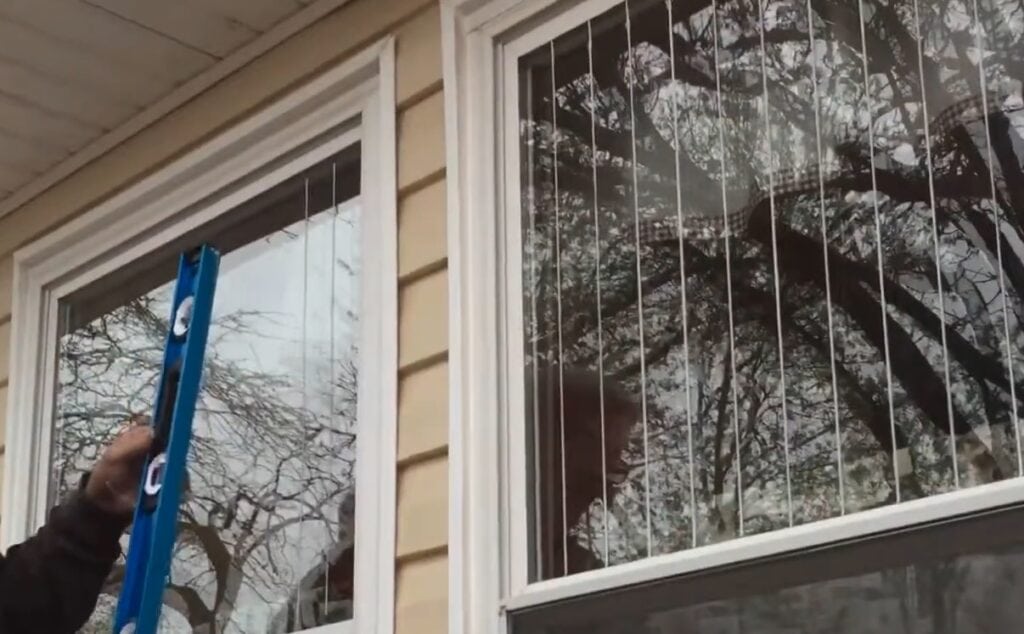
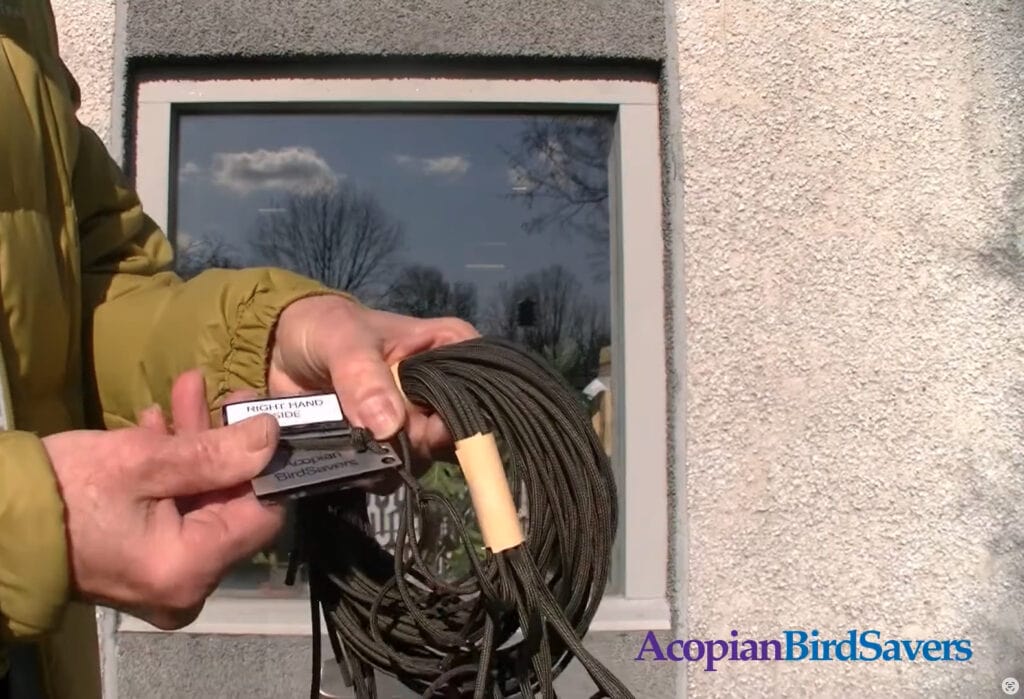
“ACOPIAN” BIRDSAVERS
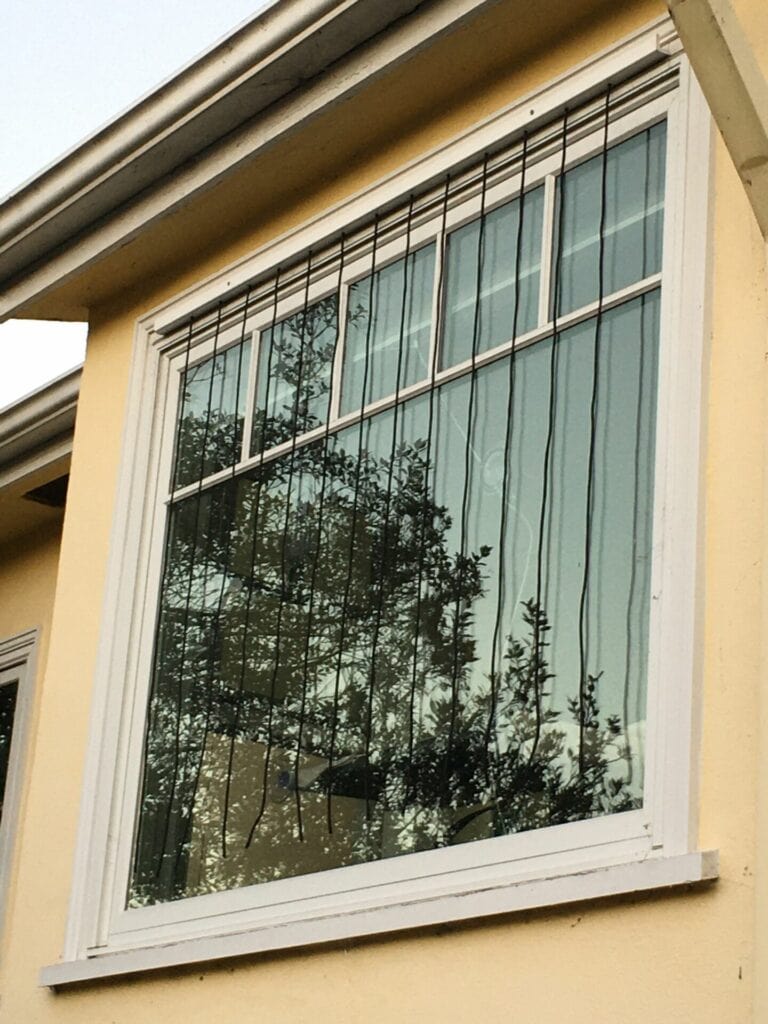
- 4-inch spaced cording
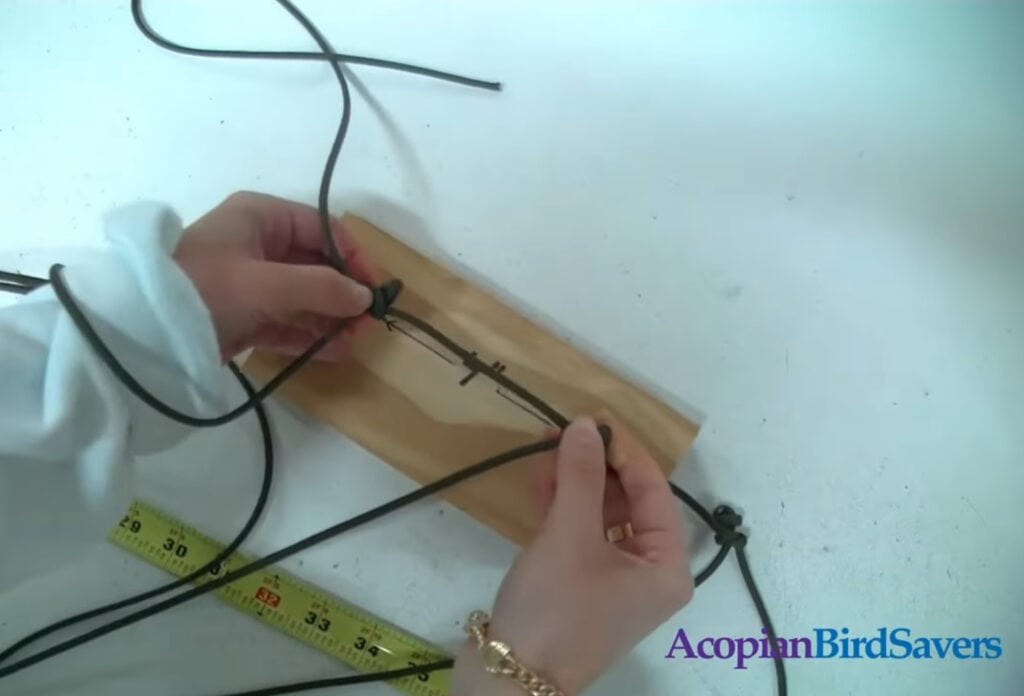
- Many ways to build and install
- Extremely helpful DIY instructions
- Very affordable (one roll of cording only $20)
products FOR PURCHASE
INSECT SCREENS
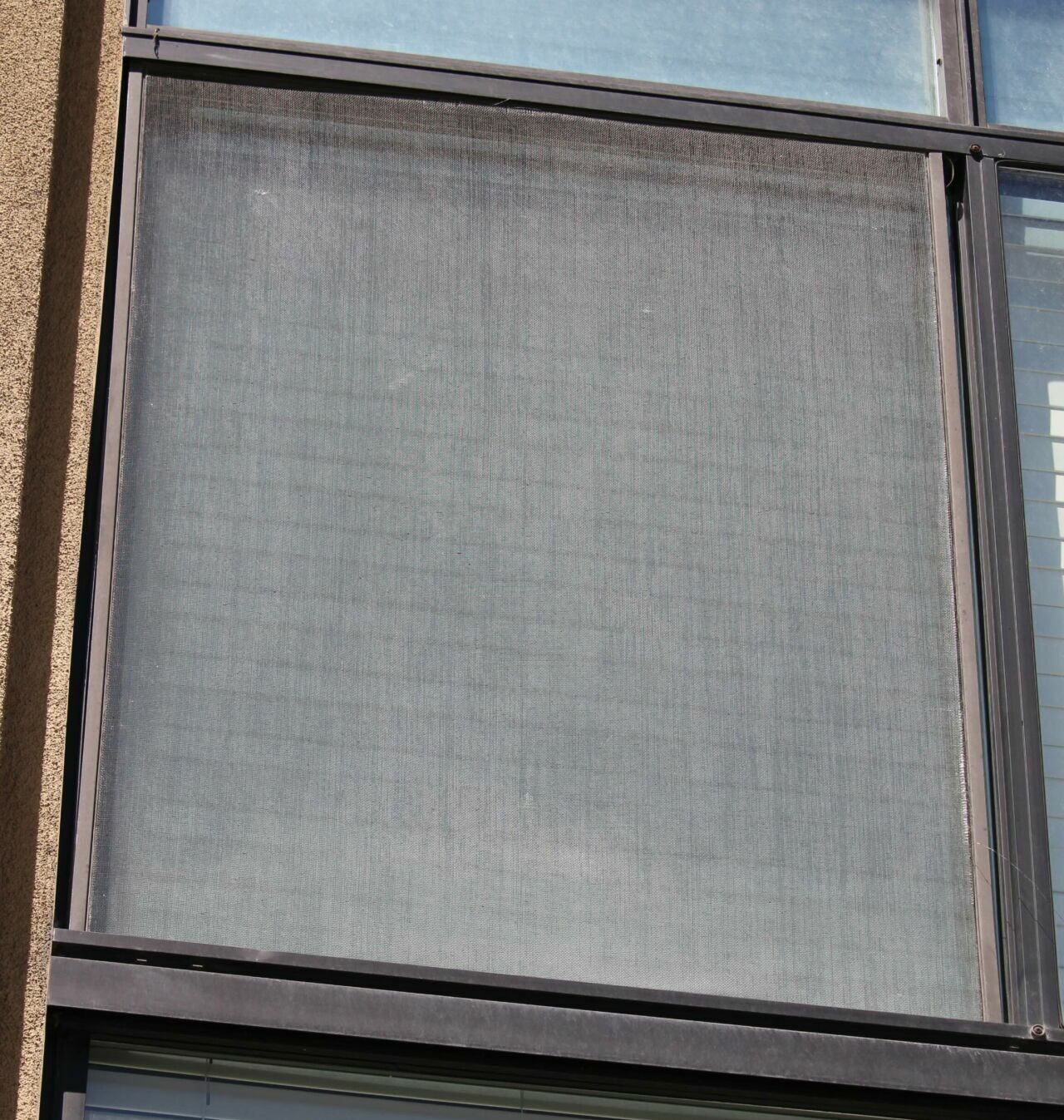
Photo: Erin Diehm
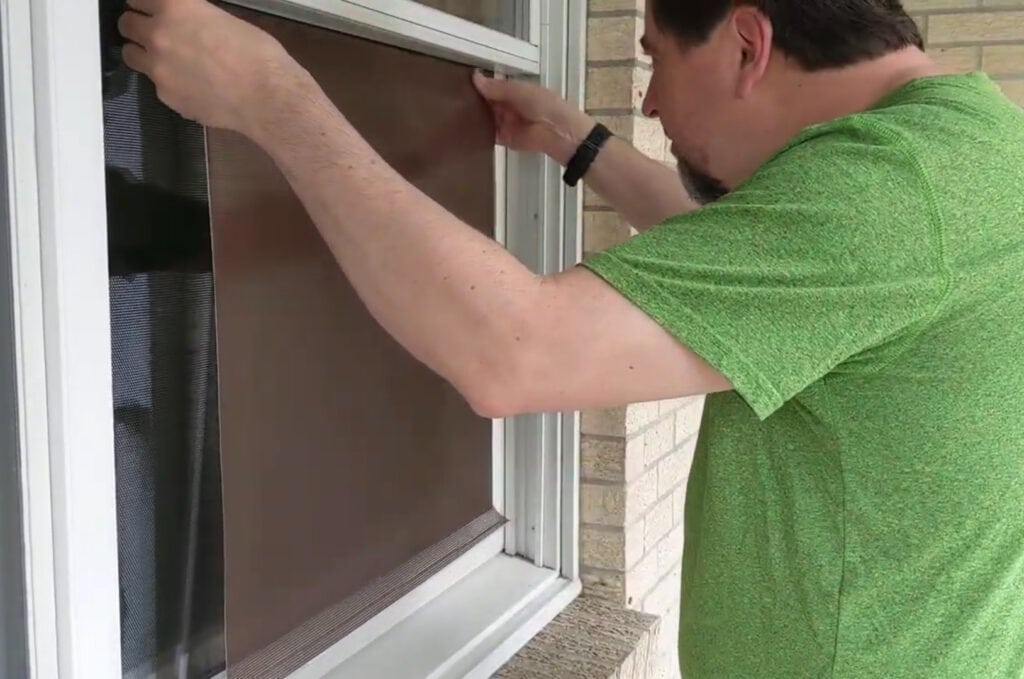
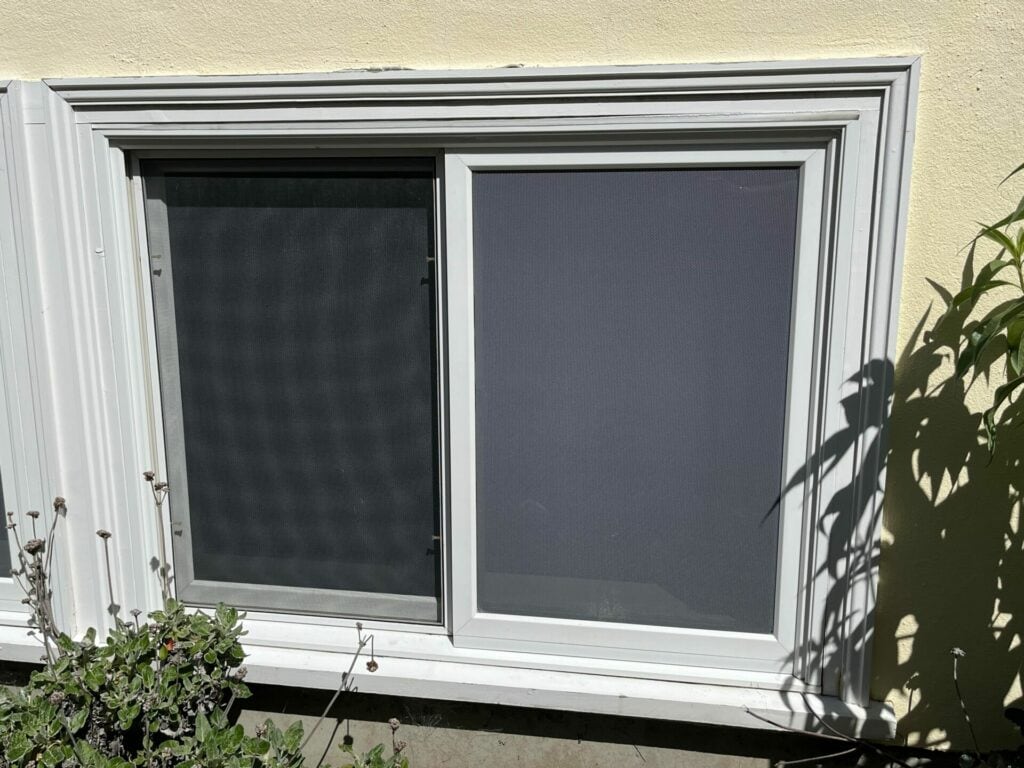
- Insects (or “fly”) screens
- Full window coverage, hung at least 1″ from glass, on the outside (screens on inside don’t protect birds)
- Available in a variety of materials – aluminum, stainless steel, fibreglass and more
- Dual protections – visual barrier and, if a bird strikes, softening trampoline effect
FEATHER FRIENDLY MARKERS
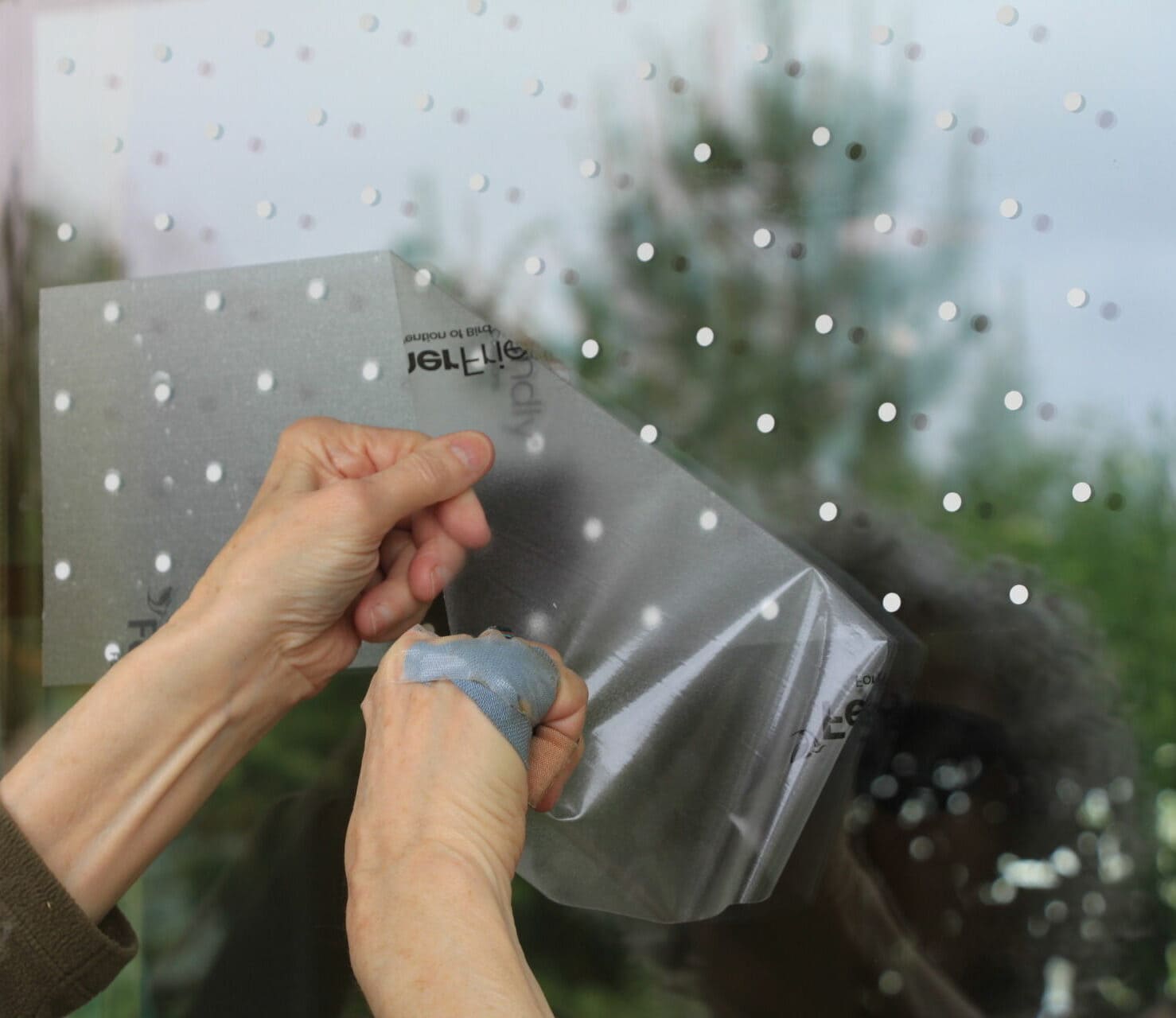
Photo: Kathy Kramer
- 1/4-inch white markers (round, square, or other)
- Only markers remain
- Available in “small”, “medium” and “large” formats – choose one that suits your needs!
- Easy-to-follow videos and alignment guides simplify installation, for a long-lasting, attractive and clean design
COLLIDESCAPE FILM
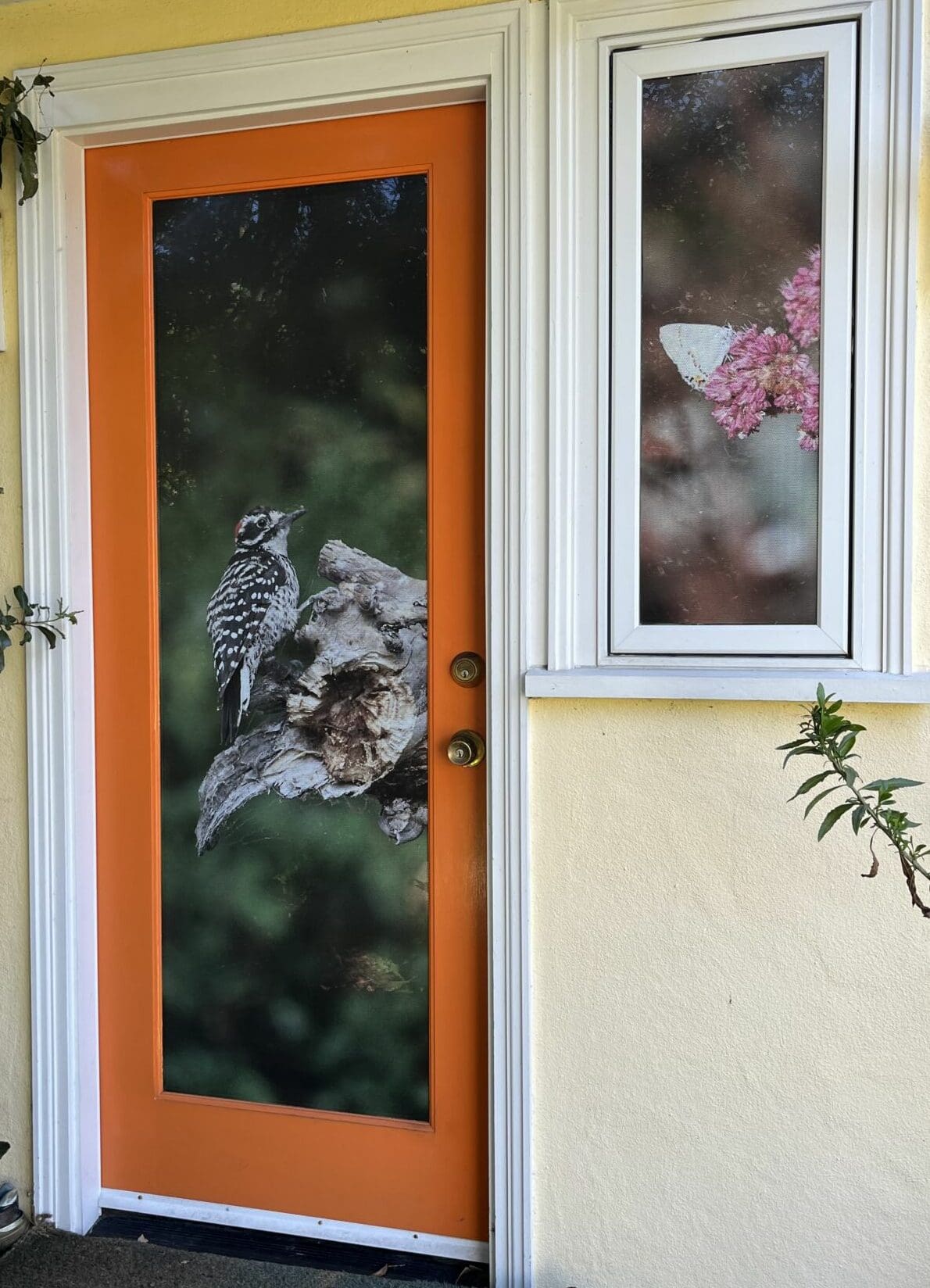
Photo: Erin Diehm
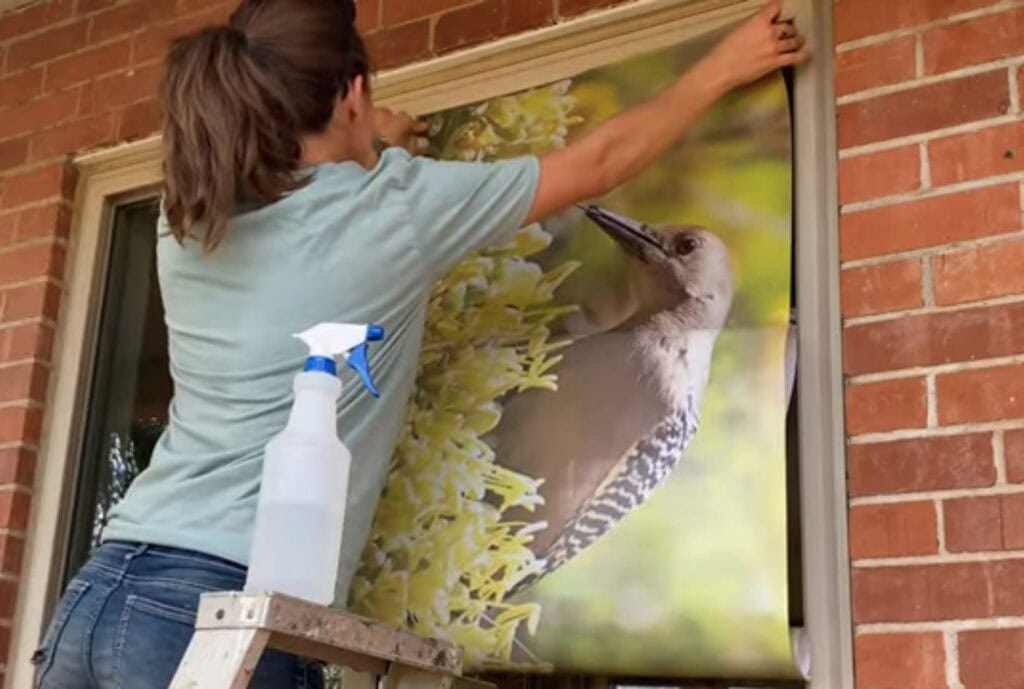
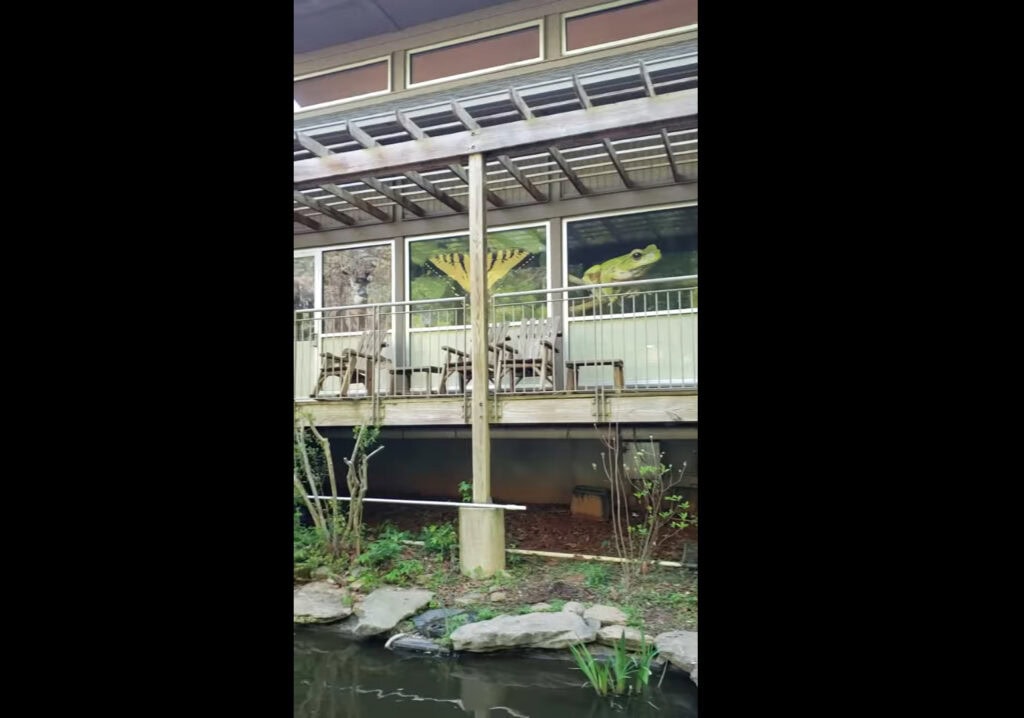
- Similar to window graphics on a bus – perforated film permits one-way visibility and natural light.
- Full glass coverage
- “Guaranteed” model, available in solid colors or with a custom photo (above) – use your favorite!
- Privacy, “secret” wildlife viewing, and reduced heat gain 50-60%
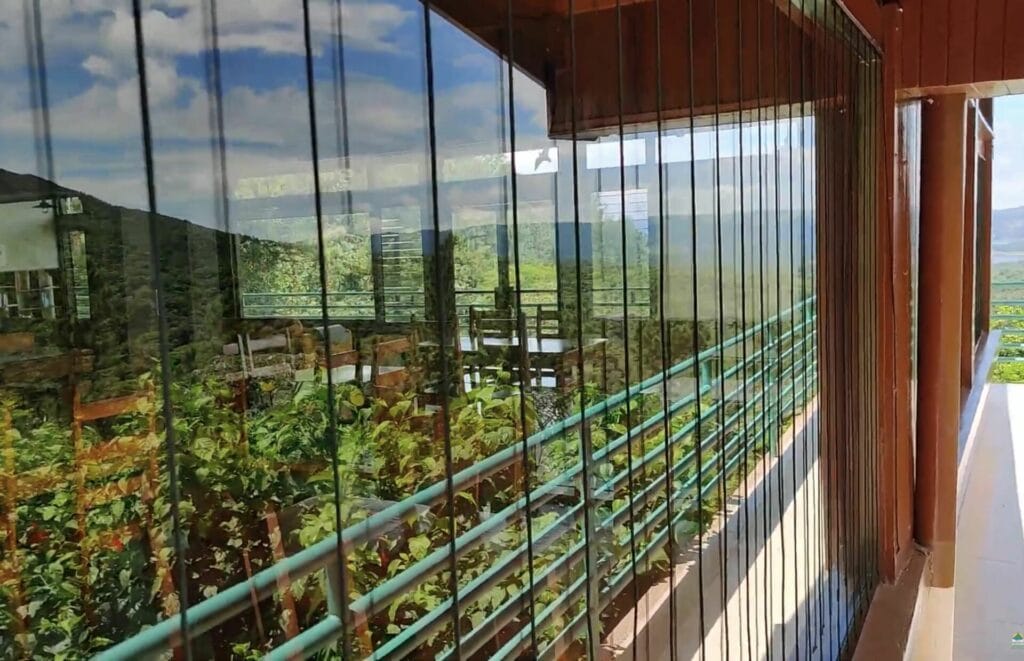
ACOPIAN BIRDSAVERS
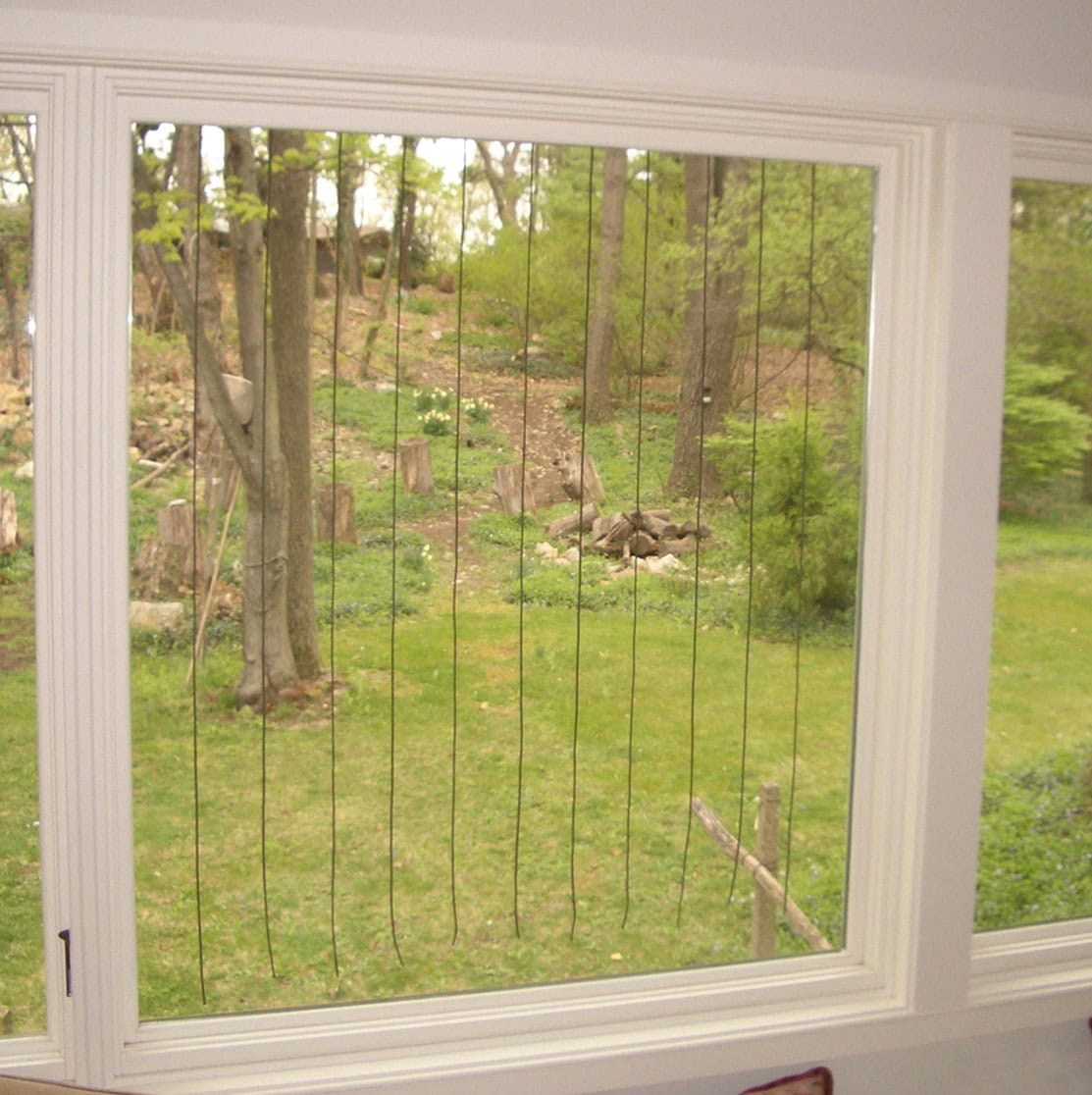
Photo: © Jeff Acopian / Acopian Birdsavers
- 4-inch spaced cording hung outside, 1- to 2- inches from window glass
- DIY or purchase
- Numerous options for mounting, from long-lasting hardware to quick-hit adhesive tabs
- “Zen Wind Curtains”, fluid, aesthetically pleasing, great for upper stories, quick install
BIRD DIVERT
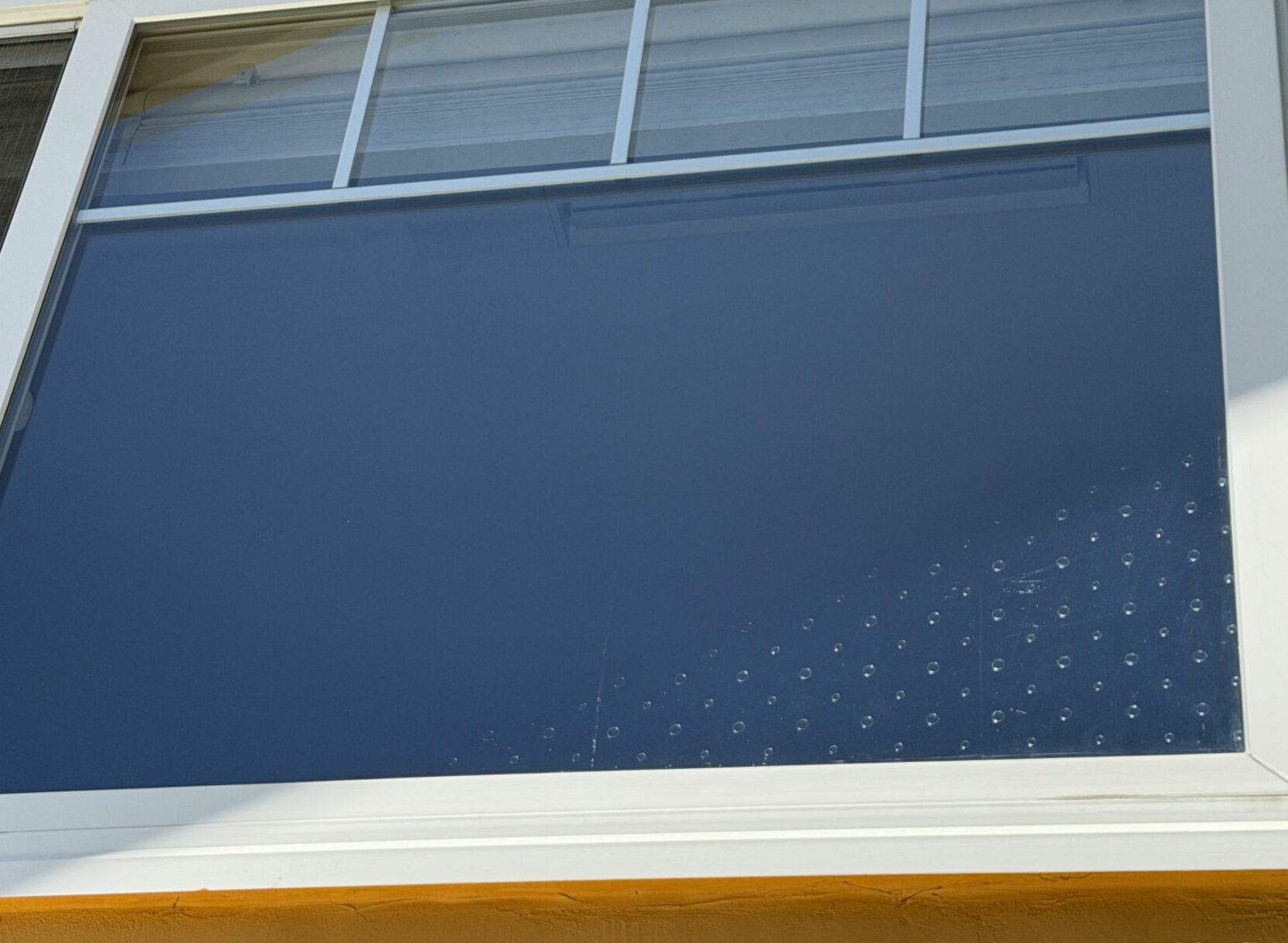
Photo: Whitney Grover
- Clear round markers that reflect ultraviolet (UV) light NOTE: Not all birds see in the UV spectrum, so they’re not as effective as opaque markers.
- Only the markers remain
- Available in “small”, “medium” and “large” formats.
- May be preferred by those who want a nearly invisible treatment
COLLIDESCAPE MARKERS
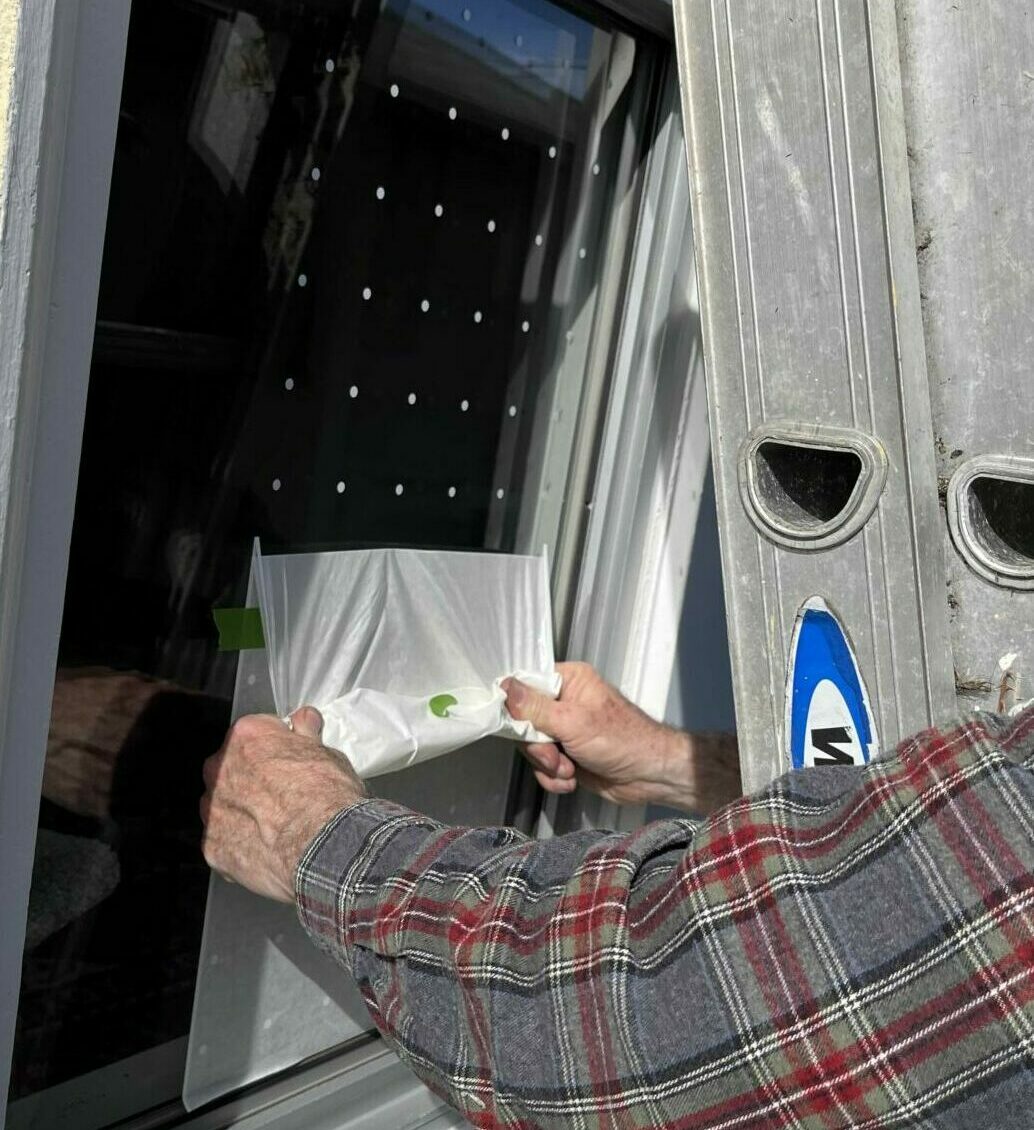
Photo: Erin Diehm
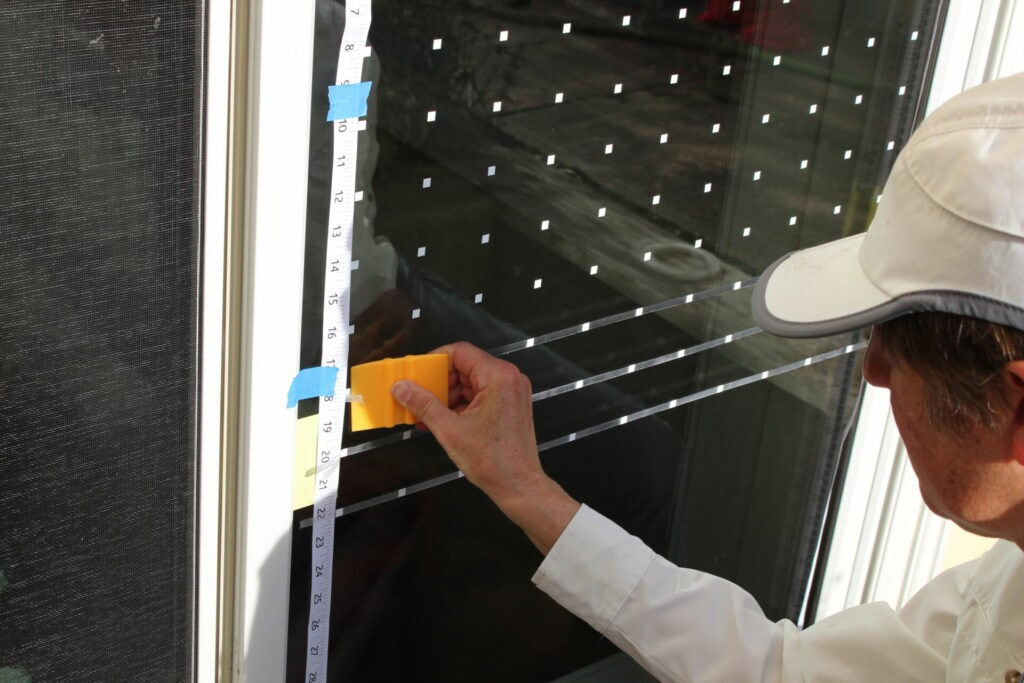
- Adhesive markers available in several, formats, patterns and sizes
- For example, 1/4-inch solid white round on sheets (above), 1/2-inch round perforated film (white exterior & black interior), or clear “spiderweb” tape on a roll
- Only the markers remain
- Long-lasting with a clean, attractive design
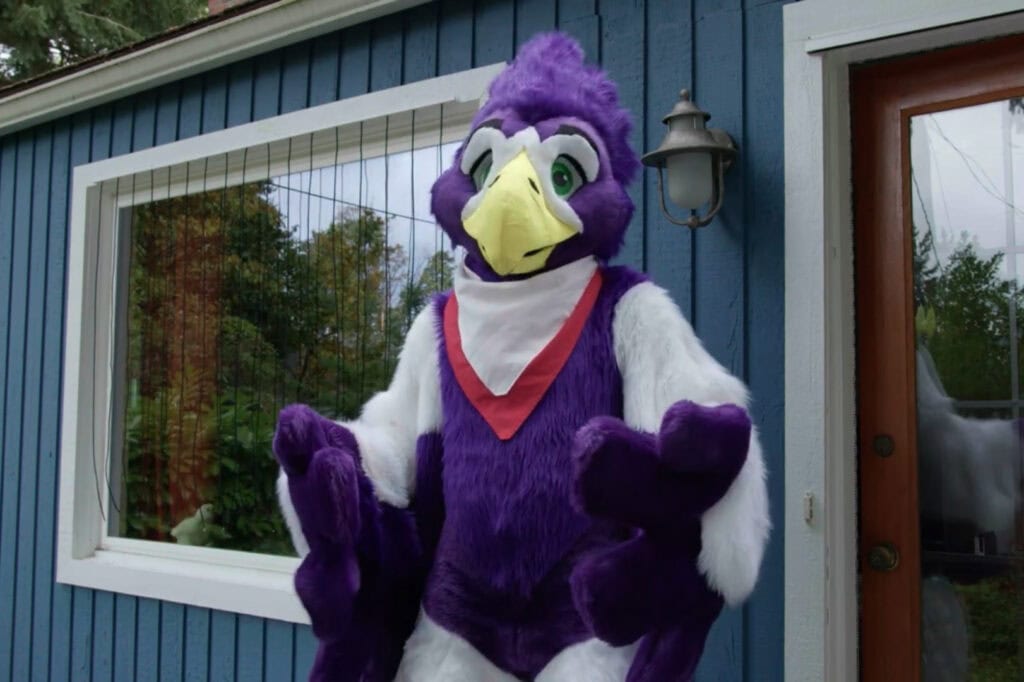
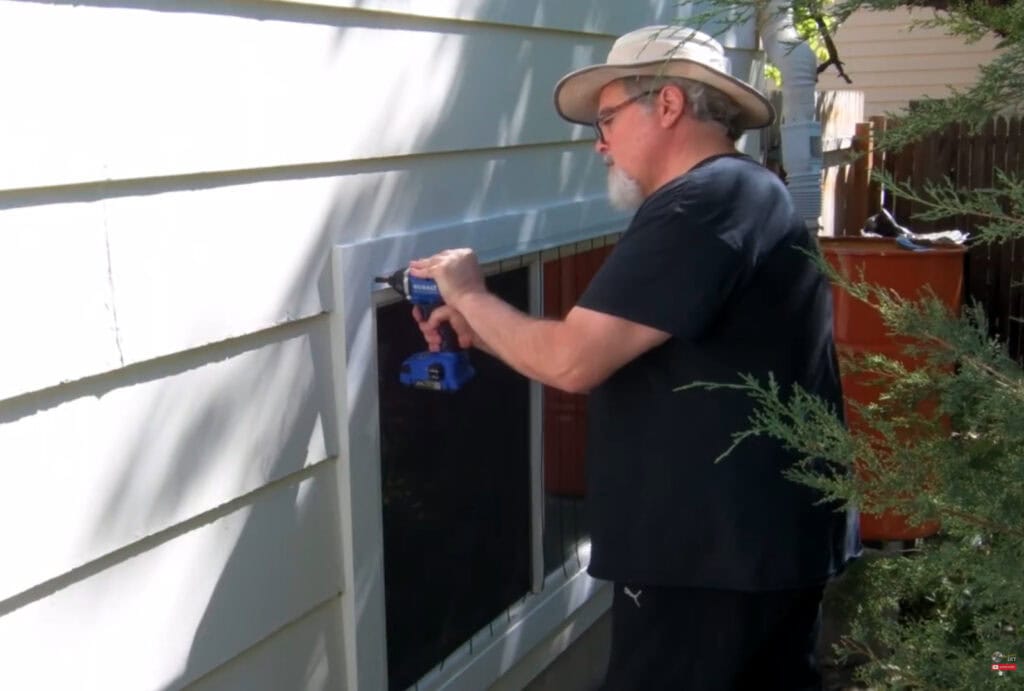
To help you get started, here are some videos demonstrating several ways to make your windows bird-safe. (If you find additional helpful ones, please share with us, at birdsafe@goldengatebirds.org.)
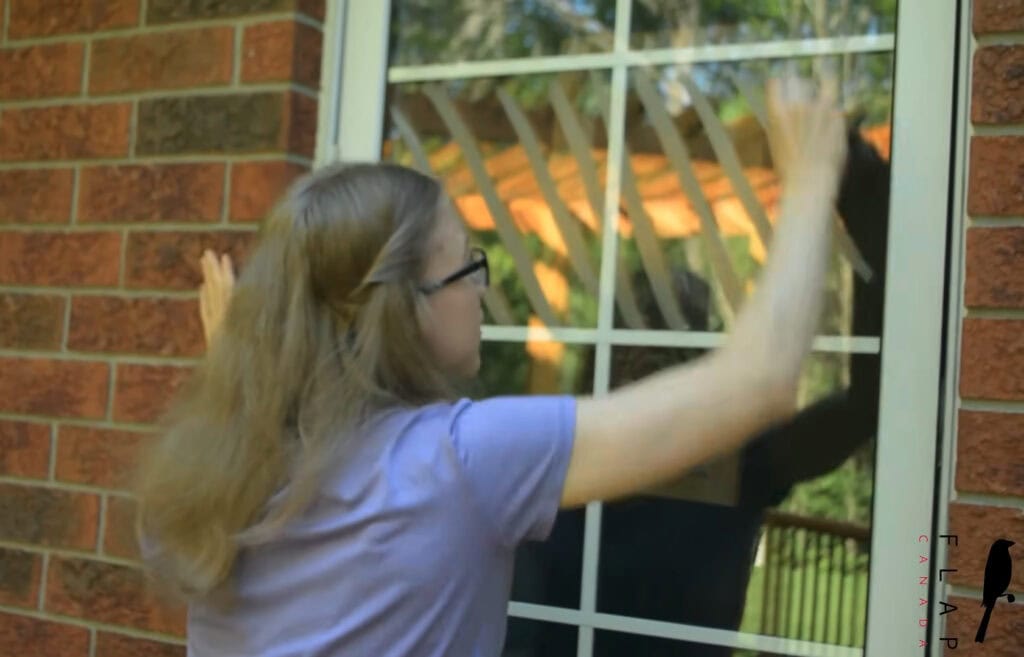
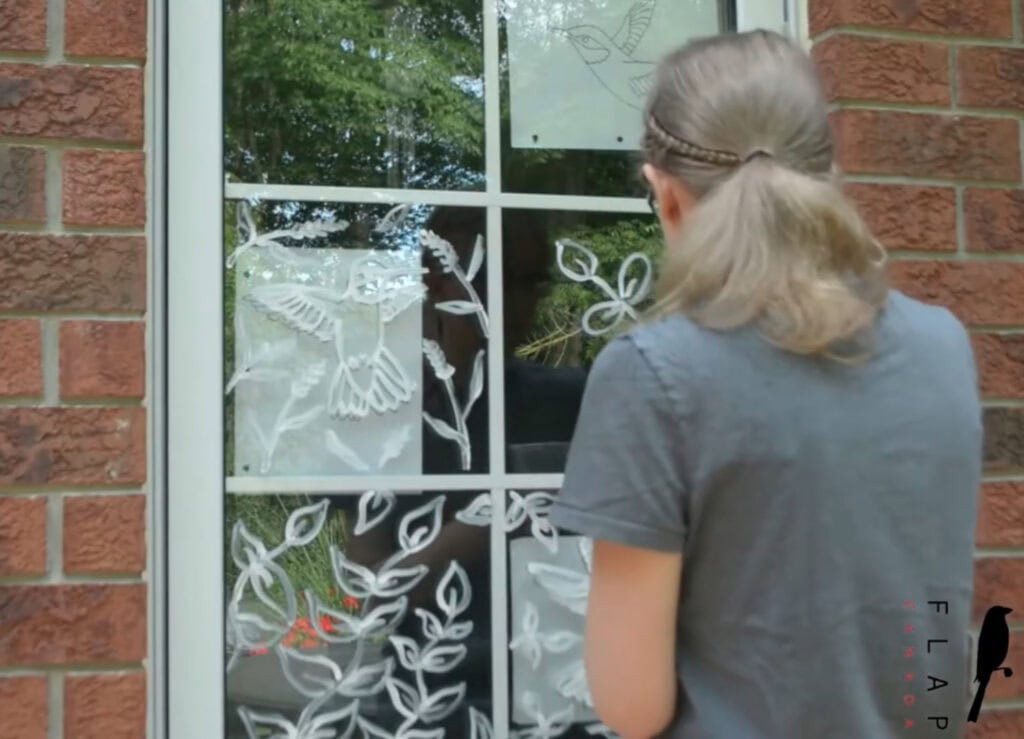
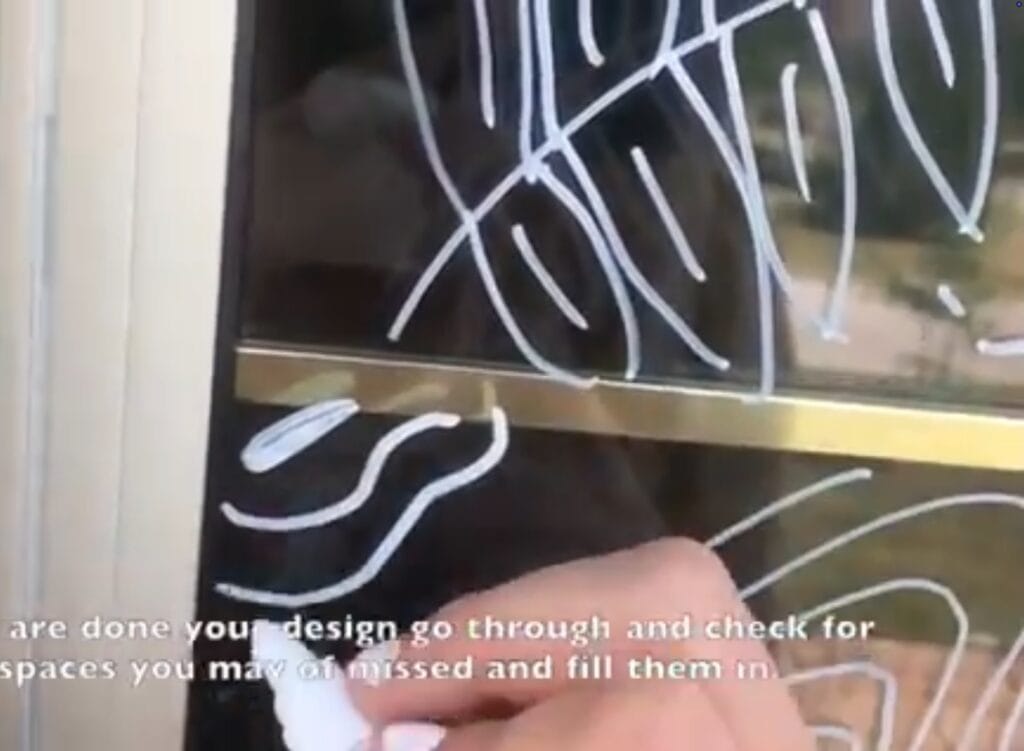
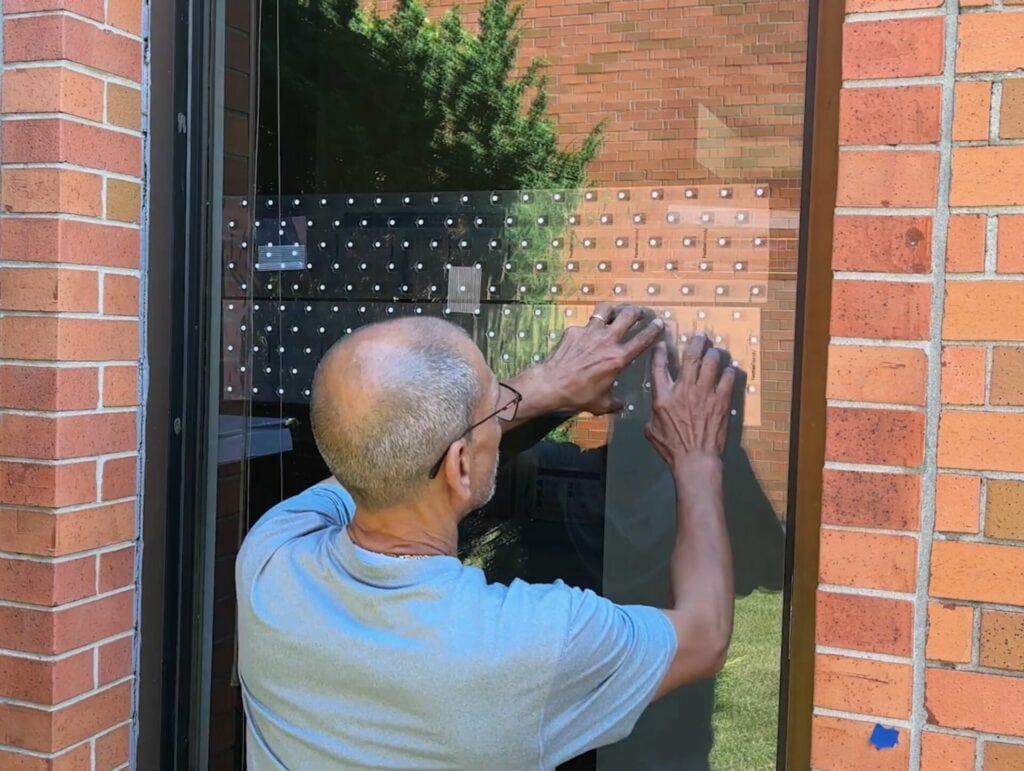
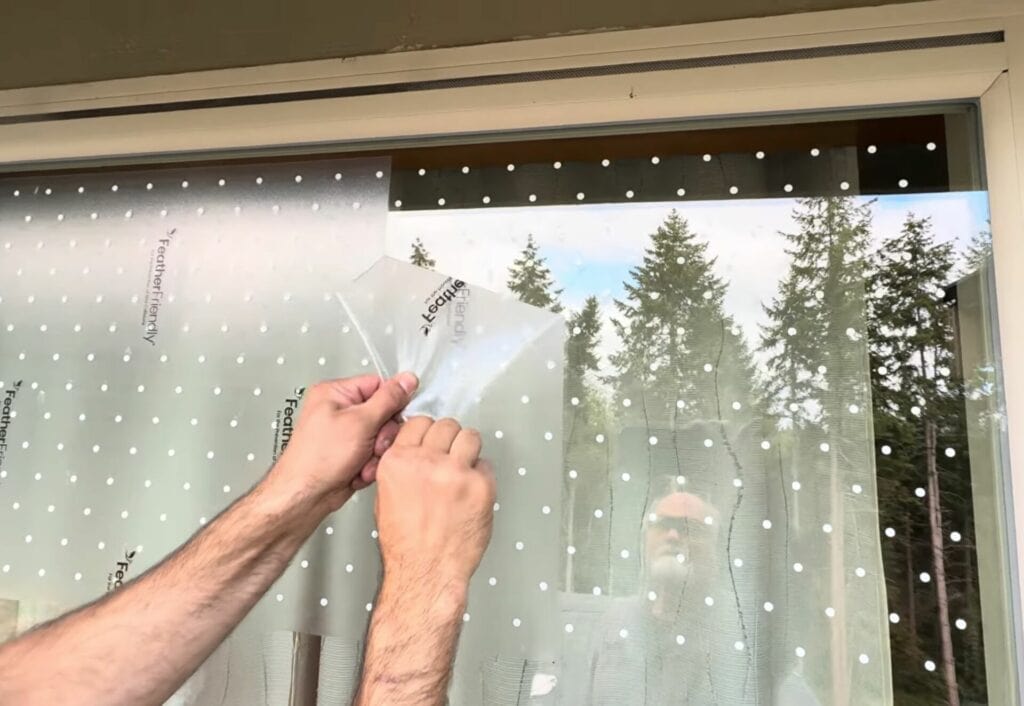
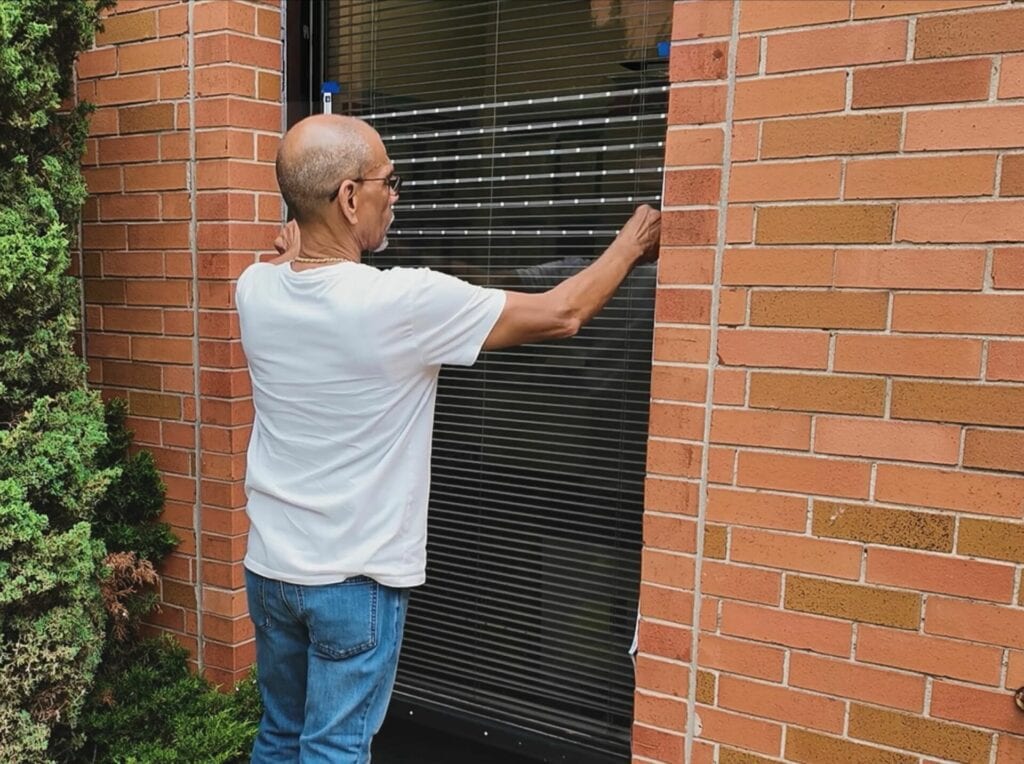
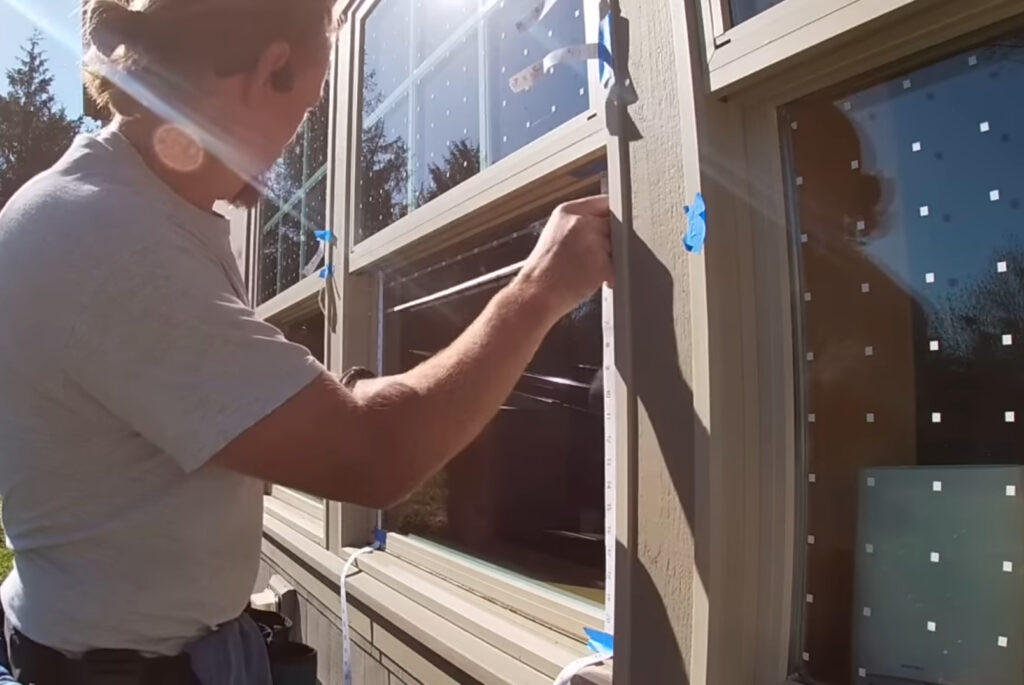
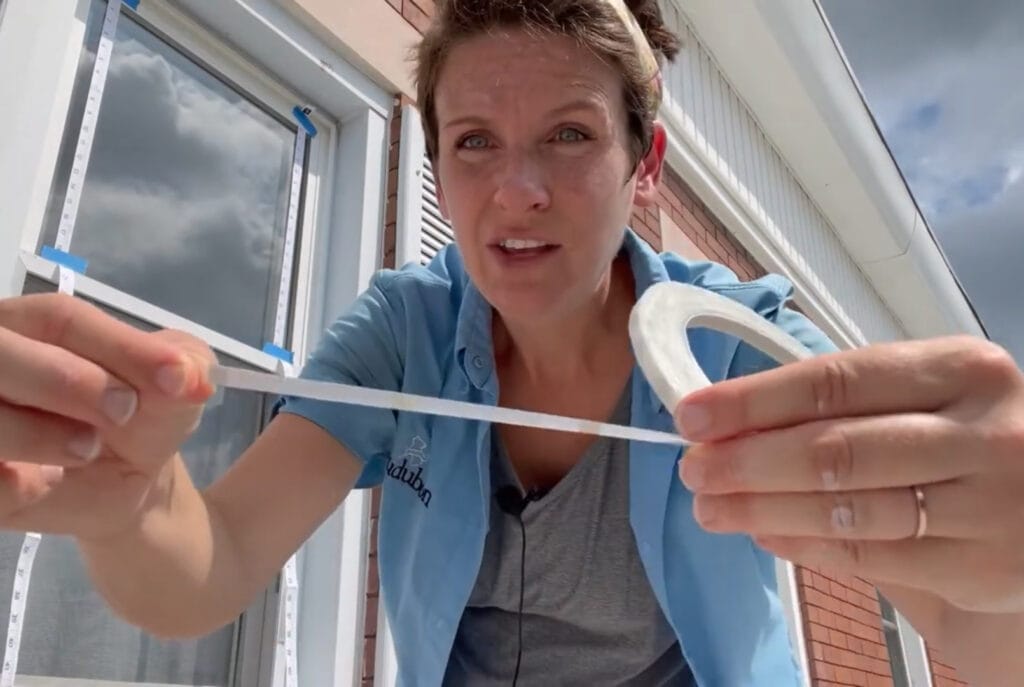
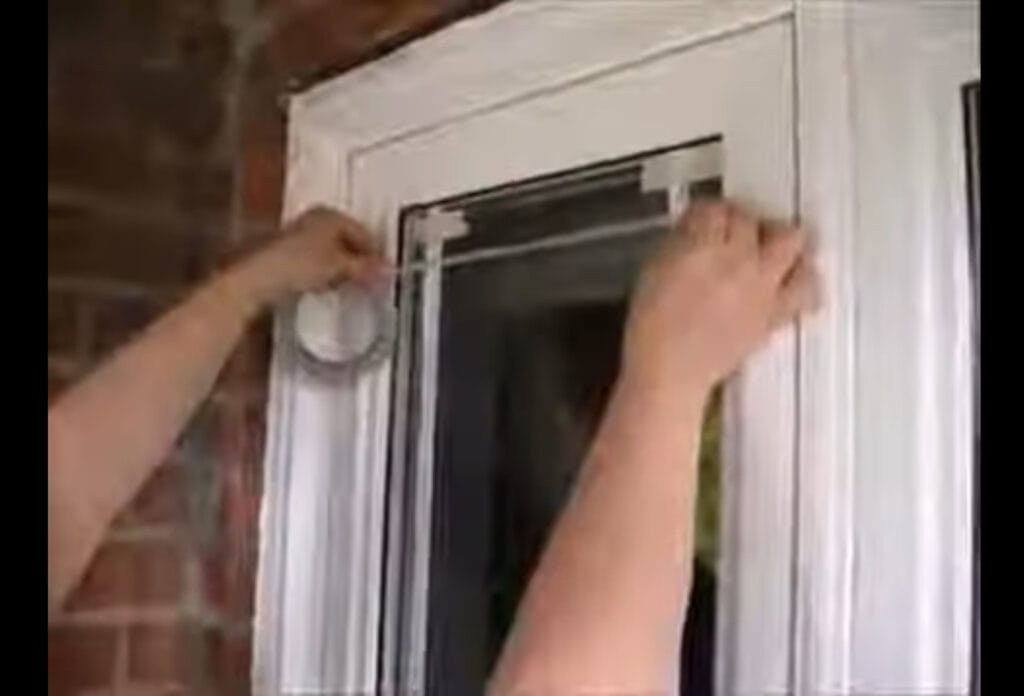
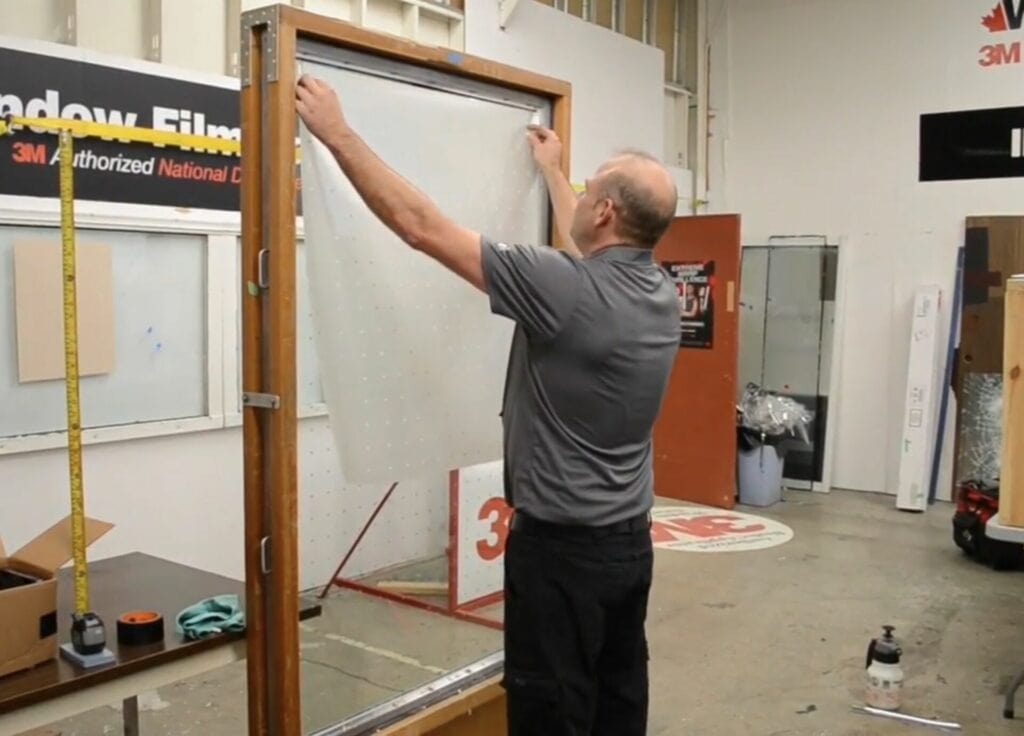
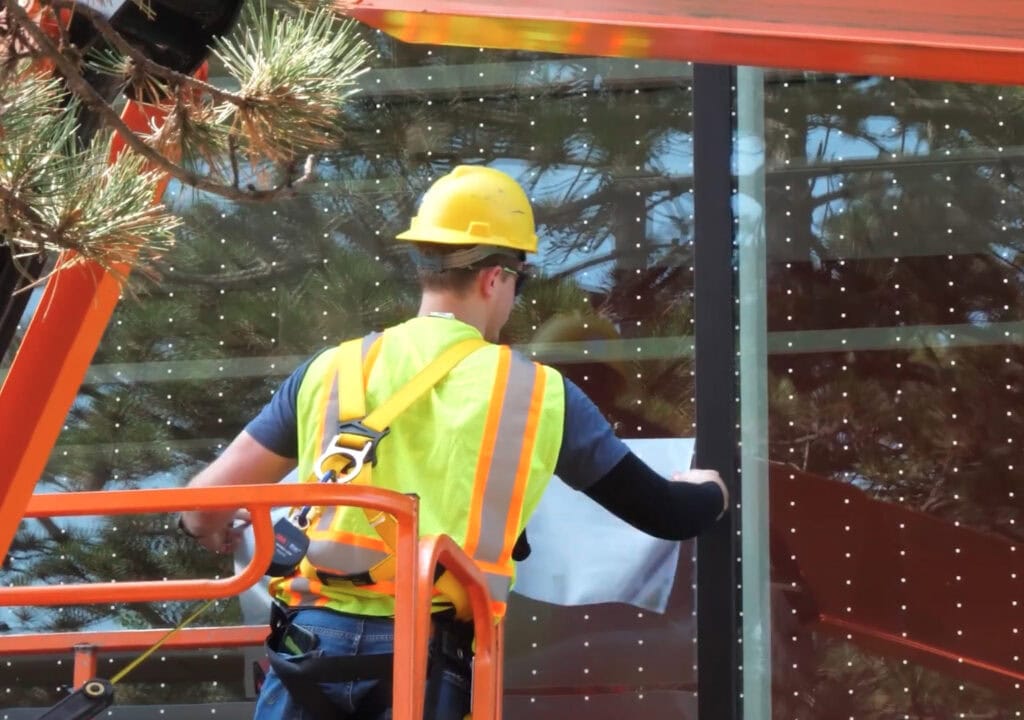
COLLIDESCAPE (films & dots)
GGBA has created a table of common treatments for retrofitting glass, ordered by cost. It includes cost, longevity, and information learned from our installation workshops. Three ways to access it: (1) see the table below, (2) go directly to the spreadsheet, or (3) open a pdf version.
NEW GLASS
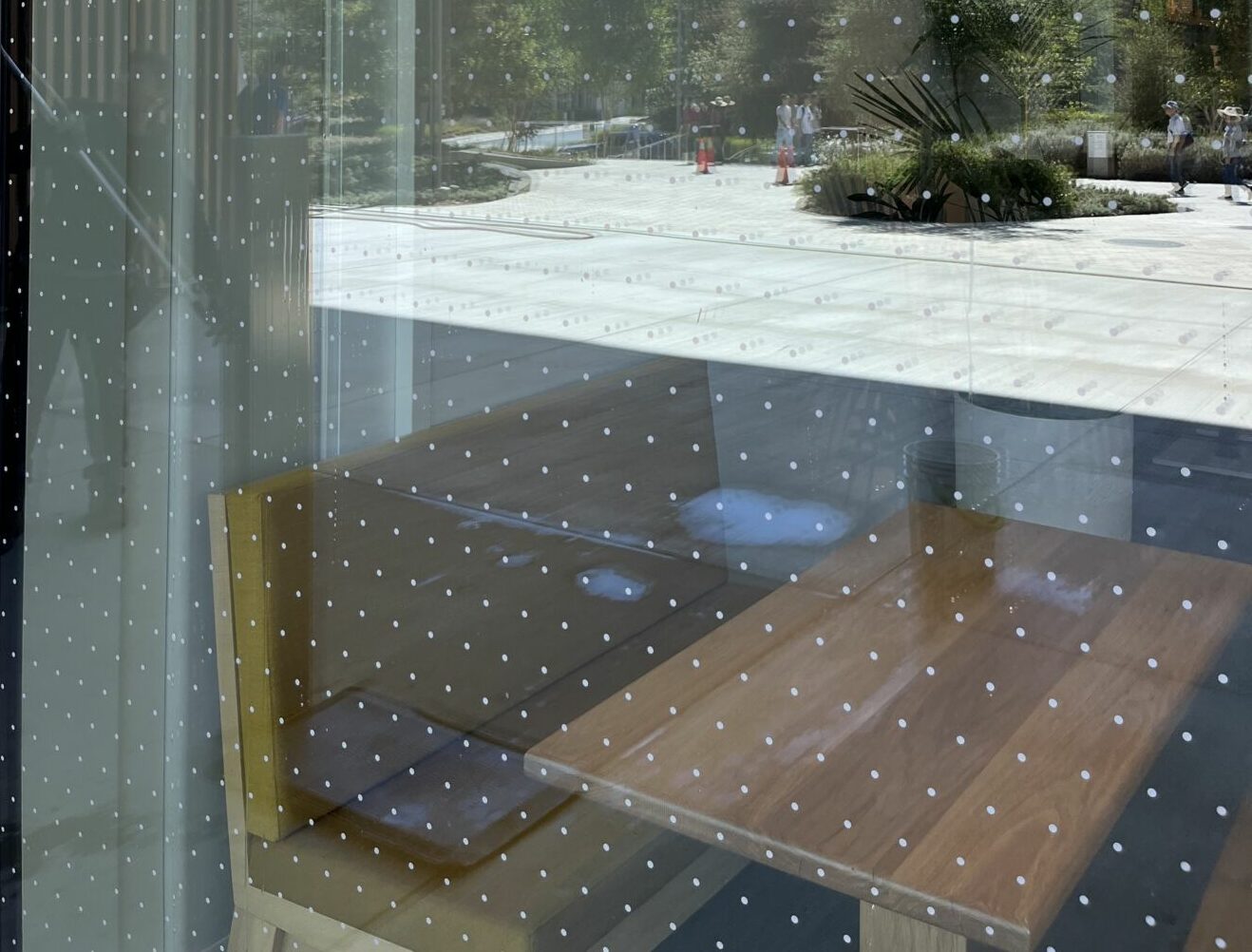
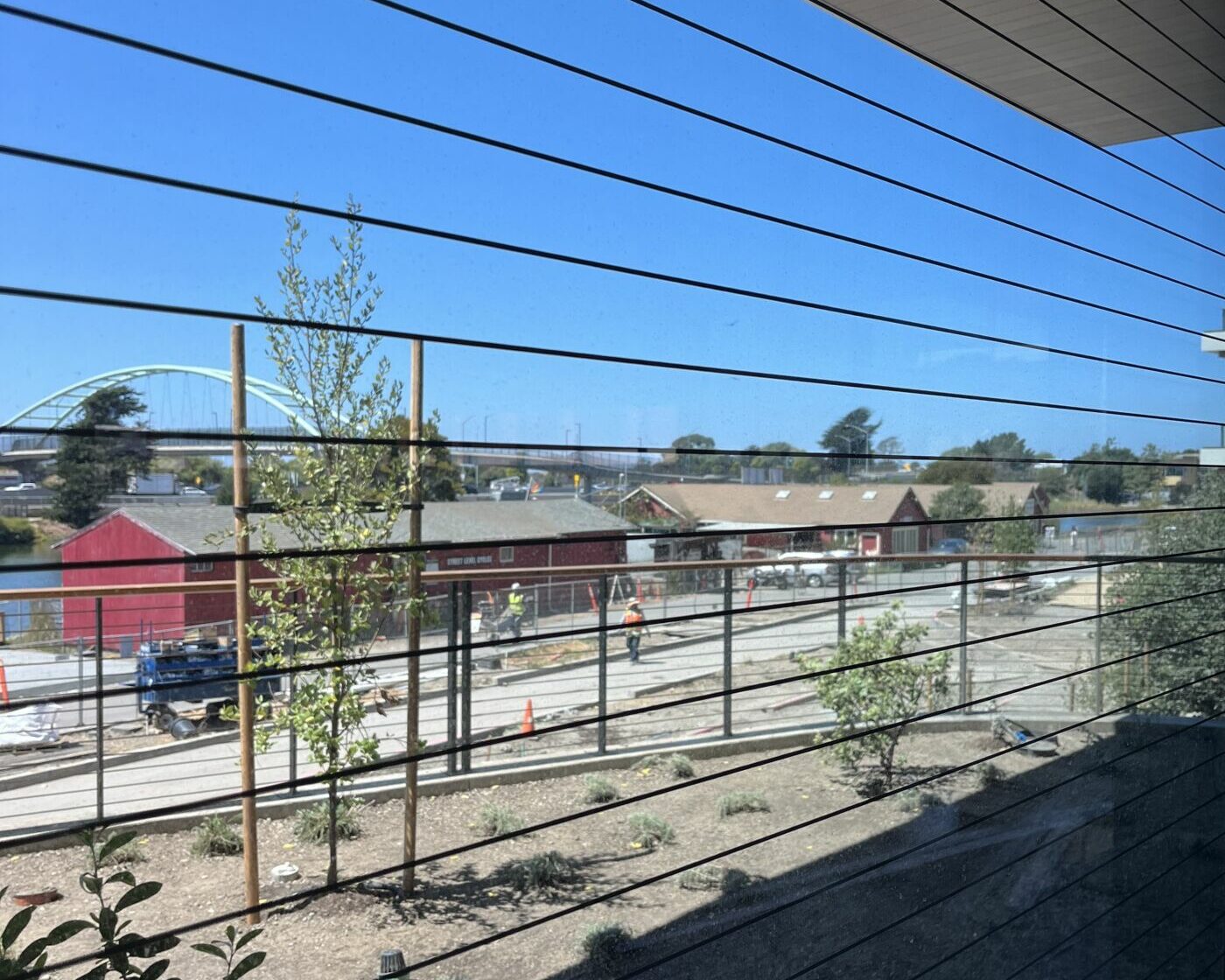
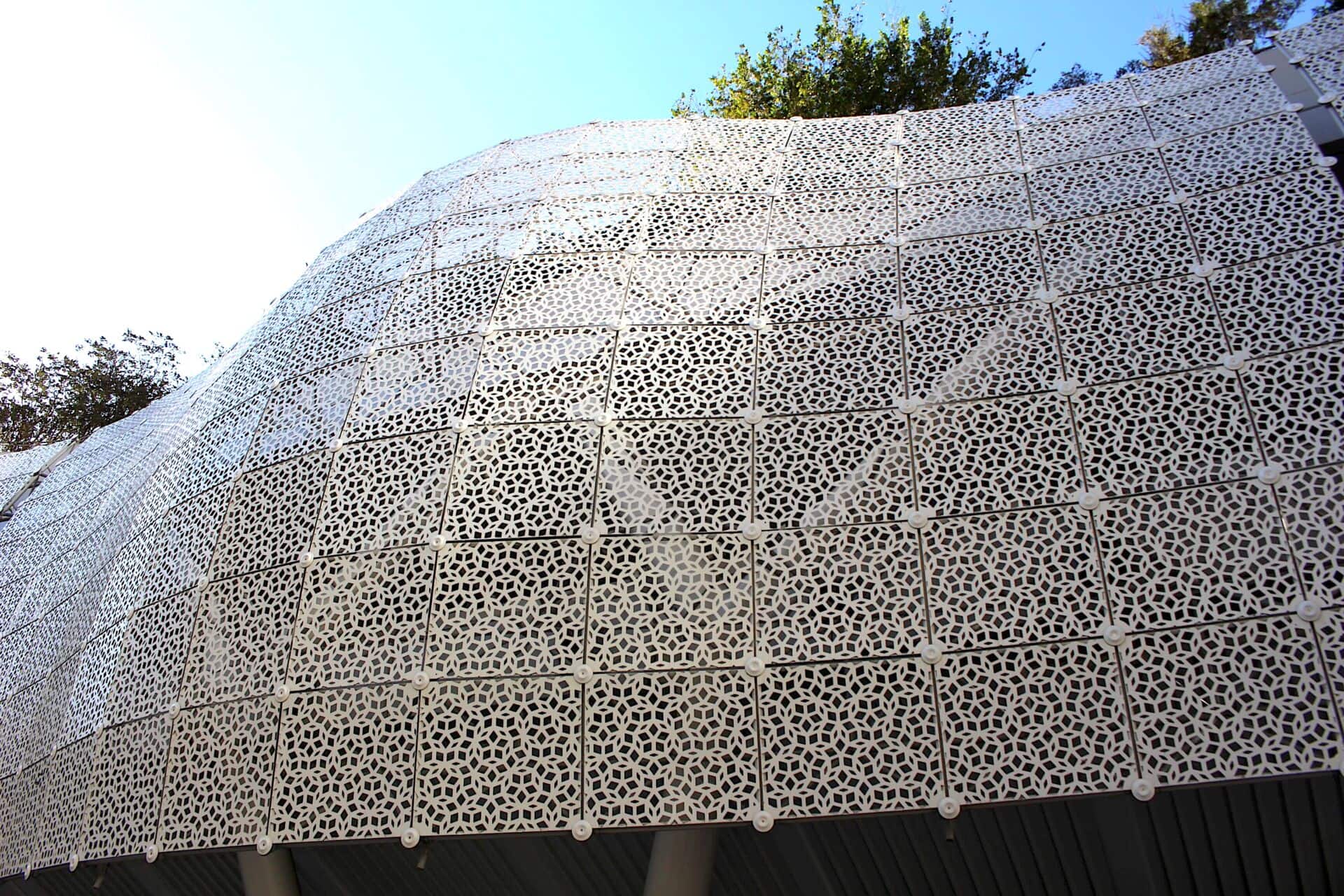
New glass, replacement glass, and construction can take advantage of a wide variety of methods to prevent collisions. And – big bonus – the protections are long-lasting and permanent, protecting birds for the life of the glass. A few examples include:
- Acid-etch and frit patterns. Glass is clear with permanent markings.
- Opaque and frosted glass. Glass is opaque, with translucent textures, channeling or glass block.
- Architectural elements added to the exterior of the building and glass, to provide a visible barrier. Shades, louvers, sheeting materials, and more.
A Note About Sourcing
While solutions are expanding, it’s currently easier to source bird-friendly glass for commercial properties than residential homes. Commercial spaces can take advantage of the benefit of scale, ordering a large number of windows and doors with custom sizing for a “special order”. Being of smaller size, residential spaces often don’t have those advantages so sourcing may be more challenging. But we hope to change this situation, by working with bird enthusiasts to help create greater demand at the local level!
Are you planning to replace your windows or add bird-safe windows to a new build? Reach out to birdsafe@goldengatebirds.org for support and more resources.
Join our bird heroes!
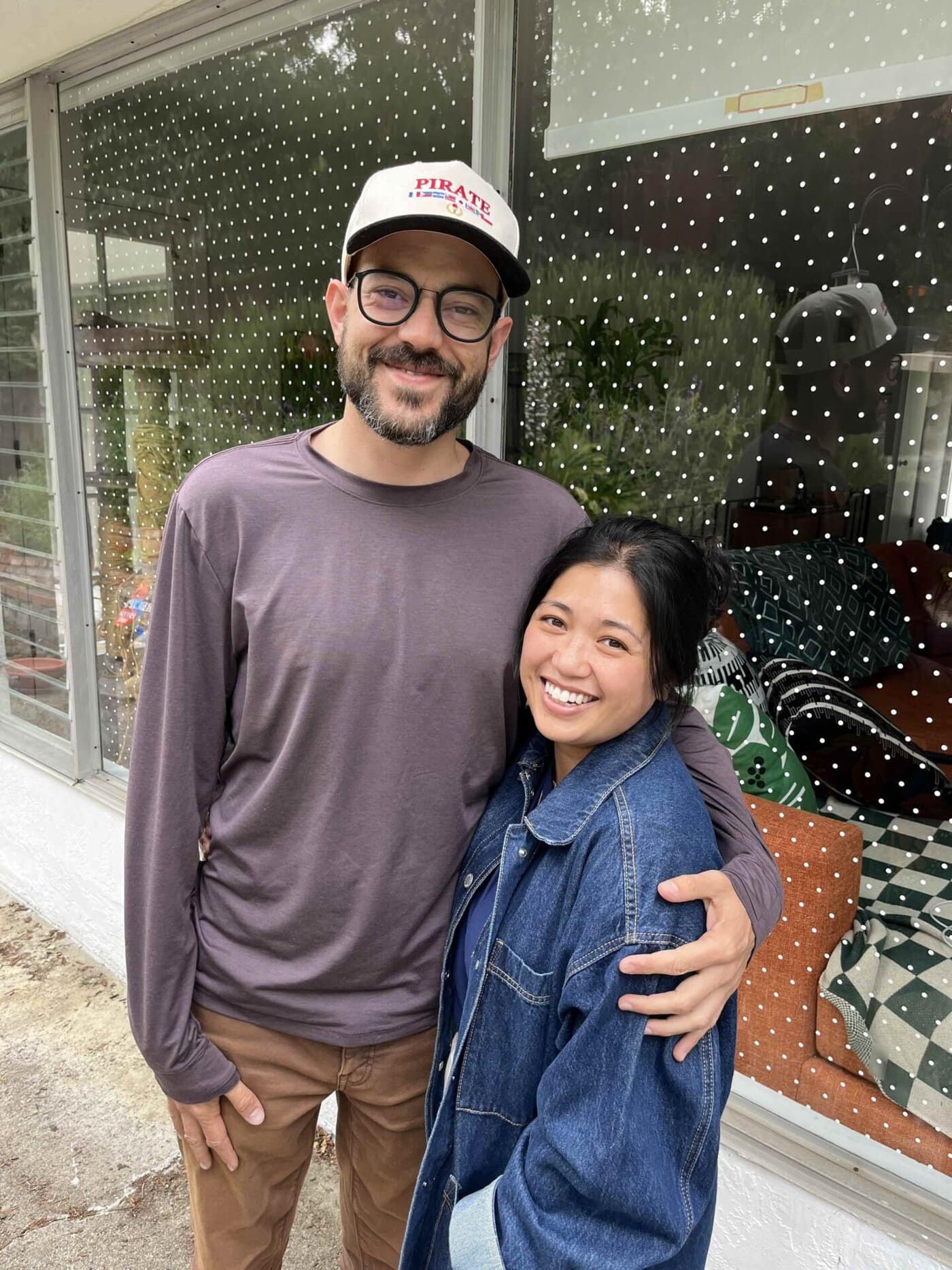
The bird-safe windows are great! We have not observed any collisions, including from band tailed pigeons who tend to flock to our feeder in large numbers and bonk the window during their feeder “rush hour.” Figaro (an operatic cat name!) still loves watching them from the window, and we actually keep the shades up MORE now because we don’t feel we need them down to prevent bird strikes.”
– Kevin and Michelle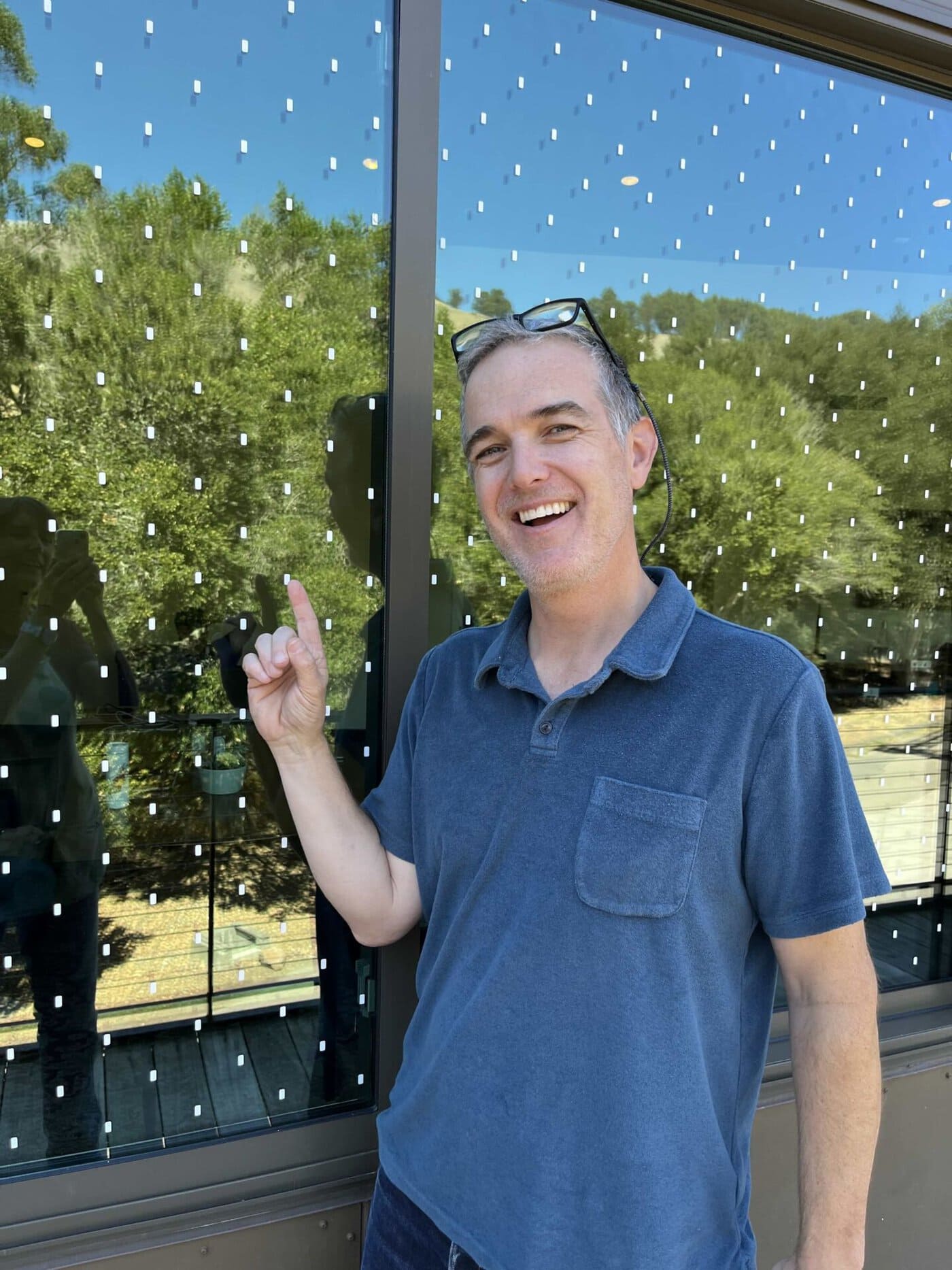
“Siesta Valley Foundation’s partnership with Golden Gate Bird Alliance has reinforced the need to protect local and migratory bird populations from collisions. When GGBA recommended applying Feather Friendly, it was a no-brainer for our team, and a win for the birds of Siesta Valley. “
– Campbell Foster, Founder & Chair, Siesta Valley Foundation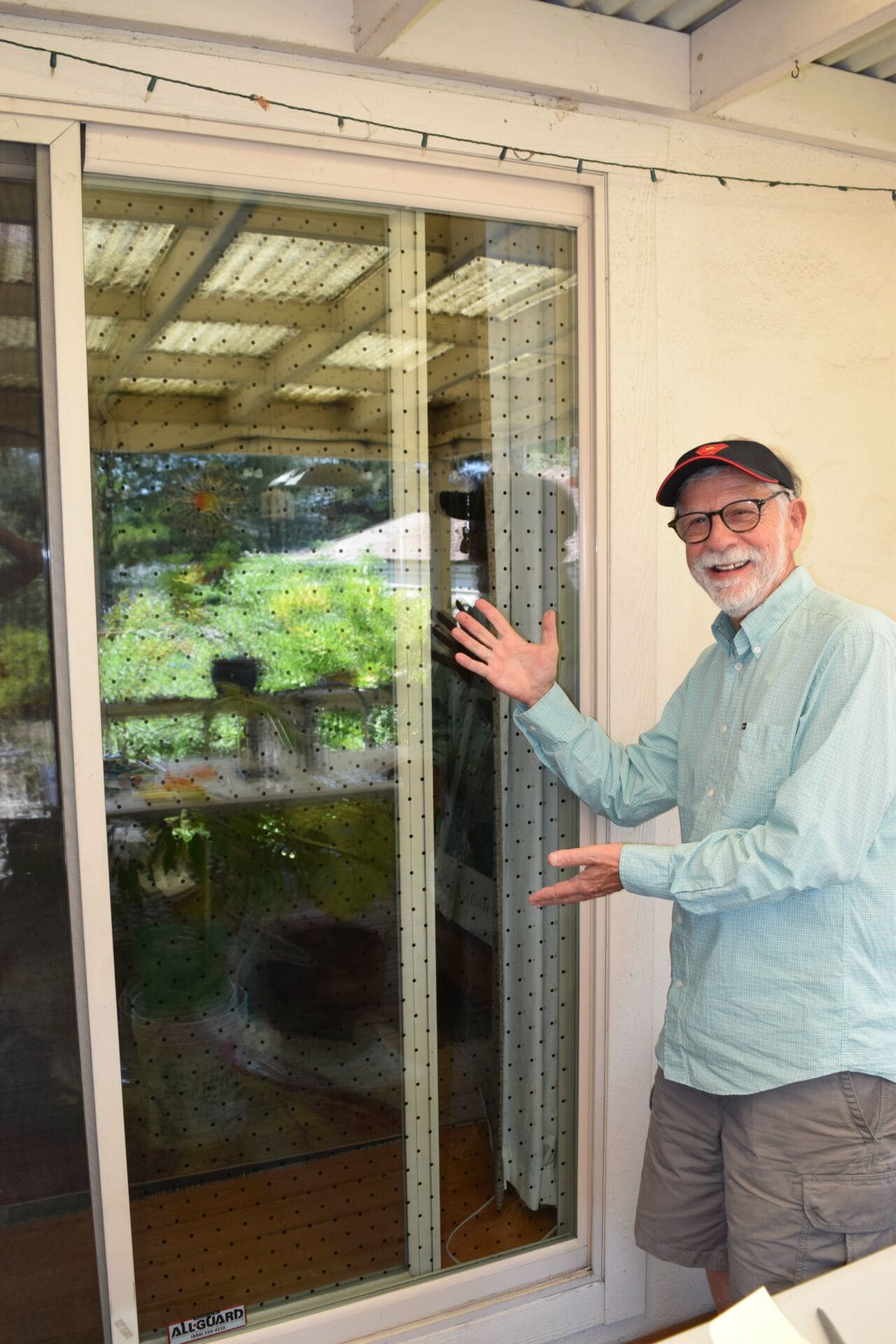
“Preventing bird-glass collisions is important and easy to achieve. Make your home safe for birds today!”
–Alan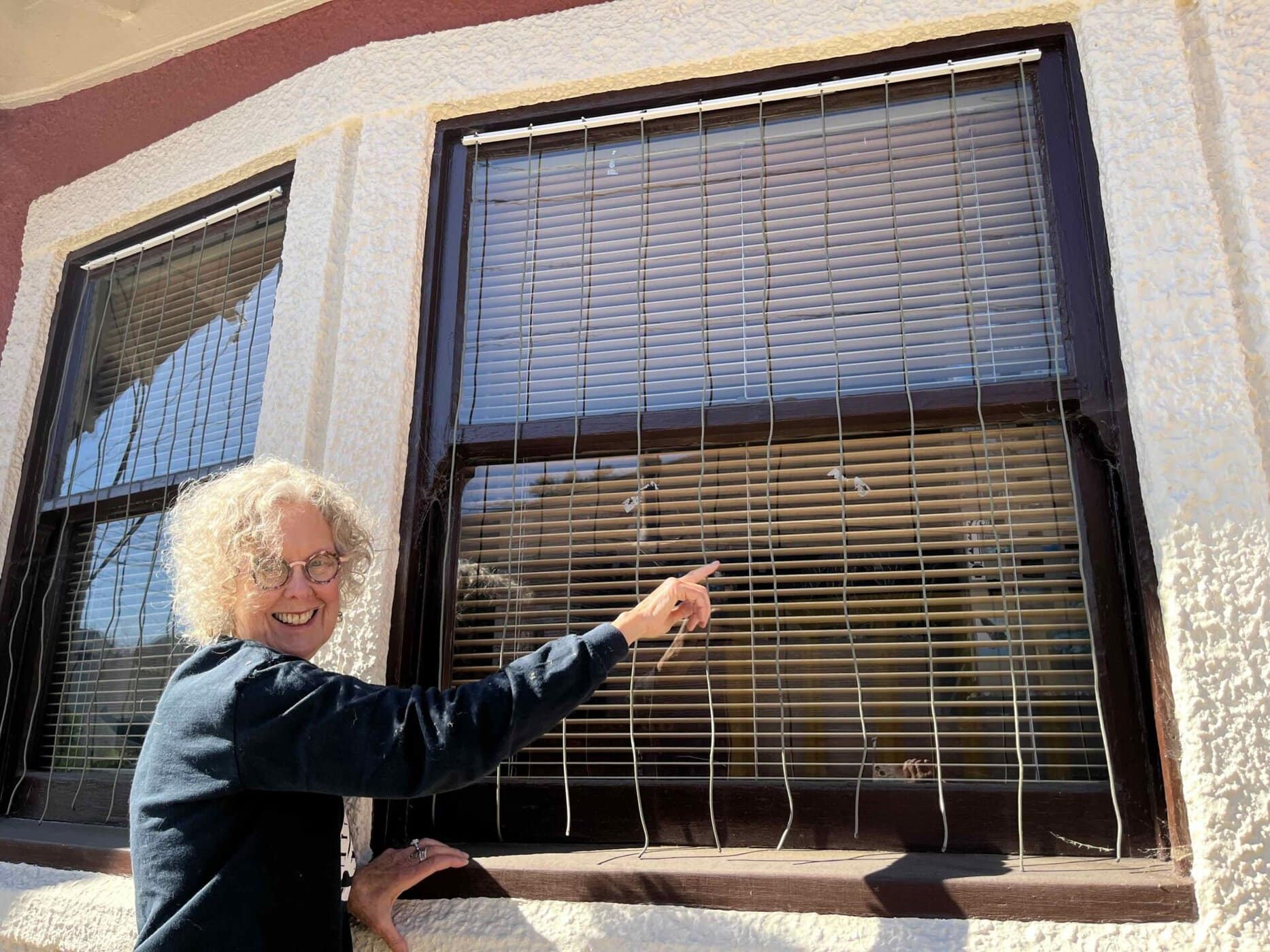
“I love my Acopian blinds! They were so easy to make and install. And no more strikes!
The hardest part was finding a match and a candle to melt the end of the parachute cord to keep it from unraveling.”
– Kelly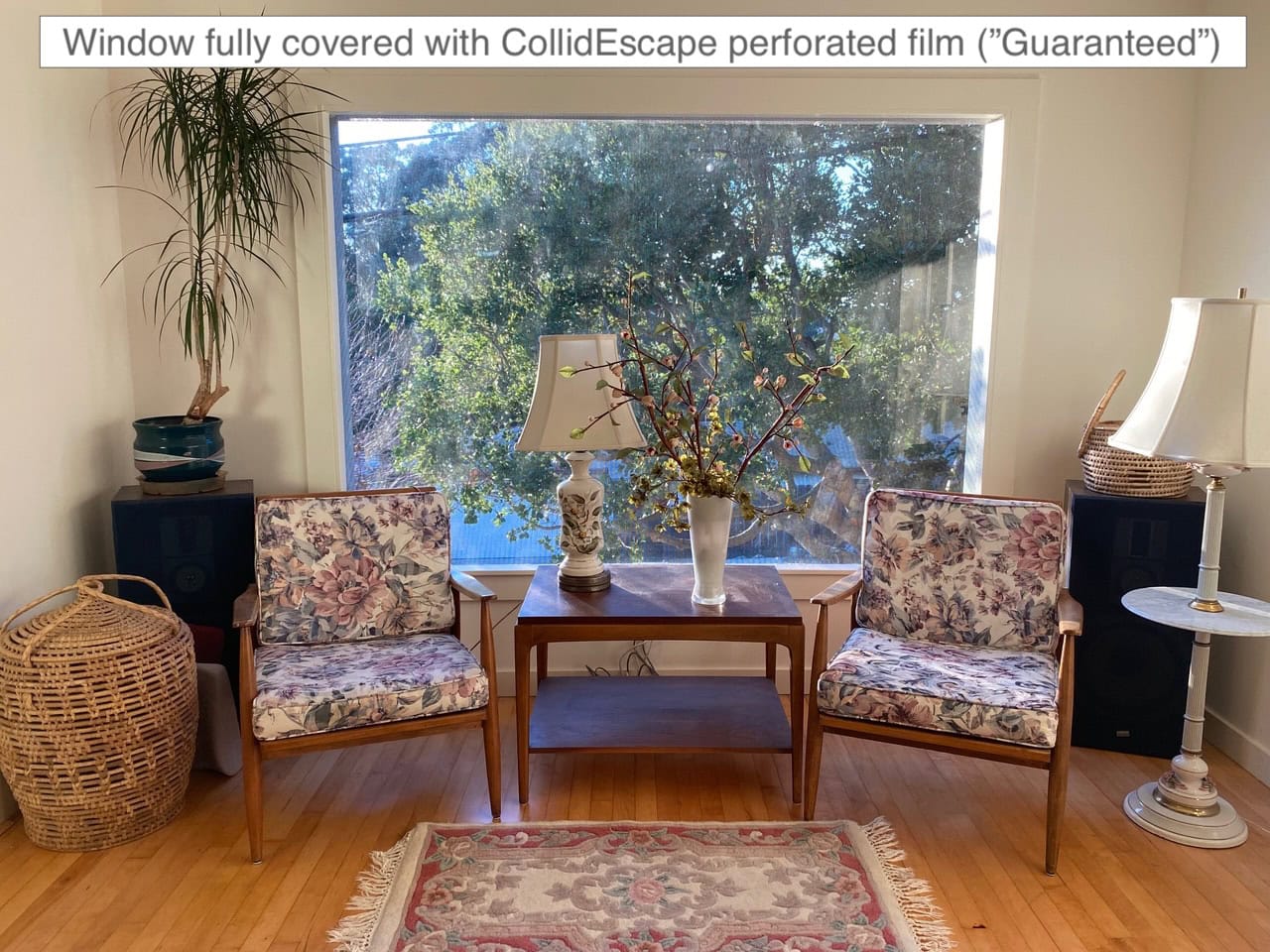
“We’d had several bird-glass collisions and were determined to stop them. My husband, Mike, and I installed CollideEscape film on the picture window in the living room (above), screens on the double-hung windows in the office, and Feather Friendly markers on the kitchen windows. No bird-glass collisions since. I have seen so many birds heading for the windows in our office – that turn away at the last moment, when they notice the screen! We’re relieved and thrilled that the window treatments work so well!“
– Kathy Kramer, Bringing Back the Natives Garden Tour Founder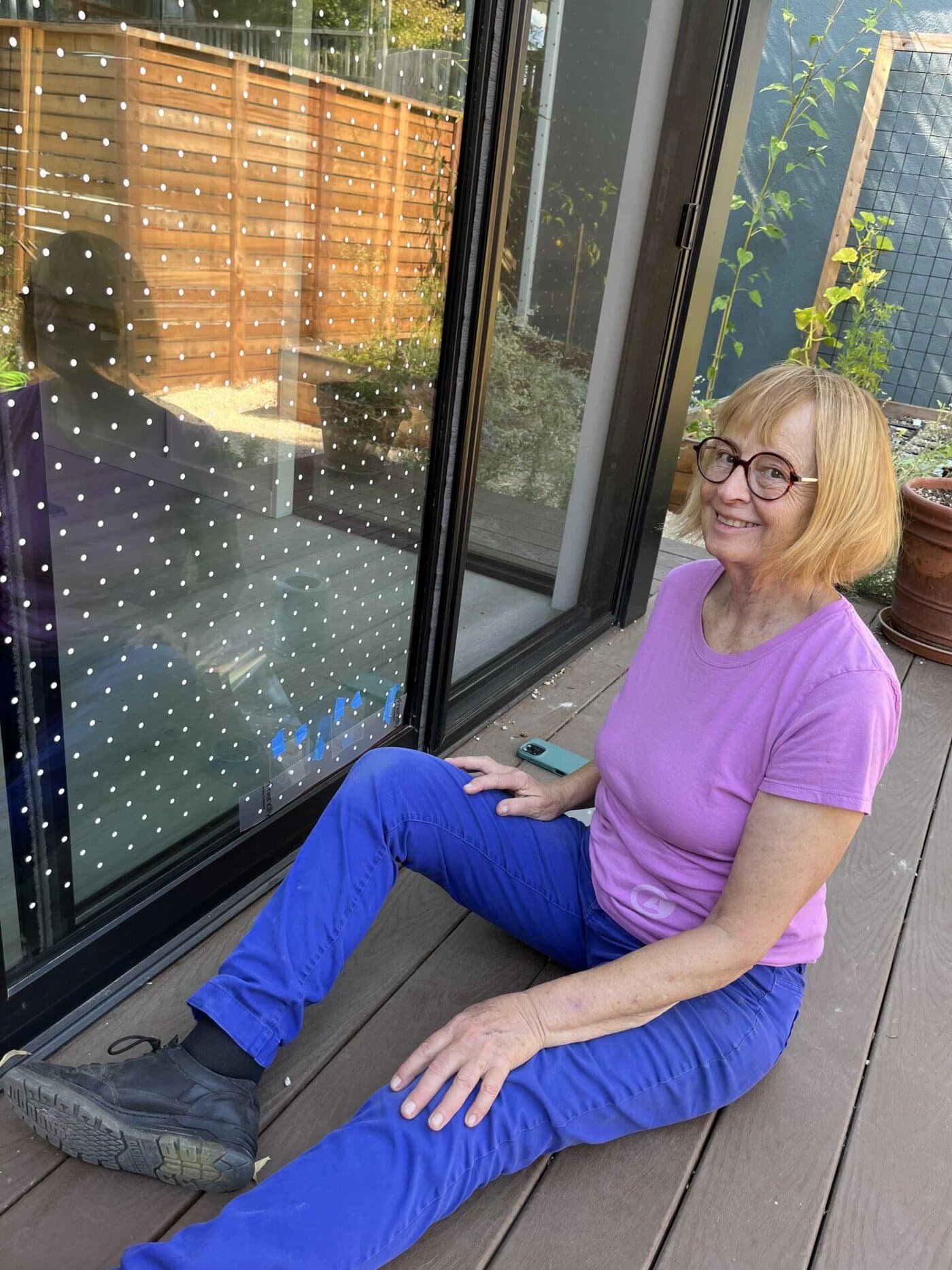
“I love the clean, modern look of the markers. Birds visit the back garden often and I’m thrilled they’re now protected. I haven’t seen any strikes since the markers went on!”
– Lucinda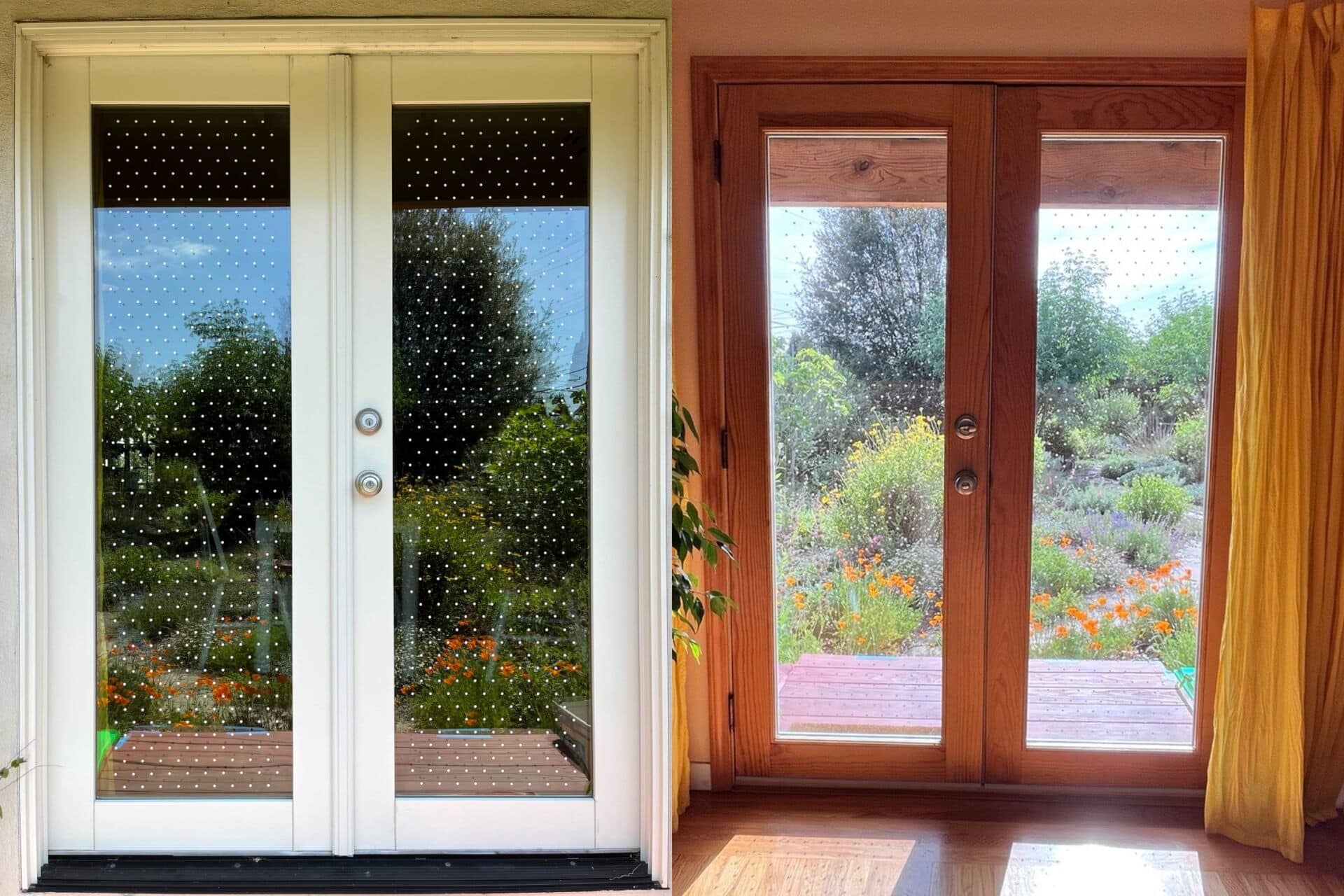
“Love my dots!” I don’t even see them anymore, and my birds are now safe.”
– Stefanie, San Leandro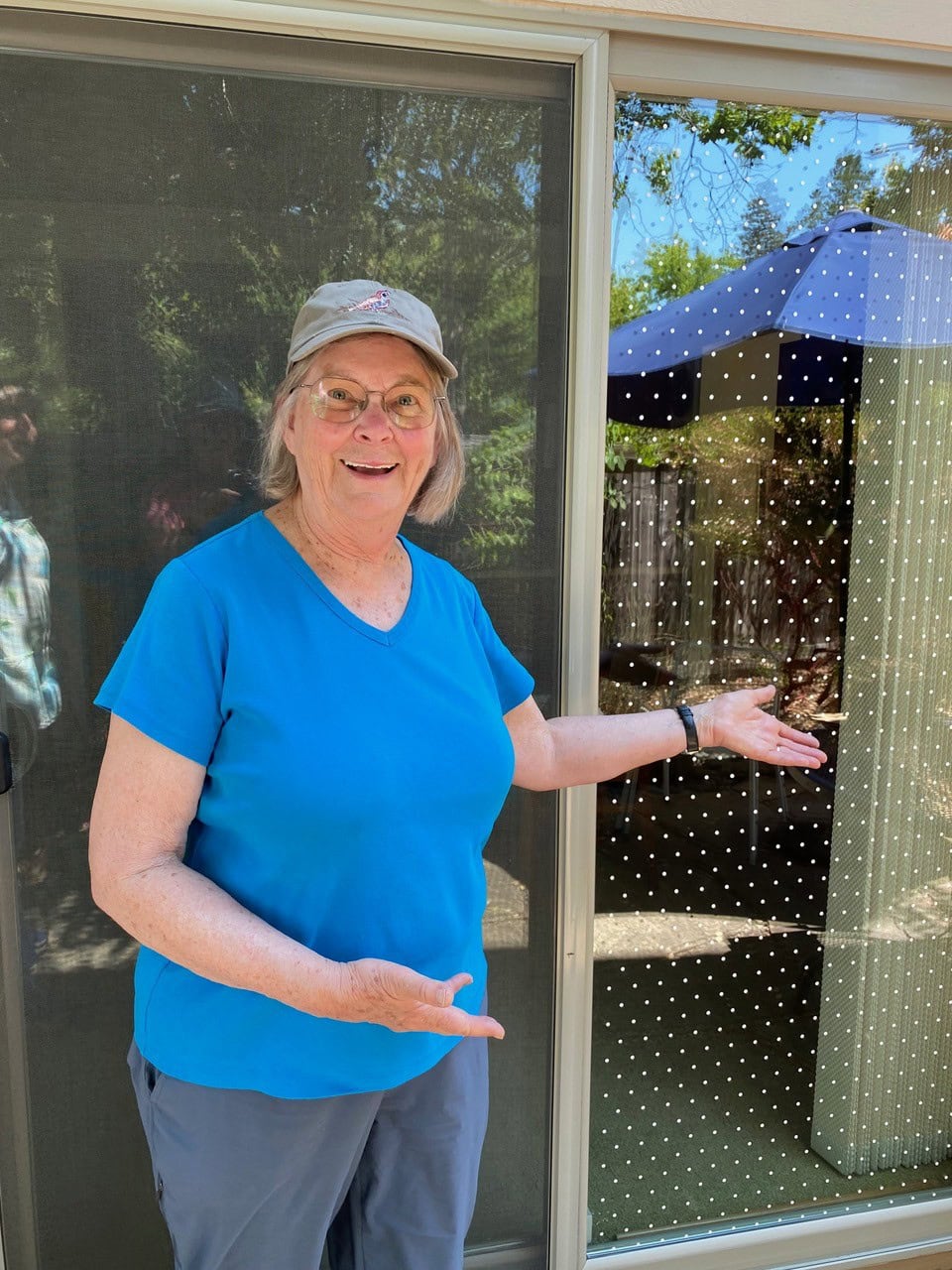
“I feel better knowing that I am doing my part to protect the birds and I hardly notice the dots now. It was fun to do this project in a group.”
– Nancy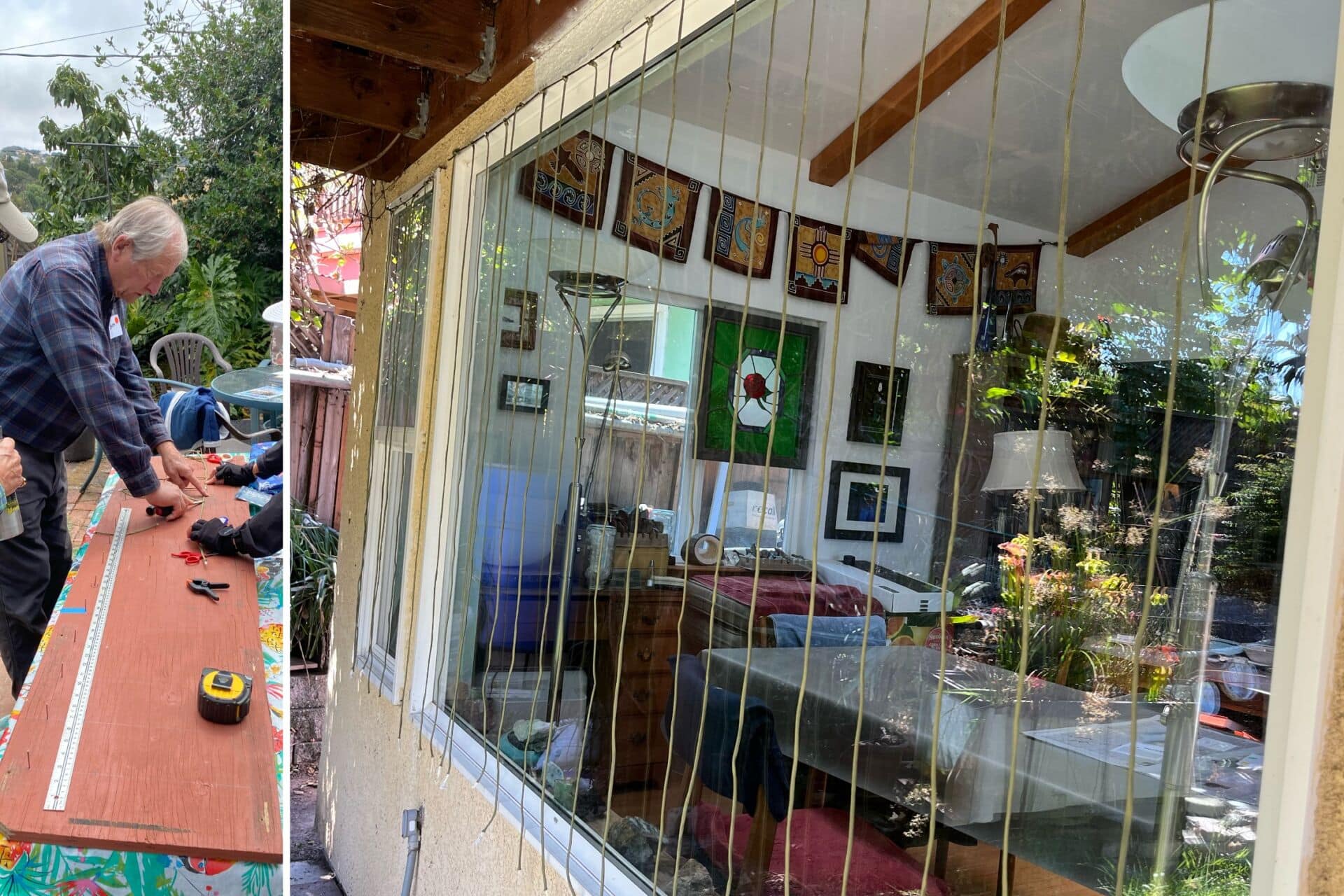
“We installed three different kinds of bird-safe treatments and love them all – adhesive markers, a drawing, and Acopian blinds. Each was easy, fun, and affordable. Here’s a photo of us making the Acopian blinds. Brian followed the excellent instructions on the BirdSavers webpage. So much fun and best of all, no new evidence of bird strikes!”
– Janet and Brian
MAP OF BIRd-SAFE BUILDINGS
Want to see bird-safe glass in-person? GGBA is creating a map of buildings where glass has been treated to be bird-safe. Check them out! This is a work-in-progress, so please visit again. See map below or click here to access directly. (To see multiple photos of the building, click on the red pin for the location, then on the photo in the upper left. A gallery of photos will open up.)
Comments or suggestions? Please email Erin at birdsafe@goldengatebirds.org.
FAQs
Reflection and Transparency are the two primary reasons.
Reflection
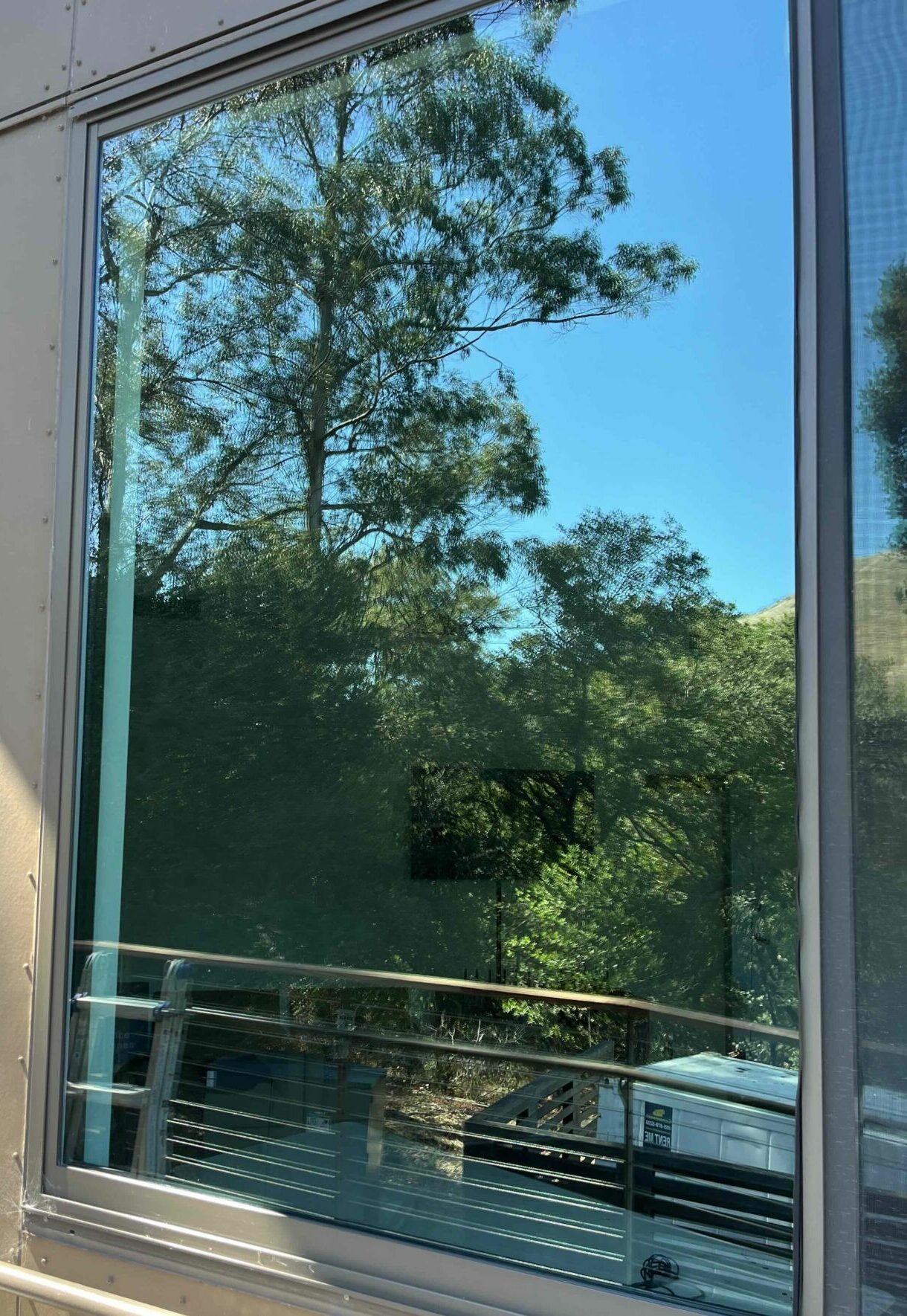
Birds don’t perceive glass as a solid object. They see the reflection of the sky, trees, or vegetation, think they’re real (a literal object), and fly towards the glass. But instead of reaching their destination, the bird strikes the glass.
Transparency
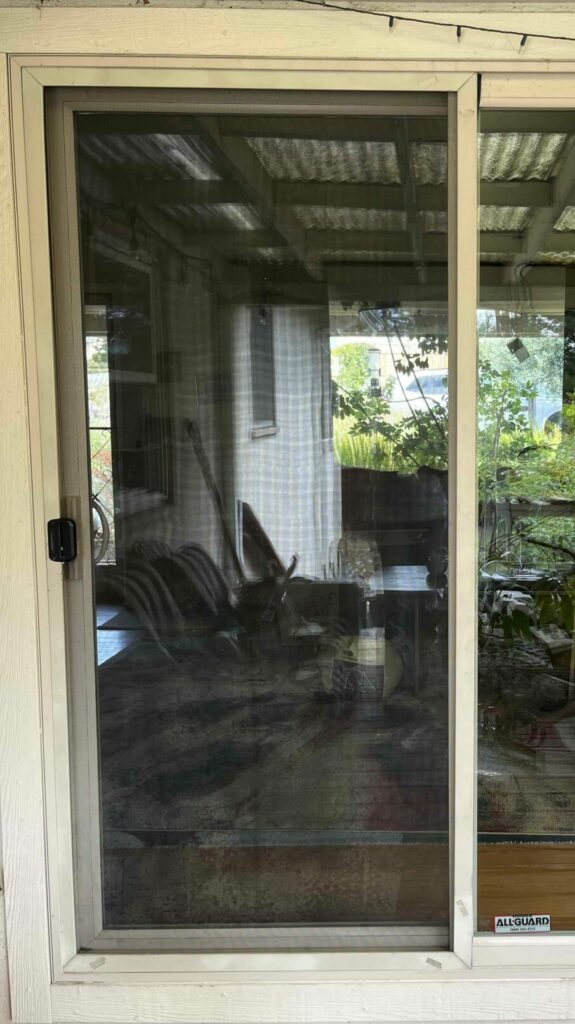
Birds see through the glass – to habitat, open space, or even into a room. They perceive the flight path as unobstructed [a safe corridor/an open flight path/a flyable pathway], and fly towards their destination. But instead of reaching it, the bird strikes the glass.
No. Low-rise and mid-story buildings are the biggest threats, with almost 99% of all collisions happening at lower elevations. In fact Residences (like many homes, 1 to 3 stories) account for 44% of collisions. That’s almost half! High-rises are associated with just 1% of all collisions.
“The majority of bird-window collisions happen at apartment buildings,
office buildings, and residential houses.”
While skyscrapers aren’t the biggest source of collisions, they are typically more illuminated at night and play an outsized role in contributing to the problem of artificial light at night (ALAN) and related bird mortality.
No. Sticking one or two decals on a window – even if they’re larger “hawks” – is usually ineffective because too much glass remains untreated. The bird simply flies between the decals, striking the glass instead. To be effective, markers must be spaced no more than 2-inches apart (hung paracording can be spaced 4-inches apart). In addition, decals are often applied to the interior side of the glass. This may be easier, but putting them on the inside makes them ineffective as they won’t break up dangerous mirror-like reflections on the outside side of the glass.
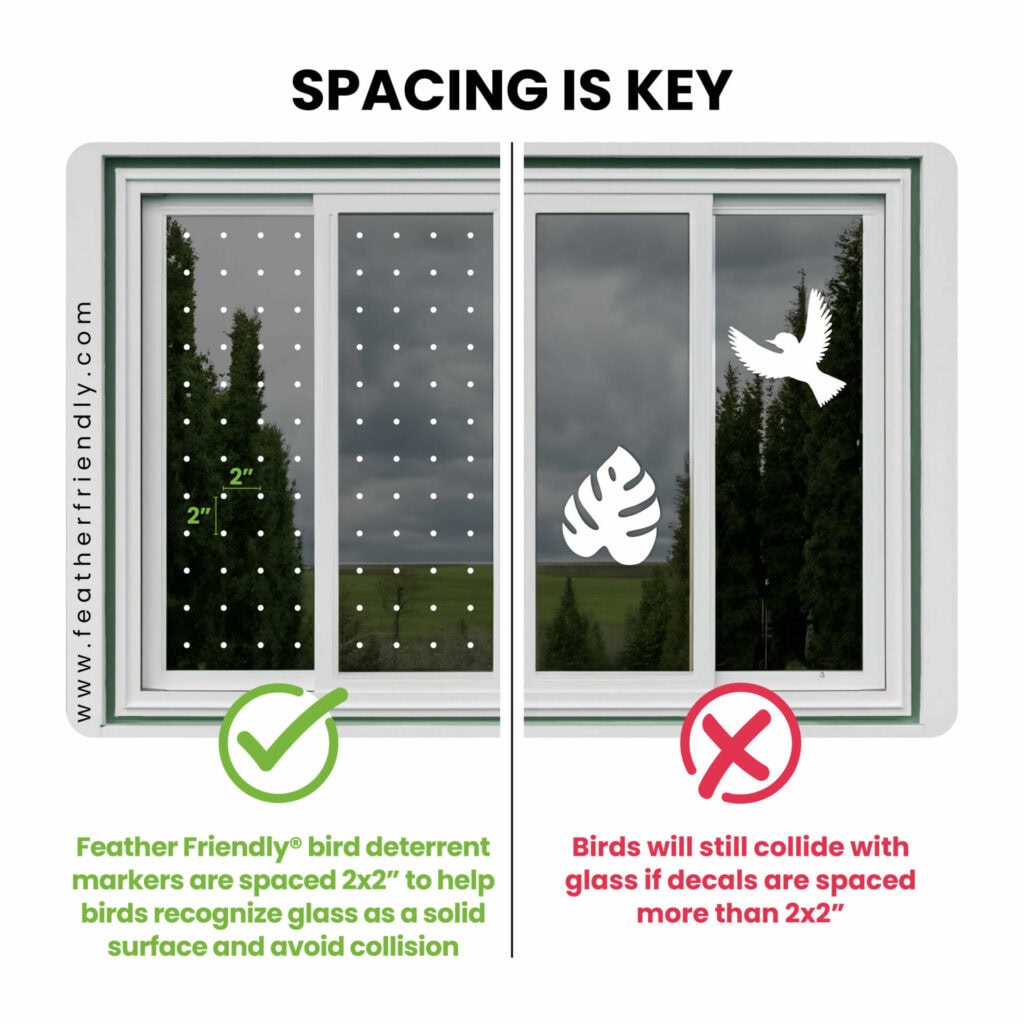
Bird-friendly treatments are very effective and can prevent more than 95% of collisions. The American Bird Conservancy has tested hundreds of bird-friendly treatments, creating an online database of products. For each treatment tested a “Threat Factor” (TF) is included. The TF is like golf – the lower the score, the better. Only those with a TF of 30 or lower are recommended (as a TF of 30 prevents half of collisions). To learn more about how products are tested for their effectiveness, see this ABC webpage or watch this short video. For a summary of some of our favorite products, see the Table of Recommended Bird-Safe Treatments (above).
Ideally, all glass up to the height of mature trees is made bird-friendly. That’s where dangerous reflections of vegetation and sky can lure birds in. If that is not possible, work your way down the following bullet list, from highest to lowest risk:
- Glass that has caused known collisions
- Glass near areas that attract birds (e.g. bird feeders, water features, gardens, trees and shrubs)
- Glass that creates a “passage effect” to trees or other habitat (transparent or reflective)
- Glass at the end of rock walls, outcrops, or other “funnel” shaped landscape features
- Glass in a courtyard
Source: Stop Bird Collisions
Remember, all bird-friendly treatments should be applied to the exterior side of the glass, meeting the 2-inch spacing rule (or, 4-inch for cording).
Renters may want to use bird-friendly treatments that are easiest to remove. Two good options might be DRAWINGS or ACOPIAN BIRDSAVERS (attached with removable 3M CommandTM hooks).
Drawings
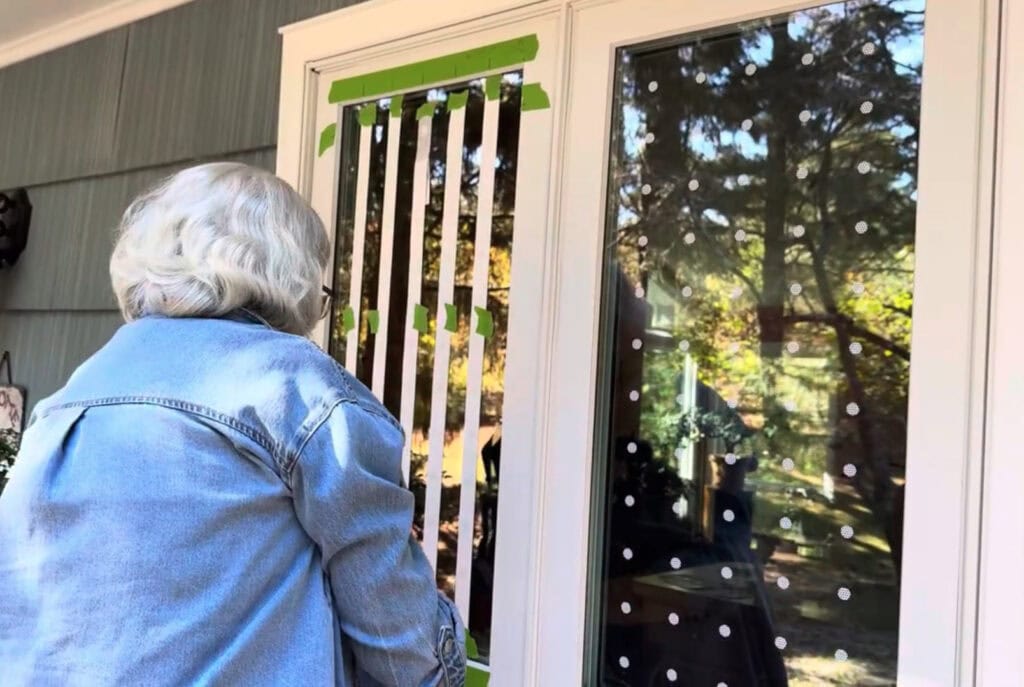
Use paint pens, tempera paint or even soap to create an “artistic” drawing or draw “dots” or other repeating patterns.
Artistic drawings. There are many examples of drawings on glass to protect birds, including this one which is easy and affordable, featuring vines and chickadees. Of course, any pattern is possible – geometric, spider webs, space ships, floral, dinosaurs, to name a few. One option – find a simple pattern you like online, print several copies, cut each one out, tape to inside of glass, then go outside and trace the pattern. Remember to ensure that the completed drawing adheres to the “2 by 2-inch” spacing rule (no area bigger than 2”x2” left unmarked). Filling in with small embellishments can be very helpful.
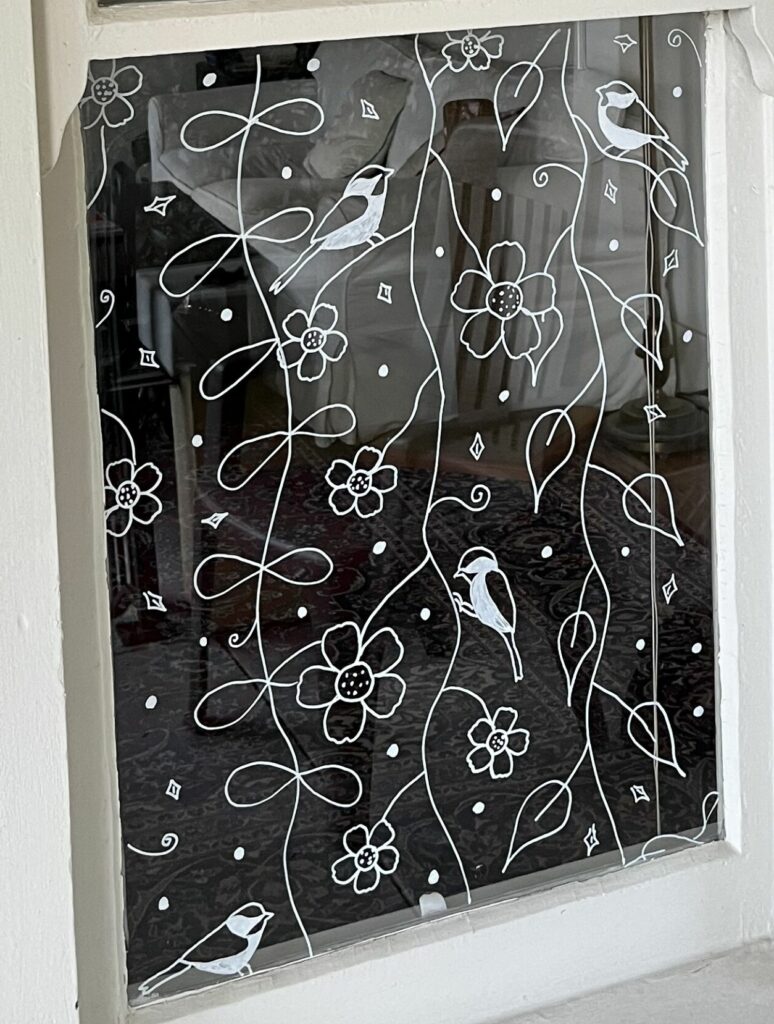
Photo: Erin Diehm
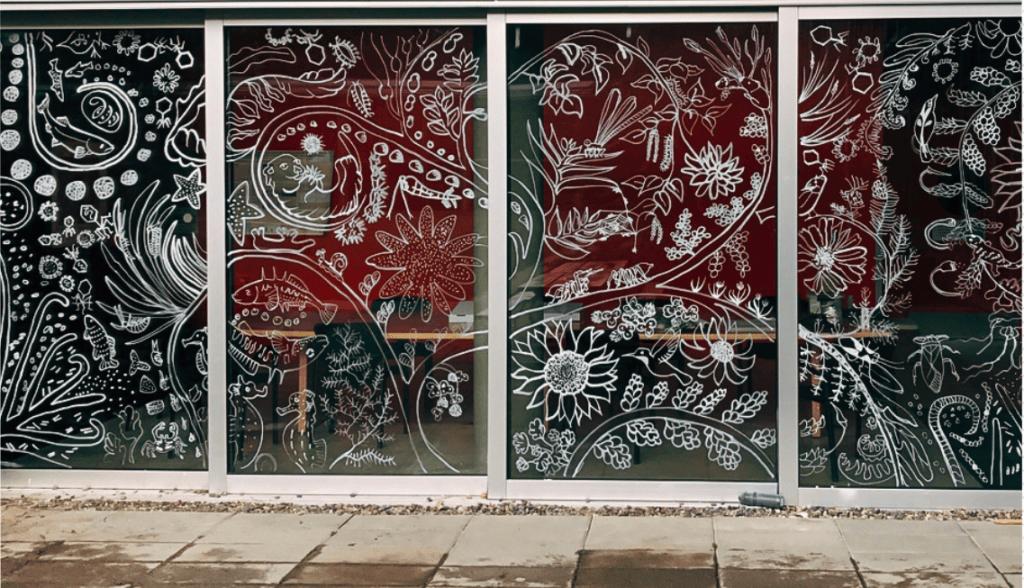
From Bird Friendly Design Guidelines for Buildings, University of British Columbia
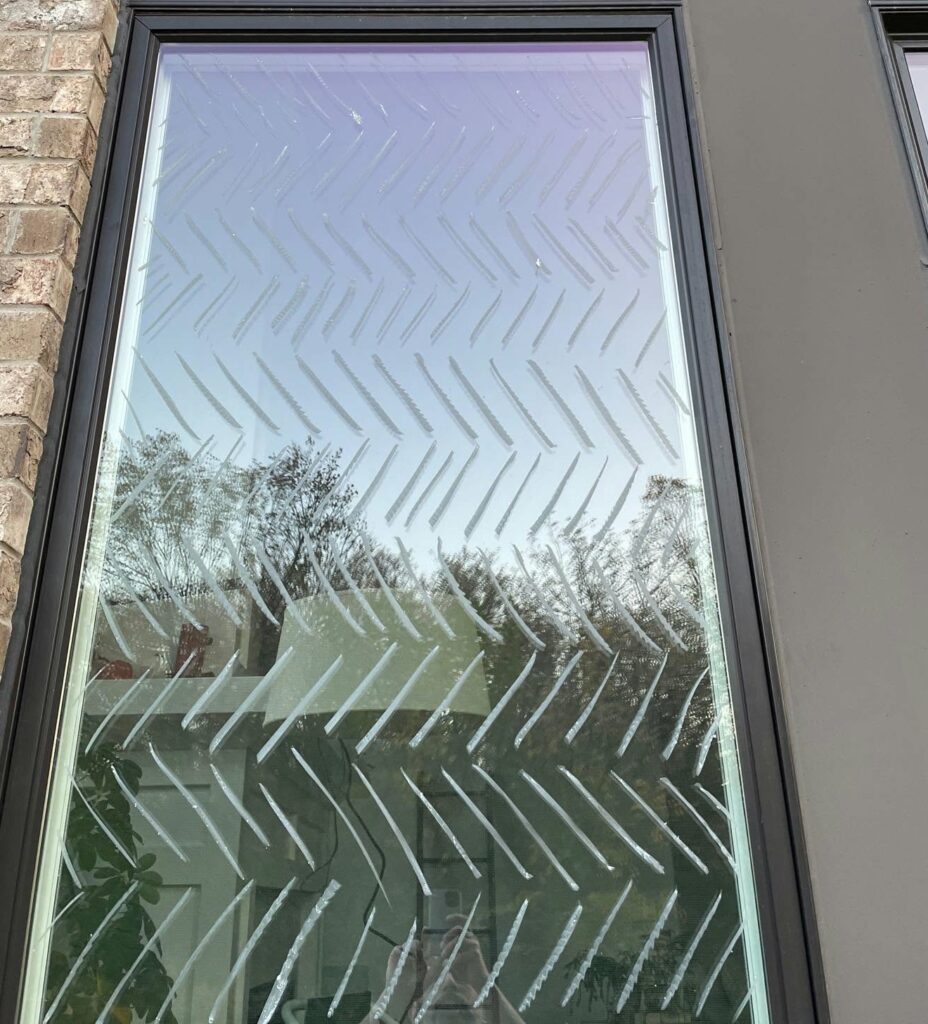
From Facebook post by Randy Tashjia
Dots or Other Patterns. Can be drawn free-hand or using a template (homemade or purchased, pictured below). Of course, any other geometric patterns could be drawn, like lines drawn on at 2” spacing.
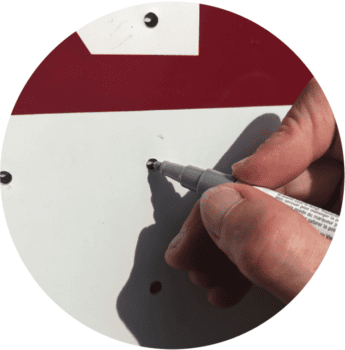
From “DIY Collisions Deterrents“,
Cornell Lab of Ornithology
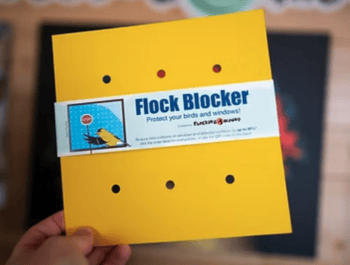
From Flock Blocker.
When it’s time to move, if needed, simply use nail polish remover to wipe away the drawing, being careful that the remover touches only the glass and not surrounding paint or surfaces.
Acopian BirdSaver blinds
Paracording spaced at 4” apart. To facilitate removal when it’s time to move out, use removable adhesive mounts like 3M CommandTM Outdoor Hook and Clips. There are many ways to mount the cording. See below for three examples.
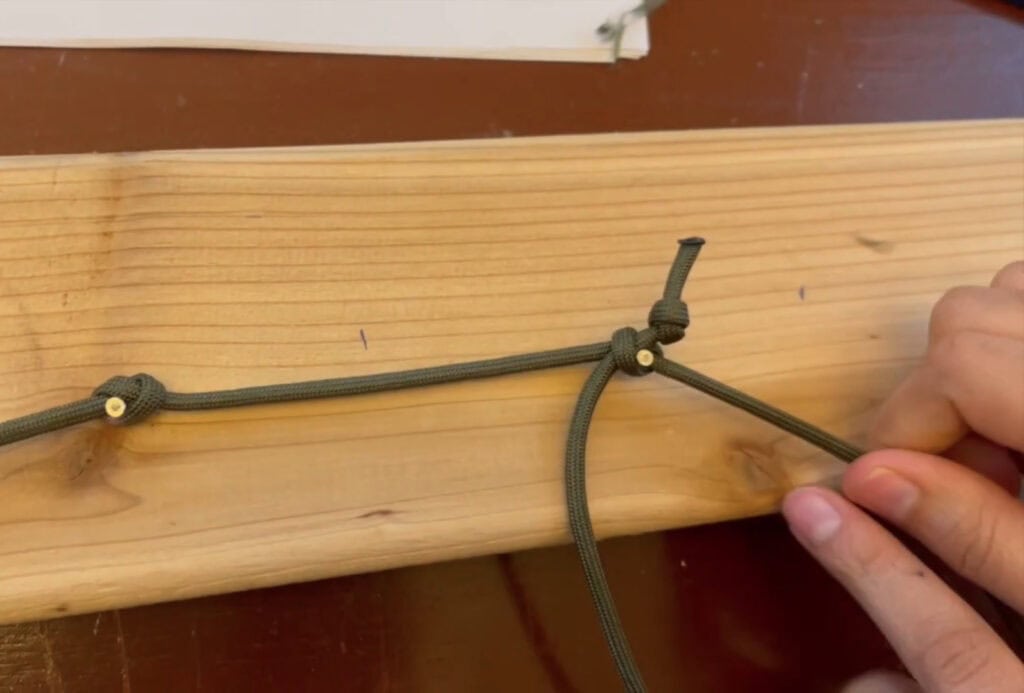
Header from Garden Stake. Some bird advocates create a header out of a garden stake, tie paracording to the stake at 4-inch intervals and then hang the stake on two Command hooks mounted to the outside of the glass on the left and right sides. Mounting the Command hooks directly to the glass ensures window frames aren’t damaged when they’re removed sometime in the future.
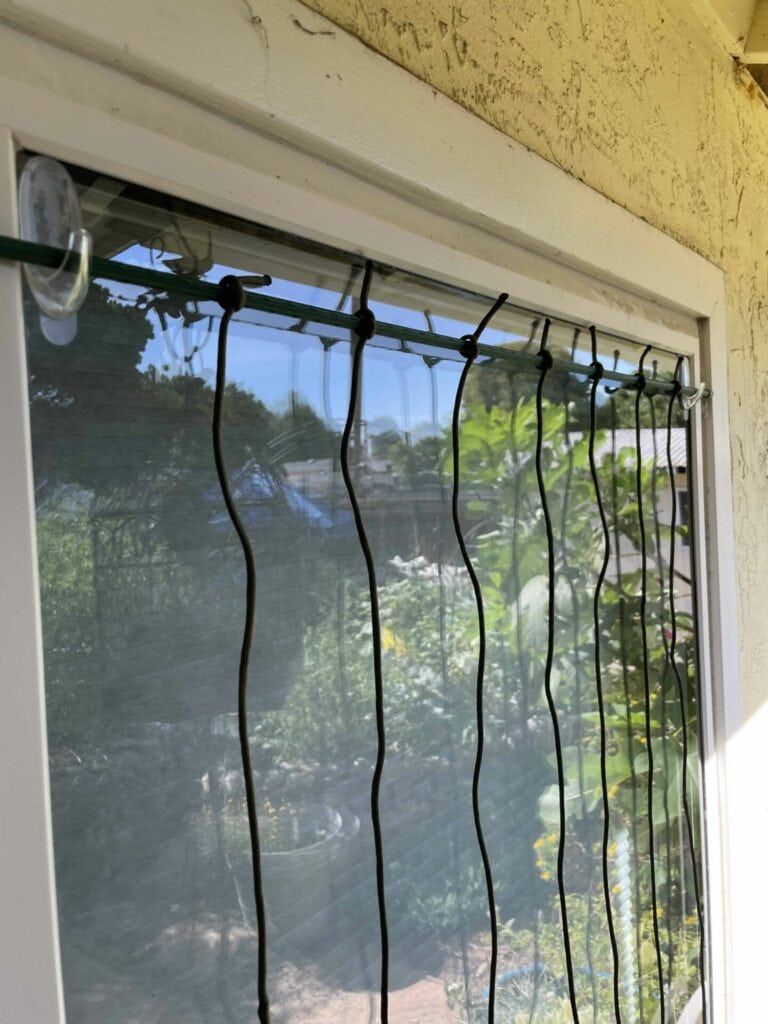
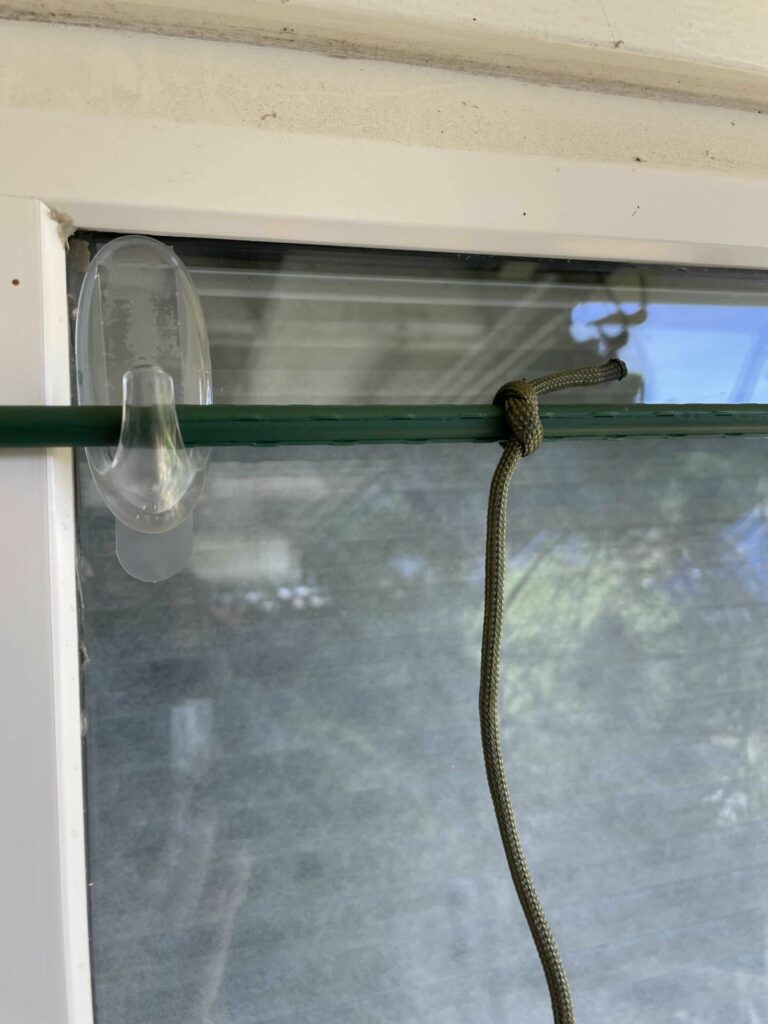
Header from Cording. Instead of a garden stake, some make the header from cording, and then attach the top cord to the window with adhesive clips. While the photos below show the clips attached to the window frame, for renters, it’s suggested to attach them directly to the glass, to ensure frames and paint aren’t affected when the clips are removed.
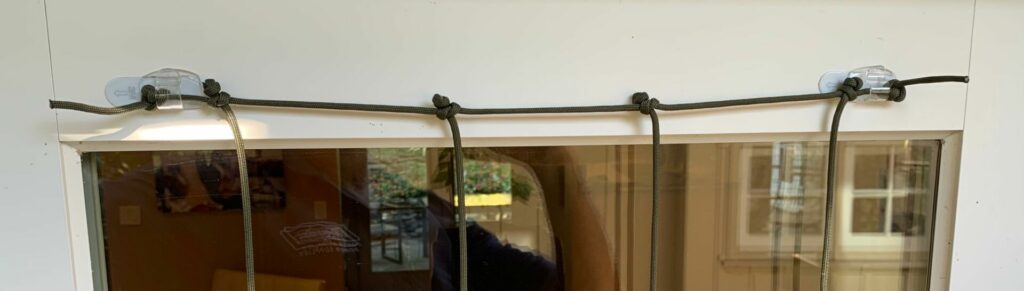
(Step 5 in “How to make “All Paracord” Acopian BirdSavers; using paracord for the top horizontal piece, as well as for the vertical pieces.“)
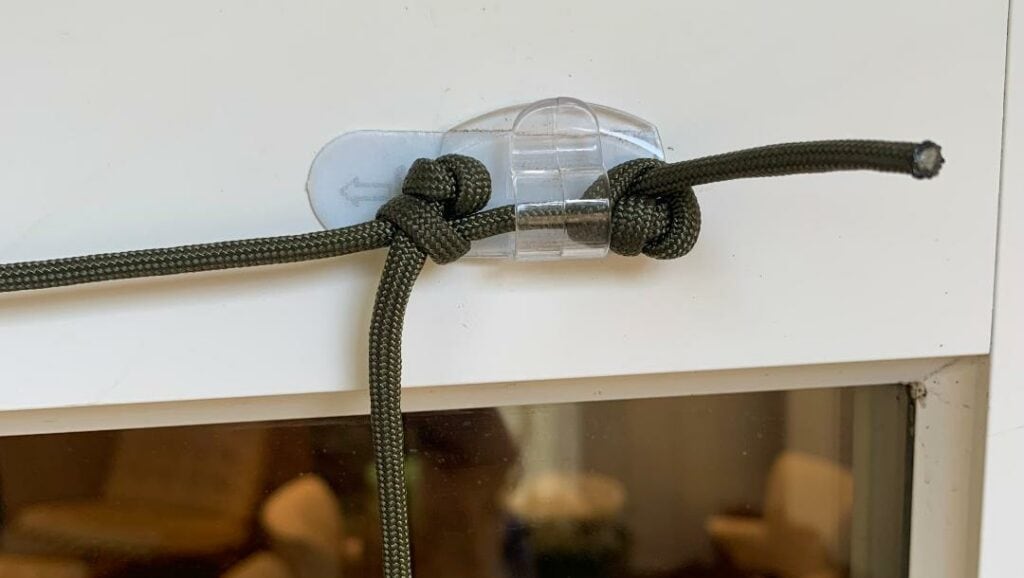
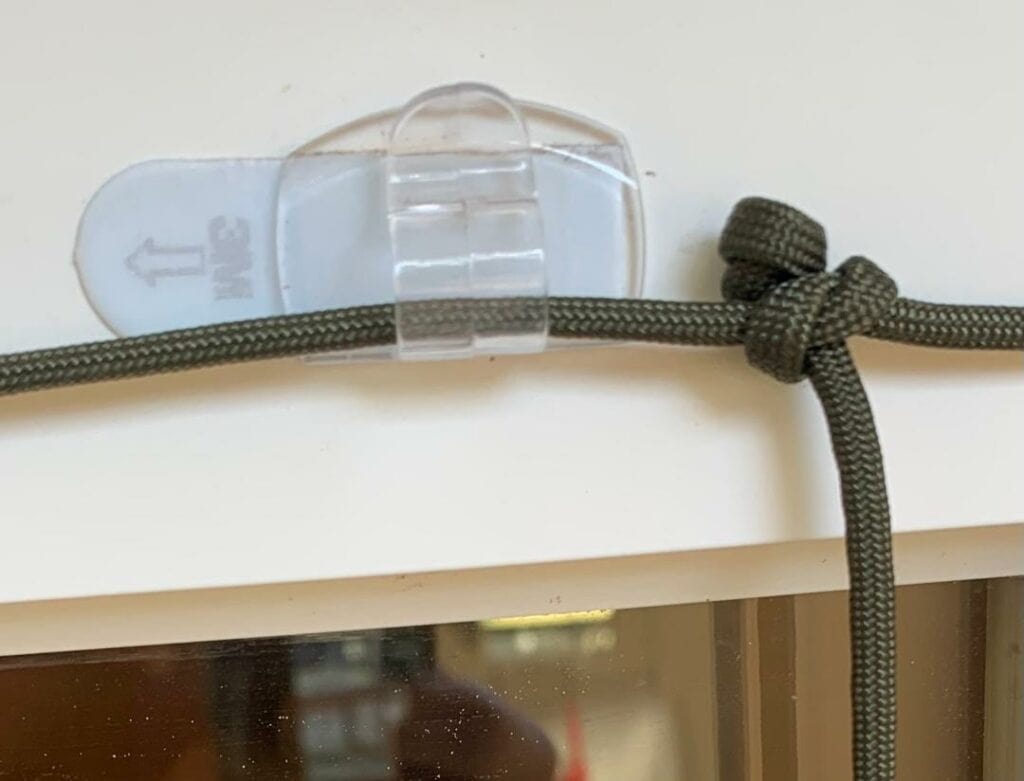
No Header, just Clips. Others avoid a header altogether by attaching 3M CommandTM Outdoor Light Clips (Model #17017CLR-AWES) hooks across the top of the window frame, spaced 4-inches apart, and then tying a separate cord to each hook. The photos below show the clips affixed to the window frame; but to avoid the possibility of damaging the frame when removing the hooks, each clip can be applied directly to the glass.
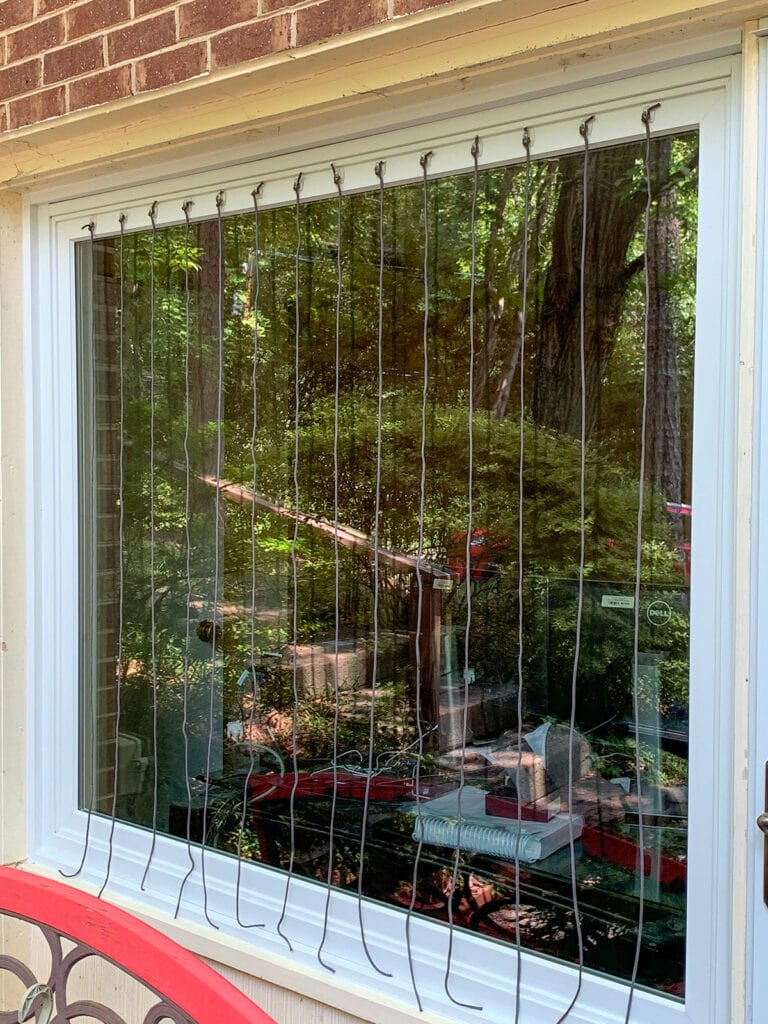
(from “Other BirdSavers Examples” on “Our Habitat Garden“)
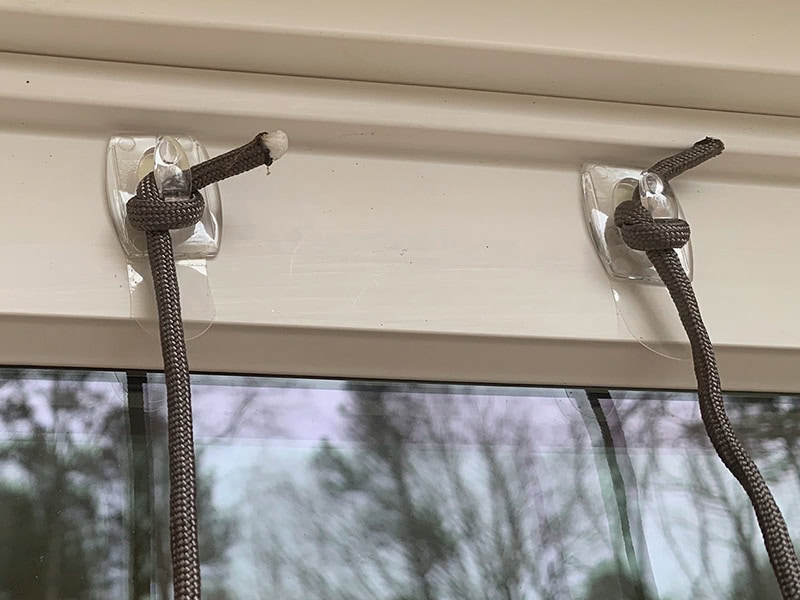
(from “Other BirdSavers Examples” on “Our Habitat Garden“)
Yes. Bird feeders and other attractants like bird baths can greatly increase the likelihood of bird strikes. In fact, where glass hasn’t been treated to deter collisions, “Homes with bird feeders have almost twice the number of window collisions as homes without bird feeders.” (“January 29, 2025: Backyard Birds Bird-Window Collisions“, U.S. Fish & Wildlife Service)
What to do? The first recommendation is to treat windows to be visible to birds, especially those facing a bird feeder, bird bath or vegetation. In addition, move the bird feeders, bird baths or other attractant to within 3-feet of the building (so birds won’t have time to build up to lethal speeds).
For additional tips on maintaining bird feeders, click here (from the American Bird Conservancy).
Yes. Guidelines are usually found on a product’s FAQs webpage. As quick reference, here are brief guidelines for three treatments:
- DIY Drawings. Depends on the type. Markings made with soap or tempera paints are temporary and will probably wash off with the first cleaning (or even rain). Drawings made with acrylic- or oil-based pens will last longer and withstand cleaning, but we haven’t yet found any clear guidelines on this topic. In general, to protect the drawing it’s best to avoid abrasives (like scouring pads). Instead, use soft tools (like a microfiber cloth, sponge), mild solutions (like mild dish soap or a non-ammonia glass cleaner), and apply light pressure when cleaning.
- Cording. (e.g. BirdSavers or Acopian Blinds) – Acopian blinds are perhaps the most straightforward to clean. If the cording is attached ONLY at the top, simply hold the paracording away from or to the side of the glass. If the cording is attached at top AND the bottom of the window, avoid a side-to-side motion and, instead, move cleaning tools top-to-bottom. Alternatively, depending on how the cords are mounted, it may be possible to remove them completely and then reinstall. (e.g. If the blinds are mounted with a J-channel, simply pull each cord up and out of the drilled holes and reinstall later.) .
- Adhesive treatments, like Feather Friendly or CollidEscape – can withstand washing for many years. See the manufacturers webpage for the latest guidelines, e.g.
- From Feather Friendly, “After the installation, allow the adhesive to set for 30 days before cleaning. You can then clean with a soft cloth, paper towels, or rubber squeegee, along with typical cleaning products for glass, including soap and water and glass cleaners like Windex. However, we recommend against using pressure washers or abrasive cleaners.” (April 2026)
- From CollidEscape, “Most CollidEscape Applications require nothing more than the occasional hose rinse… [however] There are no performance issues with regularly scheduled window washing services…. [if using a pressure washer, low-pressure hosing]… use of 40 to 60 degree pressure washer nozzle to minimize likelihood of lifting CollidEscape off the glass.” (April 2026)
It depends. Some are short-lived, lasting a few weeks (or until it rains) while others, like commercially available adhesive markers, are guaranteed for a decade or longer.
- Drawings (soap & tempera paints) – The shortest-lived. Depending on rain and weather exposure, because they’re drawn with soap or water-based paint, depending on weather, they could last several weeks to months.
- Drawings (oil-based marker) – Drawing made with oil-based paint or markers c an last years, depending on exposure to the elements. If drawings start to show signs of wear, one easy solution is to buy a new markers and make strategic touch-ups.
- CollidEscape – guaranteed for 10 years but can last much longer. In fact, some installations dating back to the 1990s are still in place.
- Feather Friendly – from 8 to 20+ years, varies by type:
- 8+ years for Small-scale DIY
- 12+ years for Medium-scale Pro DIY
- 15+ years for Large-scale Pro
- 20+ years for Large-format Evolution
- Acopian BirdSavers – Varies by installation, especially how the cording is mounted. If screws or other permanent hardware is used, the installation will likely last decades. If adhesive mounts are used (velcro, Command strips), the duration is hard to predict but likely shorter (but also easy to refresh)
Together we can make a difference! Here are a few ways to help:
- Treat your own windows. If treating all of them at once isn’t realistic, start with the most dangerous ones and then apply treatments to additional windows incrementally.
- Talk with friends, neighbors, anyone who’ll listen. Spread the word about bird-glass collisions and especially how easy it is to prevent them.
- Help friends and neighbors treat their windows. Organize work parties to help each other apply treatments – learn together!
- Advocate at work and apartment buildings. If your workplace has an Office of Sustainability, try starting with them. (See the NYC Bird Alliance webpage for helpful suggestions.)
- Advocate with your city to pass legislation for bird-friendly buildings. Even better, include requirements for reducing disruptive artificial light at night. If your city doesn’t have bird-friendly legislation, attend a meeting and ask elected officials to invest in birds. Contact your elected representative(s) to share your interest in protecting birds. (Electeds usually pay attention to their constituents.) Contact your local birding groups and ask for support.
The first place to check is the American Bird Conservancy (ABC), which maintains a database of current legislation, ordinances and codes in the U.S. to prevent window collisions. If your city has adopted bird-safe protections, and they’re mandatory or incentivized, it will probably be listed there. (Because voluntary guidelines tend not to be followed, only mandatory and incentivized guidelines are included.)
Note that the ABC database is broken down into three groups: “Recommended”, “Recommended with Reservations”, and “Not Recommended”. When glancing through the list, it might be useful to review legislation under “Recommended” and “Recommended with Reservations”, to see what specific guidelines are the most effective and which could be improved upon.
If you learn that your city doesn’t have any bird-friendly requirements, now is the perfect time to advocate for them! Contact local elected officials, city departments and local environmental and bird groups to express your support for bird-friendly legislation. To help you get started, the ABC has a webpage on Bird-friendly Legislation & Code. It’s written to help communities successfully advocate for and pass bird-friendly building codes and laws. It even includes a Model Ordinance, which can be downloaded and edited.
Any bird that has collided with glass should be taken to a professional wildlife rehabilitation center. Even if the bird appears fine it still needs professional care.
Why a rehabber? Birds strike glass at speeds of up to 30 miles an hour, often leaving them with concussions. Others have pelvic injuries broken bones, and internal bleeding. Anti-inflammatories and professional care are usually needed, including time to recover. A lay person simply isn’t equipped to diagnose and treat collision injuries. Without receiving professional care, most birds that collide with glass will to their injuries days later and not survive.
What NOT to do
- Do not feed or give the bird water. Giving it food or water could cause the bird to aspirate, a potentially deadly condition.
- Do not excessively handle or engage with the bird. Avoid petting or touching it. Minimize voices. While these behaviors may calm our pets, they are stressful to birds and most other wild animals.
- Do not release it.
What to do
Adapted from the NYC Bird Alliance webpage:
- If there’s time, put on gloves or wash your hands
- Approach the bird slowly and quietly – ideally from behind, to avoid startling it. “Do not talk to the bird as you approach it. Wild birds are frightened of humans and could fly back into the glass or into traffic.”
- “Gently but firmly grab the bird by putting one or two hands over its wings. You can also carefully throw a lightweight towel, cloth, or jacket over the bird and scoop it up with the towel.”
- Put the bird in a small paper bag, small cloth sack, or small shoebox. Containers should be ventilated. Close the bag or container (e,g, with a binder clip) to prevent the bird from escaping later. A small space protects the bird from excessive activity which could cause further injury. Lining the container isn’t necessary. However, if lining is added, avoid strings and cloth with loops (like a terry cloth towel), which could entangle the bird’s legs and feet. Instead, any lining should be smooth, like newspaper, a paper towel, a cotton pillowcase or T-shirt (again, be sure to avoid any strings or threads).
- Finally, wash your hands and call a professional wildlife rehabilitation center. In the San Francisco Bay Area, local rehabbers include the Lindsay Wildlife Experience (Walnut Creek), Wild Care (Santa Rafael) and Yggdrasil Urban Wildlife Rescue (San Francisco), Peninsula Humane Society & SPCA (South Bay/Peninsula), For additional resources, see the Human Society’s helpful list of rehabbers.
- If you’re not able to transport the bird immediately, put the bag or box in a quiet dark place (like a closet) until you can. Do not try to feed or give it any water or food.
Report It
If the bird is deceased, due to collision or any cause, contribute to citizen science and report it at dbird.org:
Apply Bird-Safe Treatments
To prevent future collisions, make a plan to apply treatments to glass as soon as possible following the guidelines above: 2-inch spacing (or 4-inches for cording) and on exterior surface of glass. If you know which window the bird struck, prioritize treating that glass first.
If you found a deceased bird, due to collision or any cause, contribute to citizen science and report it at dbird.org:
- Turn lights out. Turn off outdoor lights (or put them on motion detectors), especially between 11pm and 6am during migration season.
- In addition, replace outdoor light bulbs with ones that emit warmer colors, yellow to red. Look for bulbs labeled as “warm” (not “cool”), with a temperature rating of 2000 to 2700 Kelvin (K). Warmer colored light is more similar to natural fire or sunlight, which reduces glare, is less disruptive to wildlife, and easier on our eyes. Lower-spectrum bulbs are affordable and available as LEDs.
- Close blinds and curtains at night. Close window shades and curtains at night, to keep interior light from spilling outside, especially between 11pm and 6am during migration season
- Move bird feeders and bird baths closer. Feeders and baths should be within 3 (three) feet of homes and windows. From this closer distance, birds won’t have time to build up high speed in the event they strike the glass.
- Move houseplants away from windows. Birds can mistake houseplants as open-air habitat or a place to land. Move them at least 6-feet away from the window so they’re not visible to birds from the outside.
Feedback or questions? Please email us at birdsafe@goldengatebirds.org
MORE Coming soon… this nest is being built
Bird-Safe Buildings advance in Berkeley, Emeryville
By Ilana DeBare The cities of Berkeley and Emeryville took major steps last month towards enacting…