
SF Christmas Bird Count 2026
On a rainy December 26th, in the year 1915, three hardy birders conducted the very first Christmas Bird Count in San Francisco. By the end of the day, they tallied 35 species and 2,472 birds. The five most common species were: American Coot, White-crowned Sparrows, Mallards, California Quail and Seaside Sparrows.
Fast forward 110 years and 82 counts later to December 29, 2025. California Quail have been extirpated from San Francisco, the Seaside Sparrow is now the Song Sparrow and a record number of birders (214) collectively observed and counted 94,315 birds – the second highest total ever.
Boosted by a sunny day, access to normally off-limit golf courses, enthusiastic birders, and a training workshop for birders new to the count, the annual tally jumped by 37,000 birds over 2024’s total of 57,330. A boat generously provided by San Francisco Bay Keeper also helped maximize effectiveness. Collectively, participants found a total of 183 species – two short of the all-time record for the Count, with the Count Week total reaching 185.
Rare Species
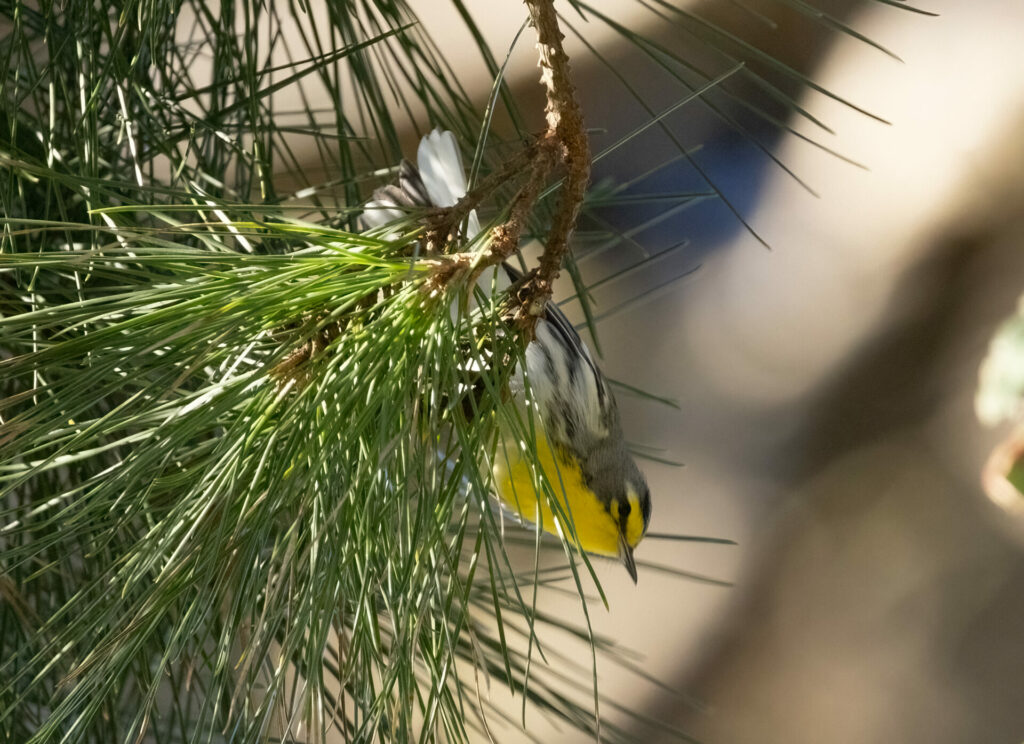
While we didn’t add any new species to the Count in 2025, there were several rare species found. A Grace’s Warbler returned for its second winter (first sighting was last year), and a MacGillivray’s Warbler, last spotted in 1995, was seen for only the second time. A Rufous-crowned Sparrow, with the only prior sightings being in 1983 and 1987, was voted Best Species of the Year at the Count dinner at the end of the day. A Magnolia Warbler, last found in 2004 and 2021, was also a third sighting.
All of the expected species were found on Count Day, along with 37 rare or uncommon species. We found two Black-and-white Warblers, three Tennessee Warblers, three Wilson’s Warblers and three Bullock’s Orioles (tying a record for each species).
The Bright Spots
Several species showed dramatic increases from last year – Common Murres went from 3 to 7,785; Northern Pintails from 0 to 412; Band-tailed Pigeons from 5 to 5,368; and American Robins from 698 to 4,171.
We set all-time records for a number of species, including: Great Blue Heron (59), White-throated Swift (25), Nuttall’s Woodpeckers (137), Steller’s Jays (174), Bewick’s Wren (152), and Orange-crowned Warbler (109).
Raptors are generally doing well. We set all-time Count records for Great Horned Owl (34), Bald Eagle (7), and Red-tailed Hawk (269). On the other hand, Peregrine Falcon dropped this year, and American Kestrel numbers are at about half of historic levels.
If you are noticing more American Crows lately it’s because they are multiplying rapidly, due to the food we provide (they are good scavengers). In 1984, only 5 Crows were counted on the Count – this year we reached an all-time high of 3,260.
Another species thriving due to human activity is the American Robin – their numbers have steadily increased to a record high of 4,171. Our lawns provide earthworms in the summer and cultivated areas (particularly trees with berries) provide good food for them in the fall and winter.
Even though Band-tailed Pigeons are not normally seen in large numbers most of the year in San Francisco, this year there were a record 5,368 passing over during the Count.
Jays continue their expansion in the City. Prior to 1996, California Scrub Jays were essentially absent from San Francisco, and Steller’s Jays were here in single digit numbers. This year we hit an all time high of 174 Steller’s Jays, and there were 274 Scrub Jays (about the same as average for the past decade).
Prior to 1992, Nuttall’s Woodpeckers were not found in San Francisco, with a handful showing up in the 1990s. This year we had a record 137. There is some evidence that the Nuttall’s may be displacing Downy Woodpeckers, with the number of Downy’s dropping from 52 last year to 31 this year.
Waterbird numbers have continued to be variable. While the number of grebes and cormorants are down, loon numbers remain robust, matching both recent and long-term levels. The Red-throated Loon was the most common bird species on the Count, at 9,225. While the overall number is small, 55 Common Loons set a new record. Common Murre numbers, at 7,785, also hit a new record. Gull numbers are relatively consistent, with Western Gull numbers approaching an all-time high. California Gulls, on the other hand, dropped to 1,554 from 3,327 last year.
The most widespread species this year was the Yellow-rumped Warbler, reported on 251 of the 337 checklists submitted, while Anna’s Hummingbird dropped to second place with sightings on 242 checklists.
Troubling Tallies
While relatively stable over the past decade, the number of ducks and geese have declined dramatically from historic levels. In 1986, more than 23,000 were counted – but by this year that number had dropped to 6,018. We missed Wood Duck, Eurasian Wigeon, Cinnamon Teal and White-winged Scoter. Despite the overall decline, a few species hit new record highs – Greater White-fronted Goose (44), Cackling Goose (107), Snow Goose (3), and Redhead (6).
Shorebird numbers continue to decline. We set an all-time low for Marbled Godwits with 7 (in 1986 there were 422). Sanderlings dropped from 2,430 last year to 1,190. Overall shorebird numbers are at half the level they were in the 1980s.
Sparrow numbers have also gone down dramatically in just the past few years. White-crowned Sparrow numbers declined from 4,583 in 2020 to 2,552 this year. Golden-crowned Sparrows dropped to 953 from 3,083 during the same time period.
Special Thanks
Many thanks to the Area Leaders – Jonah Benningfield, David Assmann, Josiah Clark, Keith Maley, Joachim Gonzales, Travis Smith, Lydia Bruno, Zac Denning, Whitney Grover, Adam Winer, Dominik Mosur, Maureen Lahiff, Bob Toleno, Juli Chamberlin, Siobhan Ruck, Crima Pogge, Noreen Weeden, Eddie Bartley, Cedric Duhalde and Liam Murphy. And special thanks to my co-compilers, Anna Sojourner, Patrick Meeker and Keith Maley for putting in many hours behind the scenes working on the Count. Thanks also to San Francisco Bay Keeper for once again providing a boat free of charge, and to the Golden Gate Bird Alliance for sponsoring the Count and handling all the logistics for the Count Dinner. And, of course, thanks to all the counters – we couldn’t have done it without you!
This year’s count will be on Monday December 28th, 2026.
David Assmann has been birding in San Francisco for more than 20 years, and leads monthly birding field trips at Fort Mason for the Golden Gate Bird Alliance and is a Compiler for the annual Christmas Bird Count for San Francisco. Prior to retiring in 2014, he was the Deputy Director of the San Francisco Department of the Environment.