• How Many Birds Can Be Found in the Bay Area in One Day?

    Originally published on June 15 in Bay Nature

    By Lia Keener and Mukta Patil

    Birders sometimes have competitions to see who can find the most bird species in a set amount of time. If you want to participate in one of these, a few things to know first: It is frenetic. It is competitive. Forget the leisurely walks through the woods; if you’re serious there isn’t even time for a lunch break.

    It is, however, a great time to watch birders watching birds, and to try to understand the appeal of a pursuit that delights and entrances people around the world. So when two teams decided on a 13-hour competition this spring to see which side of the Bay could find the most birds, the debut Golden Gate Bird Alliance Bay Birding Challenge, the two of us tagged along.

    The leaders of the two teams, Alex Henry, Rachel Lawrence and Eric Schroeder of GGBA established ground rules in advance: teams could travel anywhere within their two assigned counties (San Francisco and San Mateo for the San Francisco team, and Contra Costa and Alameda for the East Bay team). Birds could be identified by sight or sound, but at least two people from the team had to see or hear them. The birding would begin at 6:14 a.m. exactly, 29 minutes before the sunrise, and end 13 hours later at 7:14 p.m.

    1. Beginnings

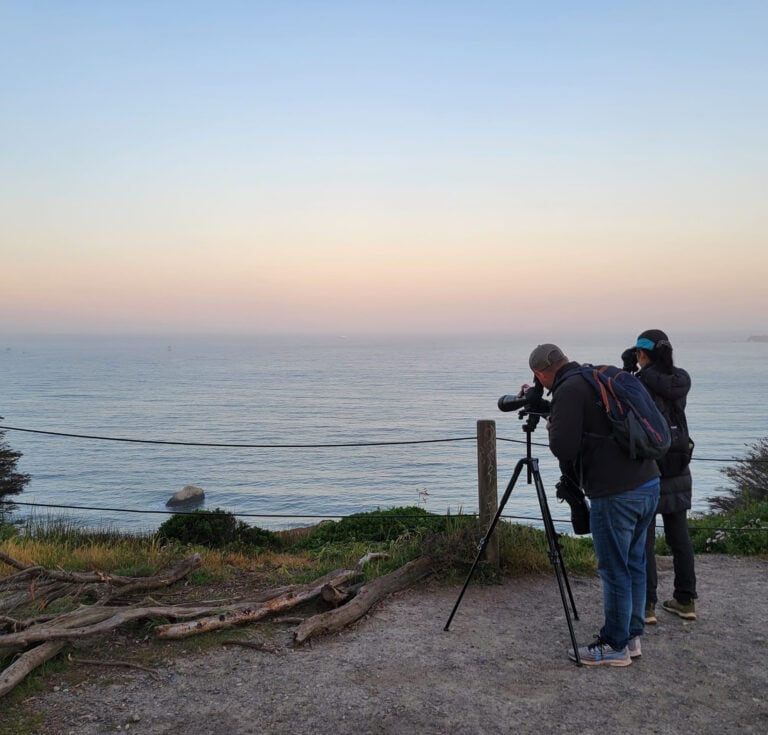
    Six fourteen a.m. rolls around without much fanfare in the mist at Lake Merced. It’s still dark at first light but bird identifications by sound fill the air around me: “ruddy duck,” “mallard,” “white-crowned sparrow.” As the sky lightens, gnats buzz below, and a double-breasted cormorant carrying nesting material flies above. San Francisco faces long odds in the competition – spring is a great time for birding in the East Bay – and the team starts here with the urgency of the underdog. “I don’t expect to win,” says San Francisco team leader Lawrence, “but I just don’t want to be embarrassed.”

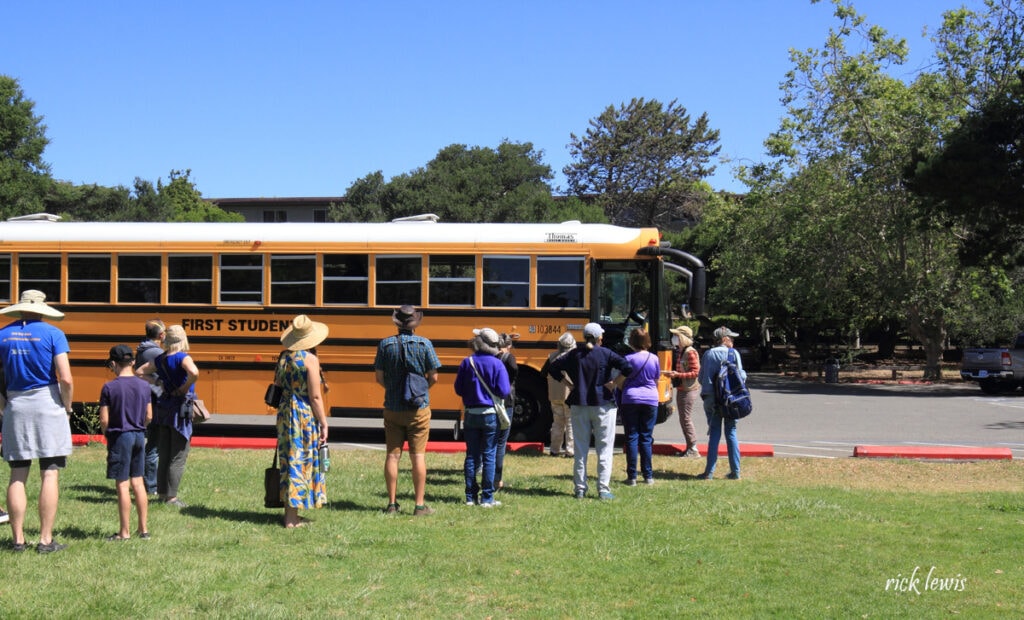
    After a 4 a.m. wakeup and a 40 minute drive from Berkeley, the East Bay team gathers in the darkness beneath Mount Diablo. It’s cold in Mitchell Canyon compared to Berkeley as the birders, decked out in hats, binoculars, walking sticks, spotting scopes, and hiking boots, materialize out of the darkness of the parking lot. The official start time marks an immediate end to our pre-dawn chatter.…

  • The Birds and The Beavers

    By Elizabeth Winstead

    I may not be the best birder since I’m not much of a morning person, but recently I woke up at an ungodly hour to drive to Fairfield for the dawn. I thought, “Who is this person who really doesn’t like to be cold, but is so captivated that she forgets she is shivering, and her hands are numb on a wind tunnel of a bridge despite a hat, gloves, and multiple layers, because she is waiting for, of all things, a baby rodent to appear?”

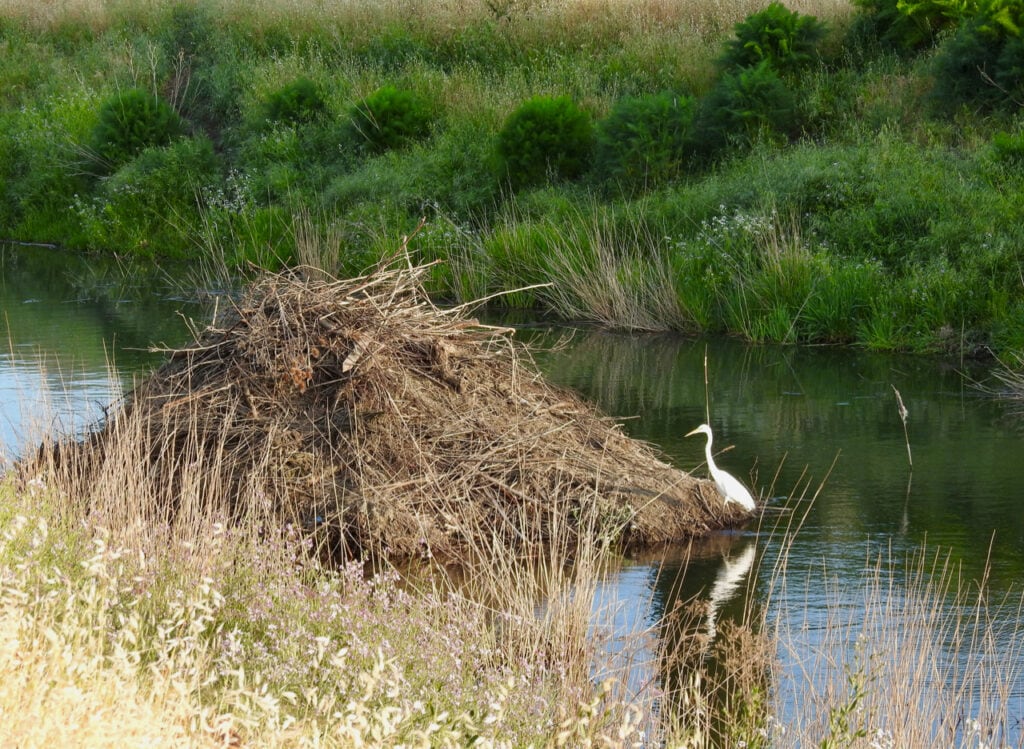
    Beaver Dam by Elizabeth Winstead

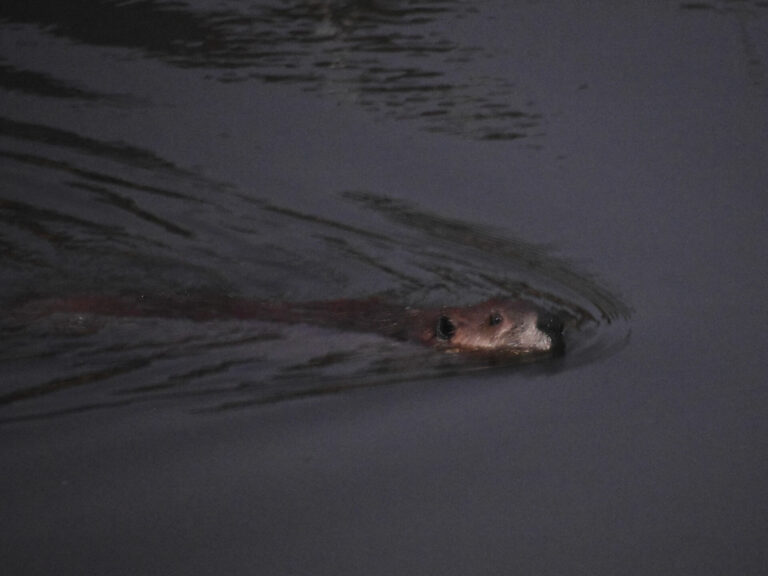
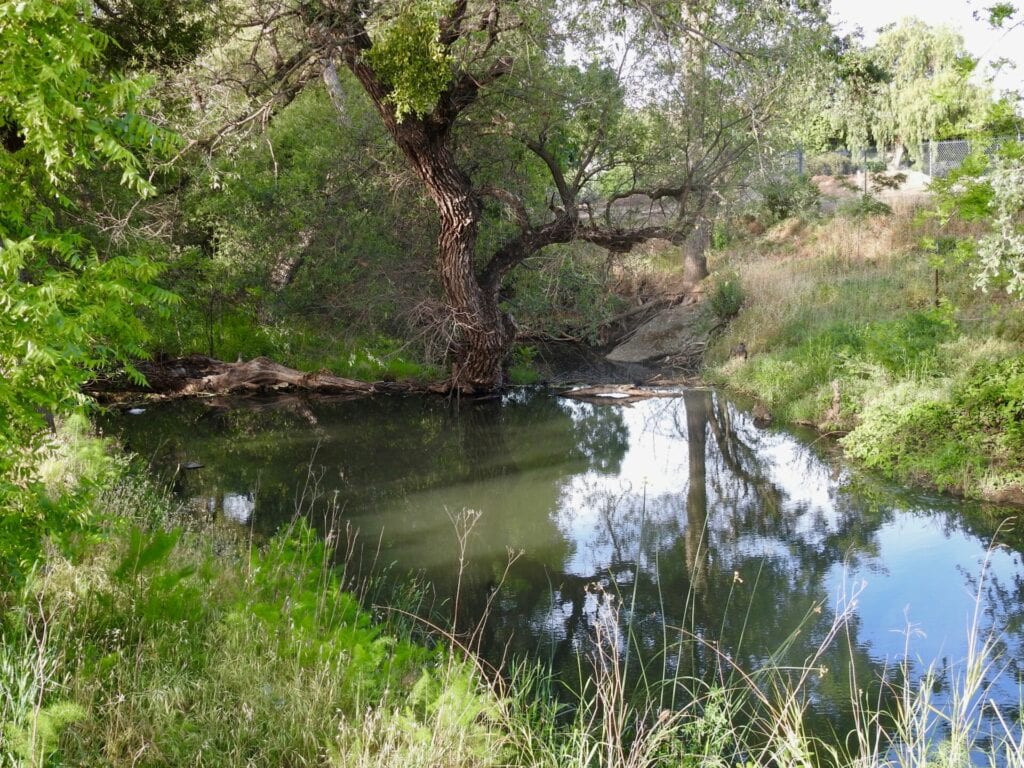
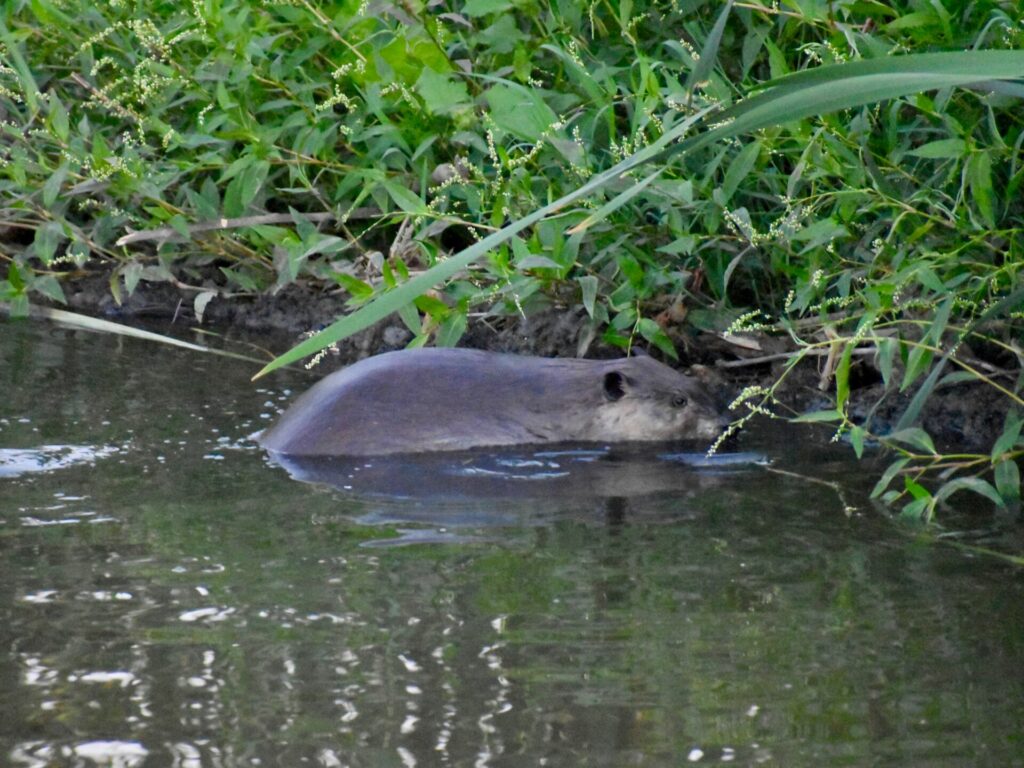
    The dawn slowly lit up the small creek below as I searched the water because I heard there was a beaver kit, and I’m a pushover for baby animals. Suddenly, a Green Heron erupted out of the marshy edges and flew across the creek and over a nearby house. Green Herons have declined by 68% (from 1966 to 2014) and can be elusive to find as they hide in vegetation. Who would’ve thought that you could find a family of beavers in the middle of a city on a human-channeled creek surrounded by houses on both sides, and that the beavers would be able to create enough habitat to attract waterbirds like Green Herons? Happily, I got to watch both an adult beaver and a kit swim in the creek. The kit seemed annoyed by a nearby mama Mallard and her five ducklings and slapped the water with a cute tiny whack.

    Beaver Lodge and Great Egret

    A love of nature led to a love of birding, which led me to notice a reference to the California Beaver Summit in a Golden Gate Bird Alliance email last year. Worrying about climate change, I was intrigued by their hook—what if one of the solutions to problems like drought and wildfires was simple, affordable, and nature-based? What if it involved an unlikely, plump rodent with buck teeth and a flat tail?

    Beaver at dam

    The two-day summit of virtual presentations on this keystone species included Dr. Emily Fairfax, who researches how beavers can engineer drought and fire-resistant landscapes, and Dr. Michael Pollack who studies how beavers create slow water habitat that is critical for salmon growth and survival. I was on my way to becoming a beaver believer.

    eBIRDing a Local Beaver Creek

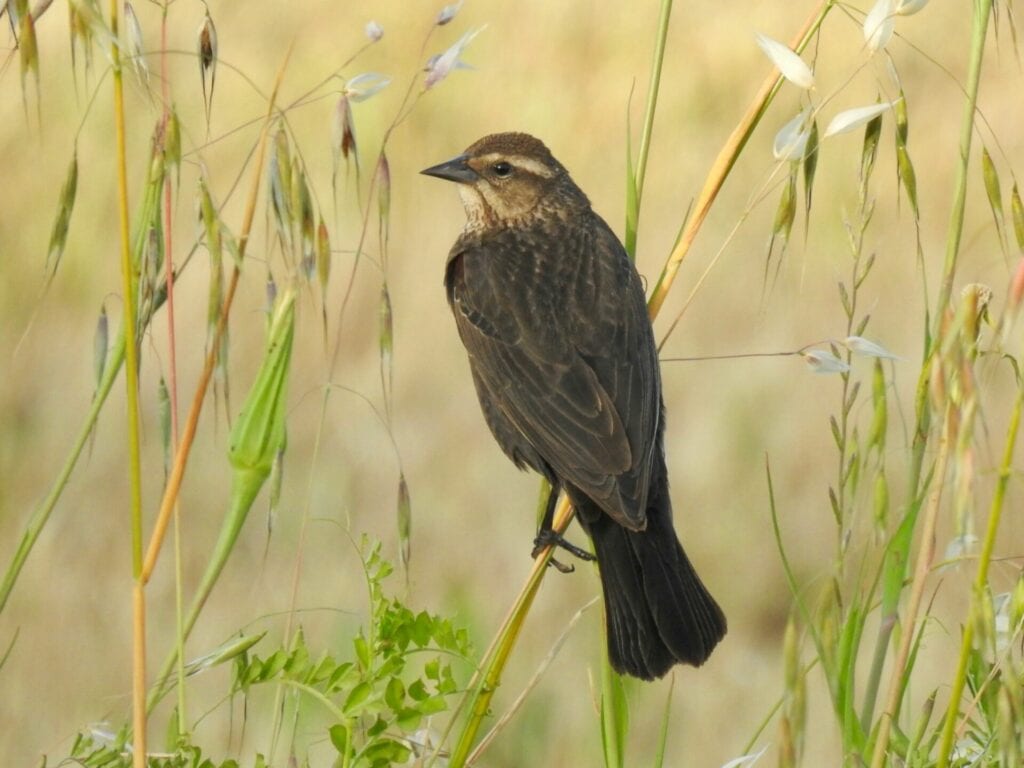
    Female Red-winged Blackbird

    Before the California Beaver Summit, I had never seen a wild beaver, so I got excited when they told me there were some in Fairfield and on the Napa River.…

  • Come for the Birds, Stay for the Chocolate

    By Ryan Nakano

    Lately, I’ve been wondering what I enjoy most about birding. As a novice, it’s hard to say that it has anything to do with generating a long list, chasing after a rare bird, or even really identifying different bird species by sight or sound. I think what I’m starting to realize is, I, myself am changing, am slowing down, allowing my senses to be open to the world in a way they weren’t before I started, and this ability to concentrate and focus my attention on one particular thing and be satisfied has brought me immense joy. 

    Before I joined Golden Gate Bird Alliance, I knew very little about birds, and if we’re being honest, I still have so much to learn. What I did know however, was that during my day-to-day I was slipping into a terrifying habit of curating my senses to a digital world. For example; anytime I would go out for a run, I would immediately cue up a playlist from Spotify and throw my bluetooth earbuds in before leaving my apartment. I never heard the dogs barking, cars passing, House Finches chirping from above, Mourning Doves singing in their low hum. When dishes piled up in the sink, my attention sought an endless Youtube algorithm as my hands tried to busy themselves with plates and soap. 

    At some point in time I had bought into the “attention economy” as it is referred to in the book How to Do Nothing by Jenny Odell, leaving me with a feeling of unresolved longing. I felt that somehow by maximizing stimuli I was maximizing my time, therefore living the fullest and most efficient life possible. In reality, I was disappearing “life” altogether.

    So what does this personal epiphany have to do with birds and chocolate, the focus of this article as the title suggests?

    Photo of chocolate tasting provided by Cacao Case

    Striking up a conversation with one of our newest board members Sharol Nelson-Embry about her unique contribution to the 2022 Birdathon Auction (yes, this is indeed a long sales pitch), I was reminded of the personal change that happens when we slow down and learn to sharpen our senses to the unabridged version of the world. 

    Happening sometime in the fall/winter, a small group, led by Sharol will spend an hour or so observing shorebirds and terns along Elsie Roemer Bird Sanctuary in Alameda before heading over to a beautiful Victorian home to enjoy a bird-friendly chocolate tasting. 

  • Saved by a Pigeon

    By Patsy Wood

    While we may not realize it, an estimated 100,000 carrier pigeons served in the U.S. military in World War I and 95% of these pigeons were successful in completing their missions. Carrier pigeons were crucial messengers of information between humans during the war and due to the efforts of a single pigeon I am here today. 

    When my grandfather, Daddy Jack, left college in 1917 to enlist as a Navy pilot in World War I, he was commissioned as an Ensign, earning his aviator certificate before being sent to Florida for basic training. From there he was assigned to the Royal Naval Air Service in Norwich Great Britain where he flew fuel and supplies to the front lines in France, defended London against zeppelin raids and engaged in anti-submarine patrols against German U-boats.  

    The planes he flew were Sopwiths and Snyders. These single seater aircrafts with two pontoons and two machine guns carried 65 pound depth charges to use against submarines. Because this was the age before on-board radio, each plane enlisted a carrier pigeon trained to fly messages back to the base in Britain in case of emergencies. These pigeons were trained to alight on a seesaw at the naval base in Norwich where they were fed. The rocking of the seesaw rang a bell, alerting base personnel to the pigeon’s arrival so messages could be received quickly. 

    On one fateful mission, Daddy Jack’s plane was shot down over the North Sea. As his plane crashed into the water, my grandfather secured his carrier pigeon and swam to a nearby buoy where he released the bird, attaching a message with his coordinates to a small capsule on its leg. Just as it was trained to do, the pigeon flew back to the base enabling my grandfather to be rescued and brought home alive.  

    My grandfather was lucky that one of his duties as a naval aviator was to check the location of buoys on the routes he flew, but without his carrier pigeon, he likely would have perished. 

    Because of this single carrier pigeon, my mother and aunt, their eight children, 11 grandchildren and 10 great-grandchildren are alive today.  My family owes that pigeon a huge debt.

    Franco-British carrier pigeon getting ready to send a message

    So how is it that pigeons have the capability to be such effective message bearers? Studies have found that pigeons will find their way home even if blindfolded when they are released from distant places.