• I Heard It Through The Vine: Butterflies on Mount Sutro

    By Liam O’Brien

         People always come to a butterfly walk slightly fearful. I find this strange considering how much joy these bugs seem to give us all. But it is true primarily because many aren’t sure of their butterfly species and the butterflies fly around so damn fast how could anyone really identify them? (Fascinatingly enough this is how I feel on a bird walk.) The group always seems to be in awe when I throw out the known factoid that if one sticks to it long enough, and gives themselves many years to get it wrong, a person can not only identify a butterfly on the wing but they’ll be able to tell it’s sex then as well. I try to reassure a group before the walk that everyone can add to the day with their own set of eyes. ” If you see one flying that way and the group is looking the other way say, ‘There’s one!’ and everyone will look that way and hopefully I can identify it. But an interesting thing happened this season: it turns out I don’t really even need to be there.

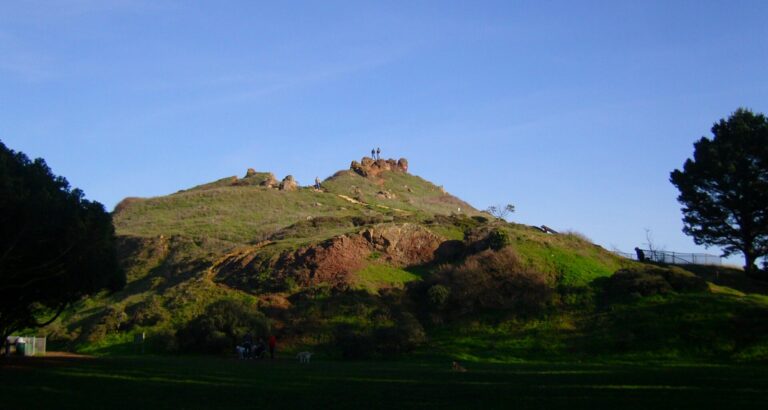
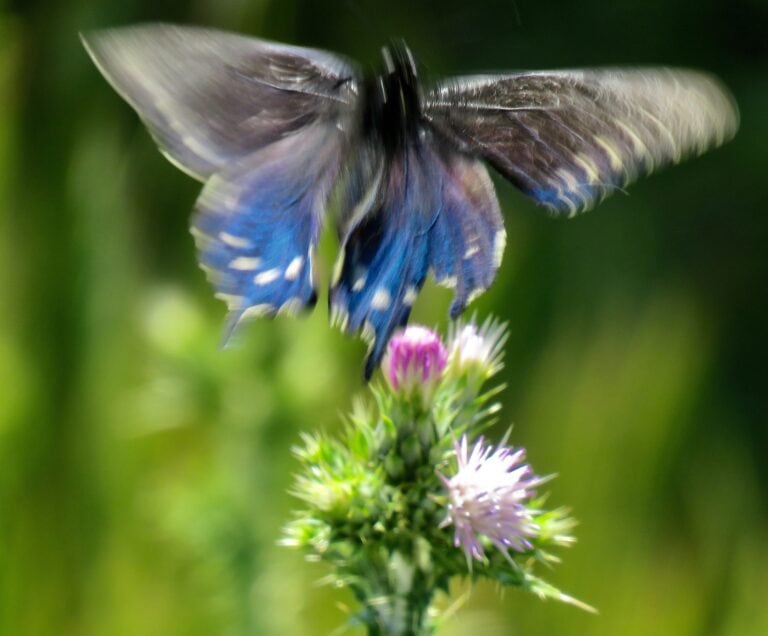
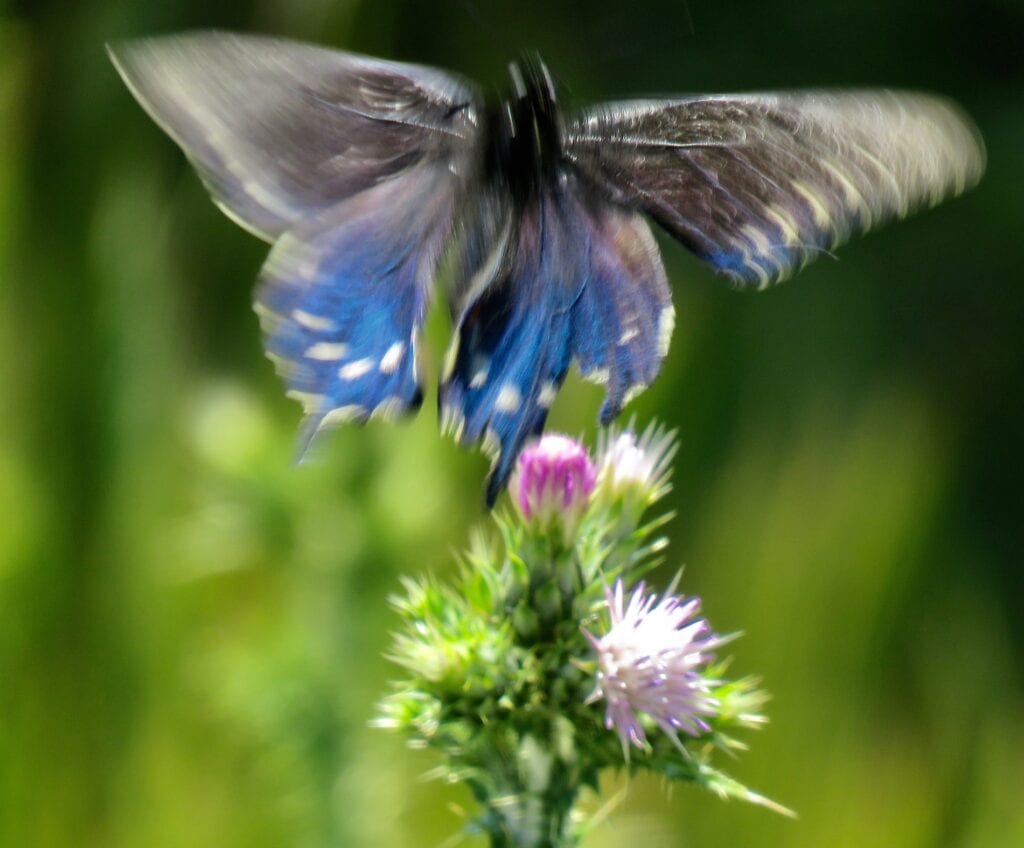
         On the morning of April 7th, 2022 Kelly Dodge, an employee of the Sutro Stewards was leading a group of volunteers up to the summit of Sutro. The following is an excerpt from an email Kelly recently sent me: ” We were at the large, main meadow right off from where the pavement ends from Nike Road. I saw a black and blue (this becomes important – the blue part) butterfly drop down from high above and into the meadow, it then flew towards the North Ridge Trailhead at the summit. Unfortunately it was moving too fast ( second clue ) to get a photo. On the same day Morgan told me he saw a Pipevine Swallowtail down by the Surge Lot around 1 p.m. Same individual?” The lawyer in me knew immediately we had a strong circumstantial case.

    Male Pipeline Swallowtail, (note the gunmetal blue on hindwing) by Liam O’Brien
         In another email Ildyko Polony, the Executive Director of the Sutro Stewards, wrote: ” I saw at least one after Kelly’s flying around sometime in the late spring/early summer. It may have been more than one individual. It was up at the summit. Bridget and I were sitting and I saw this butterfly flying in and out of the acacia thicket and in the fenced off area where the silvery lupine grows.

  • Behind a Winning Shot

    By Alan Krakauer

    Female Greater Sage-Grouse, winner of the 2022 “Female Bird” category

    By now you may have seen the winners of the 2022 Audubon Photography Awards. Given the ever-expanding ranks of excellent bird photographers, I had no expectation of winning anything when I submitted three photos this spring. I had entered a few times in the past, and with the exception of a photo of roosting Marbled Godwits at Arrowhead Marsh that made the Top 100 in 2019, I’d not had any luck. I was just happy my entry fees were going to a great organization. You can imagine my shock when a representative from the National Audubon Society called to tell me my photo of a Greater Greater Sage-Grouse hen took home the “Female Bird” prize!

    The story of the shot itself is doubtlessly similar to many other photographs recognized by Audubon through the years. Like most, it’s a variation of ‘photographer gets up early, waits patiently in unpleasant weather for birds to appear, magic happens.’

    In my case, the magic happened in central Wyoming. My day started well before sunrise carefully navigating a snow-covered gravel track into sagebrush country. Parking on the shoulder in a remote valley, I switched on my headlamp, hoisted my backpack and thermos of coffee and trudged through several inches of snow. Eventually I reached my destination and my headlamp beam swept across the photography blind that would be my home for the next several hours. The fabric blind was already staked in place so it was just a matter of popping it up (not always easy when the pieces were frozen!), opening a couple of view flaps, and waiting in the pre-dawn chill for the first Greater Sage-Grouse to arrive.

    Pop-up blind in Greater Sage-Grouse country. Photo is from a different day and location

    In the spring, Greater Sage-Grouse and other prairie grouse congregate on traditional display grounds called leks, a term that is used both for the groups of animals and the spot of land they use. These leks are extremely vulnerable to disturbance – one golden eagle zipping by or person walking up could scare all the birds away for the day and repeated disruptions could cause them to abandon the area completely. What is a photographer to do? Temporary blinds are small fabric tents that can hide wildlife watchers and their gear in view of a lek or other area of interest.…

  • How to See Nesting California Least Terns and their Chicks

    By Marjorie Powell

    California Least Terns (Sternula antillarum browni) can be seen plunge-diving for fish at several East Bay locations in the summer but seeing them nesting is more difficult. Traditionally, Least Terns make scrapes in the sand to lay their two or three eggs, but with beaches full of people and dogs, the terns have found other nest sites. At the Alameda Wildlife Reserve and Hayward Regional Shoreline, large fenced areas protect nesting terns in the Bay Area from mammal predators (feral cats, racoons, etc.) and human disturbance. Devoted birders can serve as monitors for the nesting colonies, alerting US Fish and Wildlife Service (USFWS) when an aerial predator appears (Peregrine Falcons are especially skilled at taking eggs, chicks and sometimes adults), but training for new monitors at the Alameda Reserve has not happened since the start of COVID, and monitoring provides no option for other birders or potential birders.

    yellow school bus with people lined up in front waiting to enterPeople board a bus for the trip to the Least Tern colony at Alameda Wildlife Reserve on June 25, 2022 by Rick Lewis

    About the only other option to see eggs and chicks is Return of the Terns. A cooperative endeavor between USFWS, which manages the colony at the Alameda Wildlife Reserve for the Department of Veterans Affair, which now holds title to the land, and Crab Cove, part of the East Bay Regional Park District, Return of the Terns is a yearly event where members of the public can learn about the endangered species. Pre-registered participants spend around 30 minutes on a school bus inside the reserve’s outer fence looking over the breeding site fence to watch chicks running and adults holding small fish while searching for their chick. An unadvertised bonus is the view of San Francisco from the northwestern corner of Alameda.

    Foggy view of San Francisco cityscape, with sand from the beach in the foreground San Francisco is impressive even in the haze when seen from the northwest corner of the Reserve in Alameda by Rick Lewis

    This year’s presentation was outdoors, with pictures projected onto a canopied screen. Susan Euing, the USFWS Wildlife Biologist who manages the colony, gave the first presentation about Least Terns’ life cycles and nesting practices and then lead three bus tours of twenty-five people to the colony. A Crab Cove naturalist gave the latter two presentations while tours were happening. One important take-away from the presentations is that nesting success depends on the presence of small fish and the absence, or at least lesser presence, of a Peregrine Falcon (they also nest in Alameda).…

  • On Naming Individual Birds

    By Ryan Nakano

    When I bought my first car I named it Lorelai, after Lorelai Gilmore from the show Girlmore Girls. Growing up with beagles, my family had Elsa, and then Buddy. My cat has many names, the primary of which is Eevee, after the Pokemon, although this is disputed by my girlfriend who named our cat after her aunt and did in fact sign the paperwork. The Black Phoebe I see almost every morning at the rose garden is simply Phoebe.

    The point is, naming is both fascinating and complicated.

    Last week Golden Gate Bird Alliance finished up a naming process for two new Osprey chicks. After receiving 570 responses to a choice of five pairs of potential names, it was decided that the chicks would be known as Brooks and Molate. Prior to this vote, we opened up for name suggestions and received 125 submissions. After participating in the process for submission review, I couldn’t help but think about the act of naming individual wild animals and the thought process behind what names we believe to be appropriate or representative of them.

    In an article titled What’s in a Name?—Consequences of Naming Non-Human Animals author Sune Borkfelt addresses the necessity of naming as a communication tool.

    “Indeed, it is naming something that enables us to communicate about it in specific terms, whether the object named is human or non-human, animate or inanimate.”

    Now, instead of sharing that chick A and chick B are starting to become easier to tell apart, I can say that Molate has a broader dark stripe on the back of their head, while Brooks’ head is lighter in color. But why Brooks and Molate?

    Named after two important bird areas local to the Bay Area, Brooks Island and Point Molate, it would appear that these birds now represent a reminder to continue preservation and restoration efforts of our shared natural environment.

    Borkfelt goes on to note, “A name is a representation and can therefore potentially carry all the values, ideas, perceptions and conceptions carried by representations and have the array of potential consequences, which can ensue from representation.”

    Under this premise, these two new chicks now intentionally or unintentionally become the mascots for local bird habitat and the ongoing efforts to preserve such spaces. (Which, all things considered, doesn’t seem like a bad thing!)

    Of course, Brooks Island itself was onced named after something, limited research concludes that it is an eponym to an unknown person from the past.…