• Bushtits in the acacias

    By Dan Murphy

    A few years ago I noticed an unfamiliar species of acacia at North Lake in Golden Gate Park.  Acacia is one of those woody plants between a shrub and a tree.  It has little needle-like leaves and yellow flowers.  What actually caught my eye about it was that fall-migrating insectivores were using it.

    That’s pretty odd for acacias, which are usually shunned by most local birds. About a year later, I observed that it was growing and spreading rapidly.  I asked the gardener about it and she referred me to her foreman.  He said it was part of the Recreation and Park Department’s plant palate for Golden Gate Park.  I thought that was pretty odd, but not a battle I wanted to start.

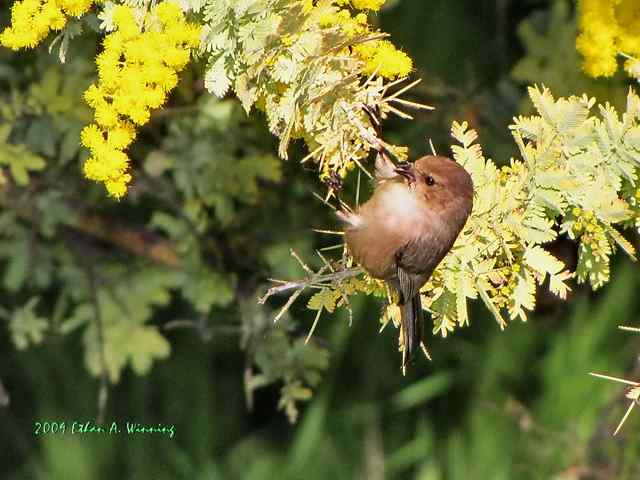
    More recently, my wife Joan and I were birding at North Lake at the end of May when we spotted a lot of activity at the top of one of those acacias. I checked and spotted a Bushtit at its nest.  Suddenly there was a second Bushtit and then more! The baby birds were exploding from the dirty-sock-like nest.
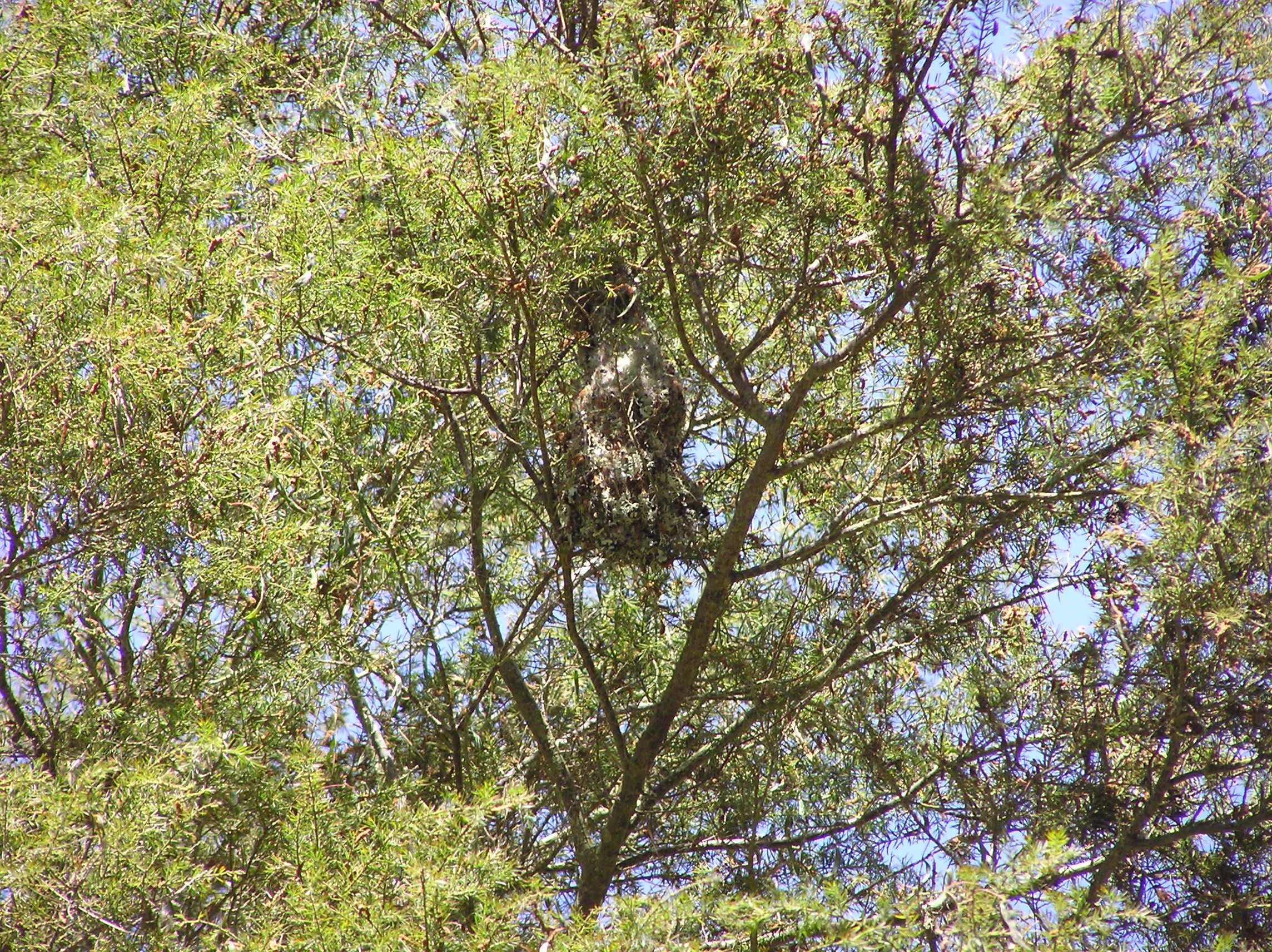
    Bushtit nest in an acacia / Photo by Dan Murphy

    The adults returned several times to move more chicks into the world.  There was a buzz of activity around the nest until the last of the chicks made it out and the flock moved off.  In all, we counted nine birds, but surely there were more.  One weak flier landed in bushes where we didn’t see it emerge.  I wonder now if it made it.

    So here’s a problem.  We have a relatively newly-introduced tree to which birds have almost immediately adapted.  It grows with little water and is evergreen.  Who could ask for more?

    I guess I could.

    The problem is that this tree is spreading faster than anything I’ve ever seen.  It crowds out other ornamentals.  It’s dense, so it shades out plants that might form an understory.  Remember, there is little native in Golden Gate Park, so I don’t really have a frame of reference for how this plant would act in a native habitat, but among the mostly exotic plants at the Chain-of-Lakes it is an example of a virulent and invasive plant that is just overwhelming everything.
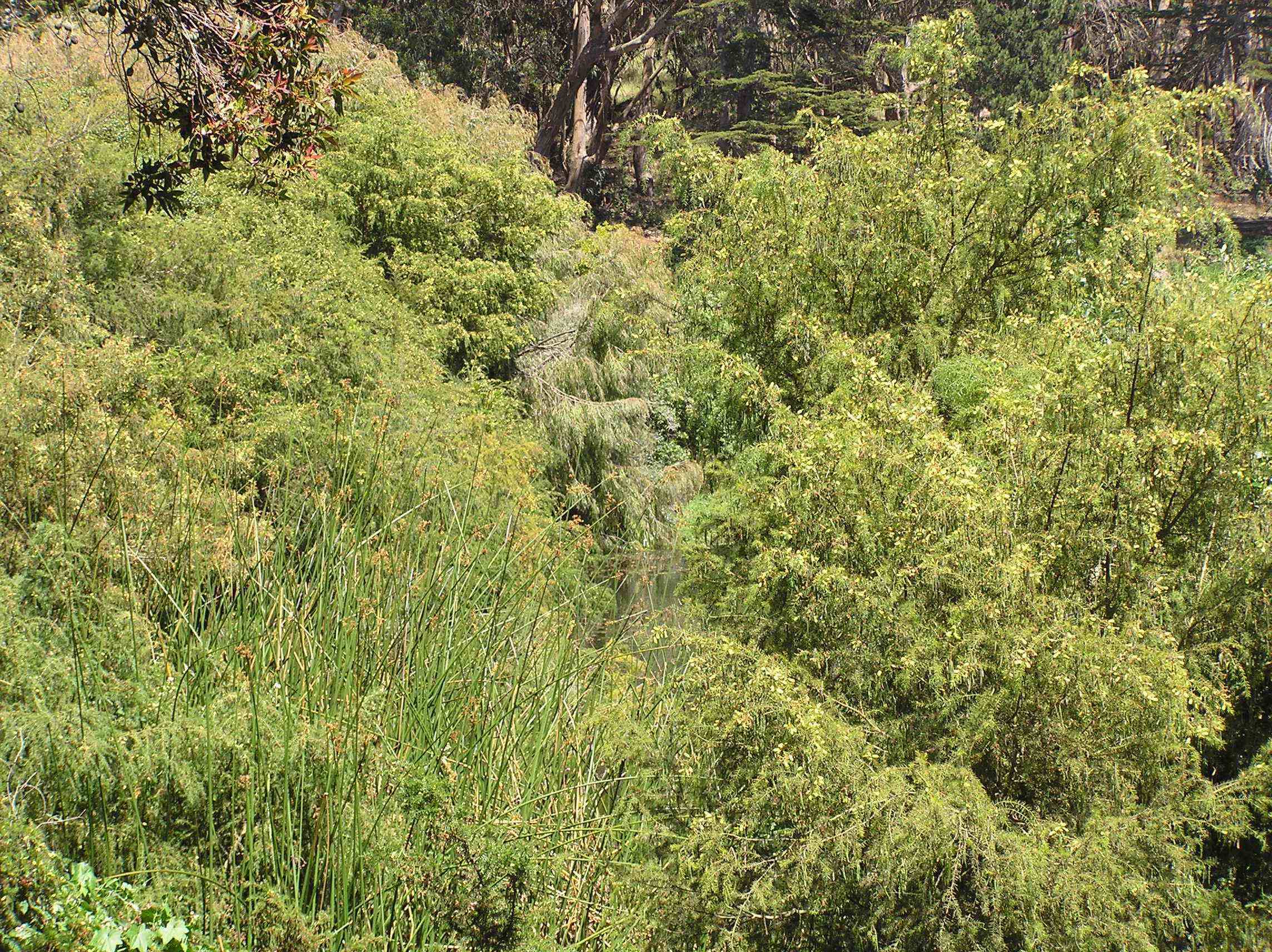
    North end of North Lake in Golden Gate Park, crowded with acacias / Photo by Dan Murphy

    It’s one of those species that — even though it appears to benefit some birds — really should be removed before it expands to the rest of Golden Gate Park and beyond.…

  • A bird sit

    By Phila Rogers

    And just what is a bird sit?  I think of it as sitting quietly and listening intently to bird sounds.  Are you hearing a song declaring territory?  Or is it a call, or series of calls, which might be considered conversational?  Or is it an aggressive vocal display to defend territory?  Perhaps the call is an alarm announcing the approach of a predator. Light calls in the spring might be juvenile birds begging.

    Other sounds may include rustling foliage. Can you distinguish the sound of wind in pines or in other trees?  And what about scratching sounds in dry leaves made by ground-feeding birds?  And then there are the ambient sounds – the collective roar from the cities below, traffic on a nearby roadway, a passing jet.

    While listening for sounds, sitting quietly allows you to watch for the slightest movement revealing the presence of bird activity missed when walking along a pathway.

    A bird sit allows you to soak up by osmosis the larger scene.  What does the air feel like — is it moist or dry?  Does it appear to be marine air coming from the ocean, or dry air coming from inland areas?  What are the fragrances?  Can you sense the mass of the nearby trees, the bulk of the surrounding hills?

    If you are sitting near a stream, can you tell by listening if the stream is flowing over pebbles or around boulders?  Follow the stream with your mind’s eye from where it begins as springs high on the hill, following it through dark culverts, and where it finally joins the Bay.  Are there more birds calling and singing along the stream than elsewhere?

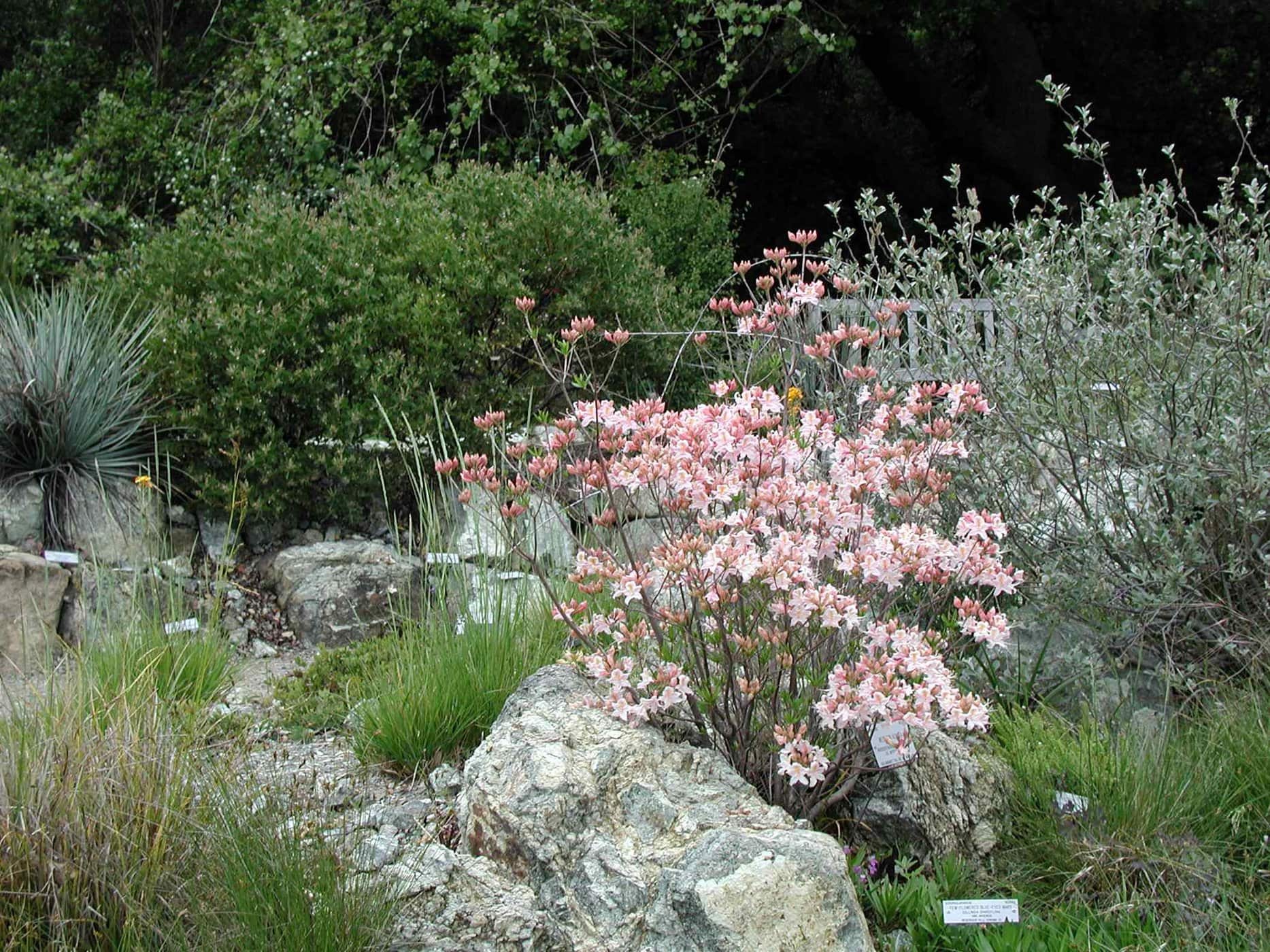
    One of Phila Rogers' favorite places to do a "bird sit" is the U.C. Berkeley Botanical Garden. Photo of California native plants (including "Myrt's blush" Western azalea) courtesy of the U.C. Botanical Garden.

    Stepping back into the past, can you imagine an earlier time before the roads and the introduced vegetation?  Go back a hundred years to grazing cattle and grassy hills when the song of the meadowlark prevailed.

    Or go back 200 years earlier before the arrival of the Europeans, when grizzlies moved up the stream canyons.  Imagine the smell of burning grass and scrub from the fires set by the native peoples to clear the land and to promote the growth of tubers and wildflower seed.

    Looking out over the Bay, imagine that 10,000 years ago the Bay was once a valley crossed by the great inland river, a time when the coastline was out beyond the Farallon Islands.…

  • Magical Madagascar

    By Bob Lewis

    (Note: Bob will present slides and describe the wildlife of Madagascar on June 21 at our monthly Speaker Series in Berkeley.)

    I went to Madagascar in October 2011 with Oryx, a South African photo tour company.  I wanted to photograph some of the endemic families of birds on this fourth-largest island, and experience Madagascar’s other natural wonders.  Madagascar has been separated from other land masses for about 80 million years, and evolution has progressed on the island in a unique way – it has all the world’s lemurs, half the world’s chameleons, and is home to six families of birds found nowhere else.

    Lemur ancestors came to Madagascar about 50 million years ago, and flourished since they have little competition or predation on the island.  There are about 70 species, and they exist only on Madagascar.  This Ring-tailed Lemur travels in small groups, and young are carried for several months.  Most lemurs are arboreal.  These were common near our lodge in the spiny forest of the south.

    Ring-tailed Lemurs / Photo by Bob Lewis

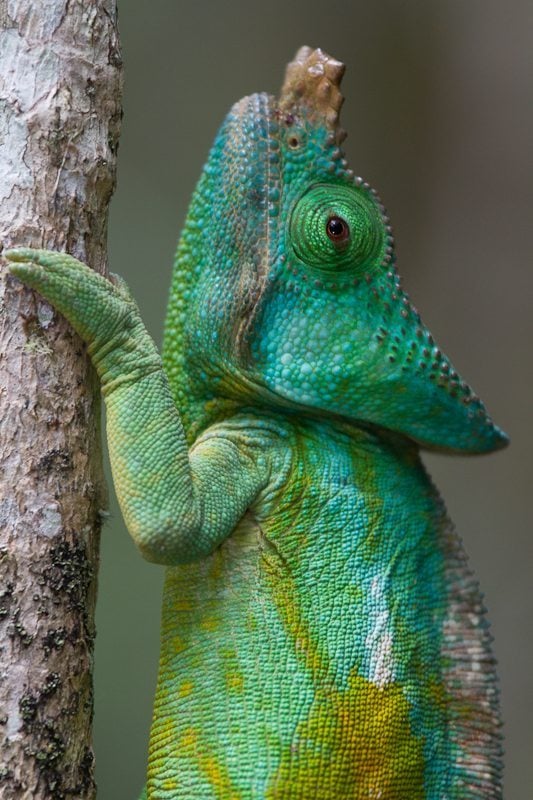
    Chameleons are hard to spot, blending into the green and brown of the forest.  This Parson’s Chameleon is about a foot long, moves slowly, and like the lemurs, lives in the trees.  The exotic pet trade threatens these creatures.

    Parson's Chameleon / Photo by Bob Lewis

    Vangas are one of the families of birds found only on Madagascar.  Their ancestors probably came from Africa, and over time evolved into over a dozen different species, each adapted to a different habitat.  This Sickle-billed Vanga nests high in large trees, and probes cracks and holes in the trunks for spiders and lizards.  Forests on Madagascar are threatened due to the use of charcoal as fuel, and most of the forested area is found around the edge of the island.  The higher, cooler central plateau has been converted to rice paddies and brick quarries, feeding and housing 22 million people.

    Sickle-billed Vangas / Photo by Bob Lewis

    Even with so much habitat lost, Madagascar still holds one of the most diverse, unique and fascinating collection of creatures in the world.

    For more images and stories of cool critters from this distinct ecosystem, come join us on Thursday June 21st in Berkeley, right after Golden Gate Bird Alliance’s Annual Meeting.

    Magical Madagascar presentation:
    Date:   Thursday June 21
    Time:   6:30 for Annual Meeting & refreshments
                7:30 for Bob’s presentation on Magical Madagascar
    Place:  Northbrae Community Church, 941 the Alameda in North Berkeley
                 (between Solano & Marin)
    Cost:   Free for GGBA members, $5 for non-members
     
  • Bluebird babies in Berkeley?

    By Janet Byron

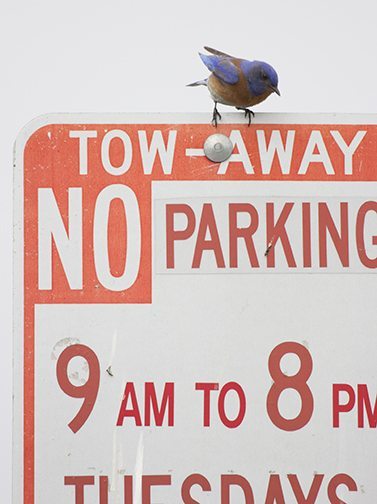
    Yes! At least three pairs of Western Bluebirds are currently nesting in Berkeley, to the surprise and delight of local bluebird lovers.

    Berkeley birder and Golden Gate Bird Alliance birding instructor Rusty Scalf first discovered a pair of Western Bluebirds nesting in San Pablo Park, in West Berkeley, in spring 2008.

    “I was stunned,” said Scalf, who in decades of California birding had seen numerous bluebirds in wild meadows and on rural fence posts, but never in urban areas. “The assumption has always been that bluebirds cannot coexist with urban House Sparrows and Starlings, as both compete for next cavities.”

    This year, the San Pablo Park pair took up residence on the park’s south side, in a box built by Scalf and placed by the Berkeley Department of Parks in a sycamore tree near Russell Street. The pair had a setback earlier this spring when a House Sparrow destroyed their first clutch, but they moved to a box on San Pablo Park’s north side and are now feeding another clutch of babies.

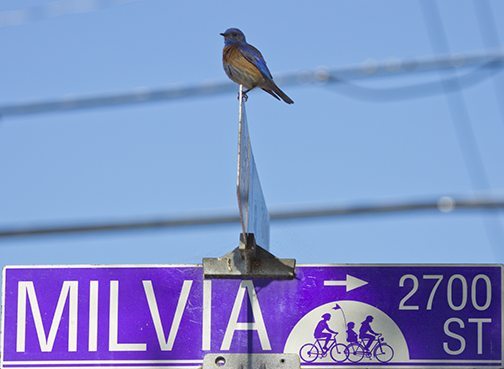
    Bluebird near Milvia & Derby Street nest box / Photo by Elaine Miller Bond

    The second pair moved into a box on a Monterey pine at the corner of Derby and Milvia Streets, also built and placed by Scalf with the blessing of the director of the King Child Development Center. Scalf was tipped off to this pair by birder Joe Eaton, who spotted them foraging around the Berkeley Unified School District playing field nearby this past winter. The young fledged on May 30 or 31 but are still spending time near the nest box.

    The Derby/Milvia pair has routinely attracted small groups of fans during busy Tuesday farmers’ markets; the birds don’t seem to mind crowds in the slightest.

    The third pair is nesting in a box on the Albany/Berkeley border along a restored section of Codornices Creek between 6th and 8th streets near U.C.’s Albany Village.  Members of the Codornices Creek Watershed Council built and installed four bluebird boxes at the site in March.

    A pair that nested in a woodpecker hole along Parker Street last year did not return this spring, Scalf noted.

    “My hope is that Western Bluebirds can take hold and maintain an urban population in Berkeley,” Scalf said.  “What a wonderful addition they are!”

    ——————————–

    Janet Byron is managing editor of the University of California’s California Agriculture journal.

  • Celebrating conservation success with art

    By Ilana DeBare

    We’re sadly accustomed to stories of environmental tragedy – dying coral reefs, melting ice caps, rivers with no salmon. Shouldn’t we also highlight stories of conservation success, where species are brought back from the brink of extinction?

    That was Robbie Brandwynne’s idea when she decided to organize Celebration, an art exhibit on display through Aug. 31 at the Environmental Education Center in Tilden Park.

    The exhibit features works by 60 artists depicting birds, animals and plants that faced extinction but have at least partially recovered.

    Peregrine and Prairie Falcons. California Clapper Rails. Golden Eagles, Bald Eagles, Belding’s Savannah Sparrows and more…

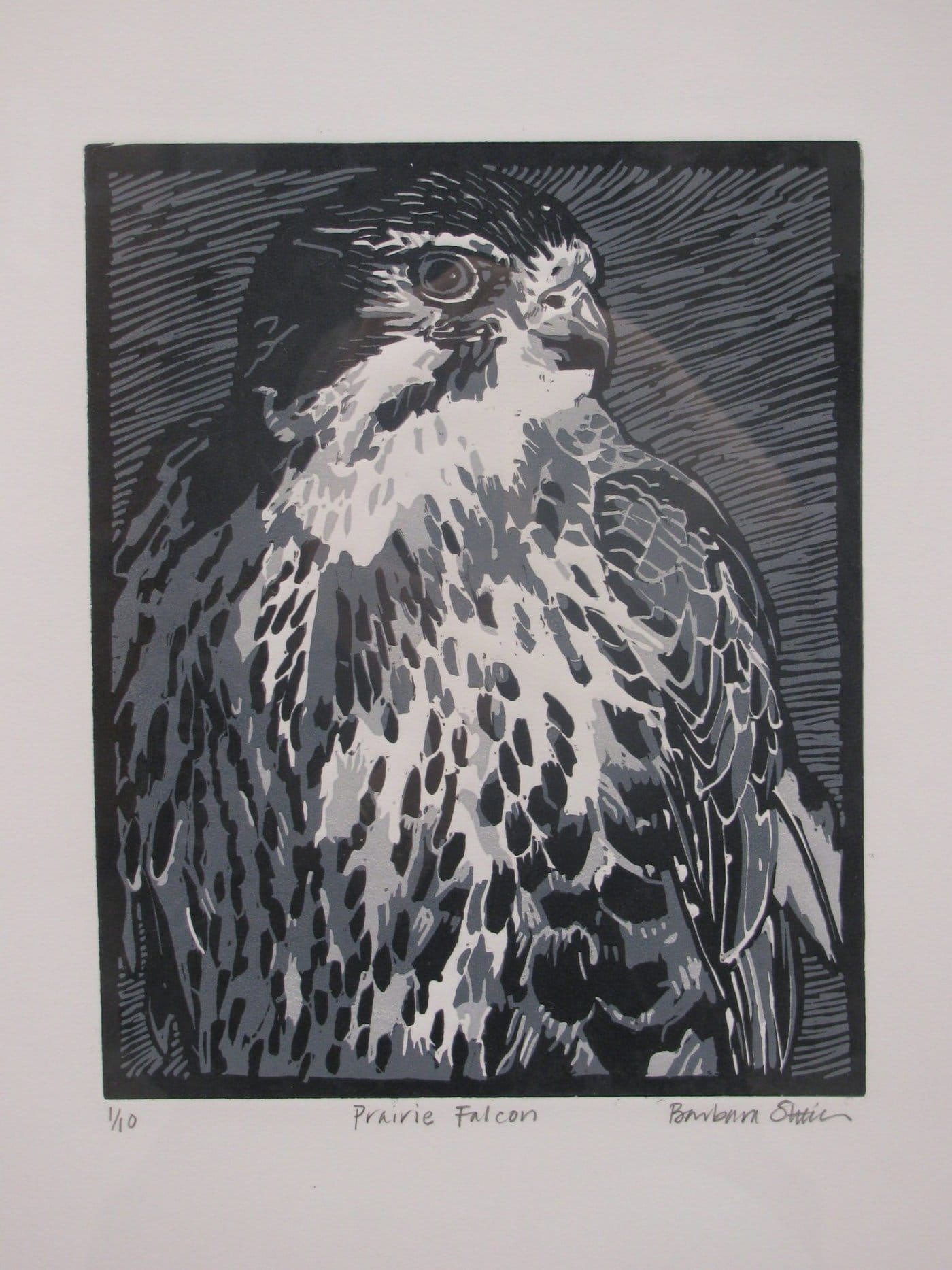
    Prairie Falcon by Barbara Stikker

    Some but not all of the works are accompanied  by short explanations of the species’ threat and revival. A note alongside Barbara Stikker’s striking linoleum reduction print of a Prairie Falcon notes that in 1977, when it was listed as a federal species of concern, there were only 300 to 500 pairs left in California.

    Today the population has stabilized at more than 5,000 pairs, thanks in part to the use of fallow and flooded rice fields as bird habitat in the Central Valley.

    Several of the species in the show owe their survival to a single environmental initiative — the banning of DDT in 1972. The ubiquitous pesticide made Bald Eagle eggs so brittle that they couldn’t withstand the weight of a brooding adult. Listed as endangered in 1967, Bald Eagles were removed from that list in 1995 and then removed from the list of threatened species as well in 2007. Similarly, Brown Pelicans had been listed as threatened in 1970 but, once DDT was banned, they recovered enough to be delisted in 1988.

    It was a newspaper photo about the delisting of the Brown Pelican that initially inspired Brandwynne, a retired psychotherapist and medical researcher who currently quilts and paints watercolors.

    “That photo meant something to me, and an idea began to grow,” said Brandwynne, an Oakland resident. “People don’t hear enough of the good news in general, and we hear way too little of the good news about conservation. That message — the pelican portrait — means that conservation and restoration really do work when adequately funded and implemented.”

    One of the most interesting features of the exhibit is the way multiple artists depict the same species. Some are as detailed and naturalistic as images from a field guide; others are more abstract and stylized.…